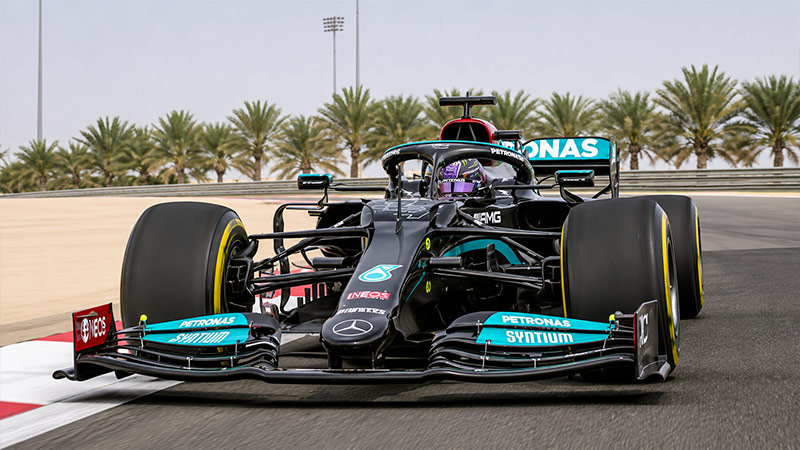
A 2026 Formula 1 car costs an estimated $15 million to $22 million to build, and nearly half of that sits in the power unit alone. Yet no team or governing body has ever published an official price.
That is because every F1 car is a hand-built prototype, rebuilt between races and redesigned each season. Its true value lies in the simulation, wind tunnel testing and engineering talent behind it, not just the carbon fibre you can see.
In this guide, we break down what each major component costs, why the power unit dominates the bill, how the $215 million cost cap shapes team spending, what changed under the 2026 rules and whether you could ever own one yourself.
Quick Answer: What Does a 2026 F1 Car Cost?
Industry estimates put a 2026 Formula 1 car at $15 million to $22 million, according to RTR Sports Marketing, updated in October 2026. Here is that number in context:
- Official price: none. Neither the FIA nor the teams publish a build cost or a parts breakdown.
- Power unit: roughly $8 million to $11 million, about half the total.
- Team spending limit: $215 million per season under the 2026 cost cap.
- Engine makers’ limit: a separate cap of $190 million per season.
For perspective, the low end of that range would buy several multimillion-dollar road-going hypercars. Yet no team builds just one car.
Each squad produces several chassis plus a constant flow of replacement wings, floors and gearboxes, so the true cost of putting two cars on the grid for a full season runs far higher than any single sticker price.
F1 Car Cost Breakdown: Component by Component
The power unit and the carbon-fibre monocoque account for most of an F1 car’s build cost, while the rest is spread across hundreds of smaller, highly specialised parts. Teams never publish itemised prices, so treat these figures as informed industry estimates rather than invoices.
| Component | Estimated cost (USD) | What drives the price |
|---|---|---|
| Power unit | $8M–$11M | Turbocharged V6, 350 kW electric motor, battery and control electronics |
| Carbon-fibre monocoque | $650,000–$1.2M | Hand-laid composite layers cured in an autoclave; must pass FIA crash tests |
| Gearbox | $450,000–$600,000 | Seamless-shift internals that must survive most of a season |
| Front wing and nose | $150,000–$300,000 | Revised several times a year; intricate multi-element flaps |
| Rear wing assembly | $85,000–$150,000 | Central to top speed and balance; moving elements under 2026 active aero |
| Floor | about $140,000 | Major downforce generator (pre-2026 baseline estimate) |
| Steering wheel | $50,000–$100,000 | Custom electronics, display and 15–20 switches and dials |
| Halo | about $17,000 | Titanium safety structure built to withstand more than 100 kN |
Add those headline parts together and you reach roughly $9.5 million to $13.5 million. The rest of the $15–22 million estimate covers brakes, suspension, cooling, wiring looms, hundreds of sensors, bodywork and the skilled labour needed to assemble it all.
Two details stand out. First, the cheapest item on the list, the halo, is the one most likely to save a driver’s life.
Second, the front wing is a recurring expense rather than a one-off. A single brush with a barrier can wipe out a part worth as much as a family home, and teams bring new specifications to multiple races each season.
The Power Unit: Why Half the Bill Sits Behind the Driver
At an estimated $8 million to $11 million, the power unit is the single most expensive item on a Formula 1 car, and the 2026 version is an all-new design. It keeps a 1.6-litre turbocharged V6, but almost everything around it has changed:
- Electric power nearly tripled. The MGU-K, the motor-generator that harvests energy under braking, jumps from 120 kW to about 350 kW, creating a near 50/50 split between combustion and electric power.
- The MGU-H is gone. This intricate device recovered energy from exhaust heat; removing it simplifies the package and lowers the barrier for new manufacturers.
- Fully sustainable fuel. Every car now runs on fuel with no new fossil carbon, while still producing more than 1,000 horsepower.
- Built-in cost controls. The rules ban expensive manufacturing materials, standardise components and limit dyno hours, according to Formula1.com.
Why do estimates vary so much? Because “cost” means two different things here. FIA single-seater director Nikolas Tombazis put the price of a replacement combustion engine at roughly a million dollars, as GPblog reported. The $8–11 million figure, by contrast, reflects the full hybrid system plus its share of years of development.
Engine makers work to their own budget. The manufacturers’ cap was $95 million a year from 2023 to 2025 and rises to $190 million in 2026, partly because a separate capital expenditure allowance was folded in.
Brand-new manufacturers may spend $148.5 million in each of the three years before they enter, per Formula1.com.
The framework has worked. Honda returned, Audi arrived with its own works engine, Ford partnered with Red Bull Powertrains, and General Motors plans to debut its own unit in 2029. Half the grid switched engine partners for 2026, Autosport reported.
From this season, any power unit change also counts against the cap, whatever the reason, which turns every engine swap into a strategic budget decision.
Beyond One Car: What a Full Season Costs
A single car is only a fraction of what it takes to race. The number that truly defines F1 spending is the cost cap: $215 million per team in 2026 for a season of up to 24 races, plus $1.8 million for each race beyond that.
The F1 cost cap jumped to $215M in 2026, mostly through accounting changes
| Season | Cost cap per team (US$) | What changed |
|---|---|---|
| 2021 | $145 million | Cap introduced |
| 2022 | $140 million | First reduction |
| 2023 | $135 million | Reached its planned minimum |
| 2024 | $135 million | Unchanged |
| 2025 | $135 million | Unchanged |
| 2026 | $215 million | Depreciation and full staff costs now count inside the cap |
Figures are base caps, before inflation and extra-race allowances.
Before the cap existed, the top teams spent more than $400 million a year.
The $80 million jump looks dramatic, but Formula1.com describes it as roughly neutral overall.
Costs that used to sit outside the cap now count inside it, including annual depreciation, which replaced a separate $36 million capital expenditure cap spread over four years, and the full cost of any staff member who spends time on F1 work.
Plenty still sits outside the cap:
- Driver salaries and retainers
- Salaries of the three highest-paid staff, usually the team principal and technical chief
- Marketing, legal, HR and finance costs
- Race travel and heritage car programmes
Add those back and a top team’s full operating budget runs past $350 million a season, according to F1 Chronicle. The rules have teeth, too: for a minor 2021 overspend, Red Bull was fined $7 million and lost 10% of its permitted aerodynamic testing time.
How the 2026 Regulations Changed the Price
The 2026 rules forced every team to start from a blank sheet of paper, which is a major reason today’s $15–22 million estimate sits higher than figures from the previous era. Since no part carries over, neither do the old prices.
The changes that reshaped the bill:
- Smaller, lighter cars. The wheelbase is 200 mm shorter, the floor is 100 mm narrower and the minimum weight has dropped from 800 kg to 768 kg, according to F1 Chronicle via Yahoo Sports. Saving weight while adding hybrid hardware demands costlier materials and design hours.
- Active aerodynamics. Movable front and rear wings now switch between a high-downforce cornering mode and a low-drag straight-line mode, replacing DRS. More moving parts mean more engineering, testing and safety validation.
- A reworked power unit. The MGU-H disappeared and electric output nearly tripled, so every manufacturer designed its hardware afresh.
- Fresh supplier relationships. With half the grid changing engine partners, many teams had to re-engineer packaging, cooling and electronics around a new unit.
Timing added to the strain. Teams designed their 2026 cars while still racing their 2025 machines, and both programmes had to fit inside the same capped budget.
The car also keeps evolving once the season starts. Teams bring aerodynamic and mechanical upgrades to several race weekends a year, so the car that finishes the season in December shares a name with its launch version but very few of its parts.
Why F1 Cars Cost So Much
The price of an F1 car is driven less by its parts than by the research, people and precision behind them. Four factors do most of the heavy lifting:
- Exotic materials and slow manufacturing. Carbon fibre is roughly twice as strong as steel at a fraction of the weight, but builders lay many hand-laid layers and cure them under heat and pressure in an autoclave. The process cannot be rushed or mass-produced like a road car’s pressed steel panels.
- Relentless development. Wind tunnel sessions and computational fluid dynamics simulations run all season long. Each upgrade is designed, tested, manufactured and fitted between races, so a team effectively builds its car several times over each year.
- People. Top teams reportedly employed more than 1,500 staff each by early 2024, up from about 1,000 before the cost cap, and that excludes engine departments. From 2026, the full salary of anyone who spends time on F1 projects counts against the cap.
- Crash damage. Accidents are budget events. Across the 2025 season, drivers were estimated to have cost their teams more than $34.2 million in repairs. Gabriel Bortoleto topped the list at around $6.8 million, ahead of Yuki Tsunoda at roughly $5 million and Lando Norris at about $4 million, per F1 Chronicle via Yahoo Sports.
That last point matters more than ever. Under the cost cap, every dollar spent rebuilding a damaged car is a dollar that cannot go into making it faster. For a team already spending right up to the limit, one heavy crash can delay or even cancel a planned upgrade, and the performance cost can linger for the rest of the season.
Can You Actually Buy an F1 Car?
Yes, but what you get depends entirely on your budget, and a current-specification running car almost never reaches the open market.
Teams guard their technology closely, so most cars that change hands are retired race chassis, show cars or historic machines.
At the entry level, non-running show cars and static display chassis can be found for under $200,000. At the top, the market behaves more like fine art than motoring:
| Car | Sale | Price | Why it matters |
|---|---|---|---|
| 2026 McLaren MCL40A | RM Sotheby’s Abu Dhabi, Dec 2025 | $11.48M | First F1 car sold before its public unveiling; delivery expected around early 2028 |
| 2001 Ferrari F2001 (chassis 211) | RM Sotheby’s Monaco, May 2025 | €15.98M (about $18.2M) | Michael Schumacher’s Monaco and Hungary winner |
| 1954 Mercedes-Benz W196R Streamliner | RM Sotheby’s Stuttgart, Feb 2025 | €51.155M (about $52.5M) | Most expensive Grand Prix car ever sold |
| 2003 Ferrari F2003-GA | Sotheby’s Geneva, Nov 2022 | CHF 14.63M (about $15M) | Schumacher’s sixth title-winning car |
Notice the pattern. A brand-new McLaren fetched less than two Schumacher-era Ferraris, because history, driver and championship pedigree drive collector value far more than technology. The F2001 tells the story best: it sold for $7.5 million in 2017, then for $18.17 million eight years later.
Retired race cars typically sell through specialist auction houses such as RM Sotheby’s and Bonhams, while manufacturer programmes like Ferrari’s F1 Clienti service and run ex-works cars for private owners.
Ownership is only the start. For simpler cars from the 1970s to the mid-1990s, historic racing specialists put a full engine rebuild at around £35,000 and a UK race weekend at under £10,000.
Cars from the V10 era and beyond cost far more to keep running, and almost no turbo-hybrid cars have yet reached private hands.
Conclusion
So, how much does an F1 car cost? Industry estimates place a 2026 car between $15 million and $22 million, with the power unit alone accounting for roughly half.
Yet that figure tells only part of the story. The real price of competing is set by the $215 million cost cap, the relentless upgrade cycle, the specialist workforce and the crash damage every team must absorb.
A Formula 1 car is less a product than a moving research programme, rebuilt and refined race after race.
That is why its value endures long after retirement, with historic chassis selling for tens of millions. Understanding the numbers adds depth to every race weekend: each lap is engineering, strategy and budgeting at work.