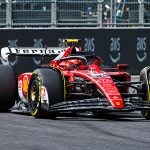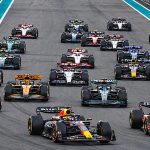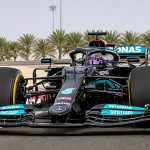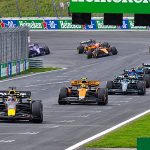
Formula 1 is the highest class of single-seater motor racing in the world. Eleven teams and 22 drivers compete across 24 Grands Prix on five continents, chasing two world championships in cars that can exceed 350 km/h (about 220 mph).
That is the short answer. The full answer is far more thrilling.
Picture a sport where pole position is decided by thousandths of a second. Hundreds of sensors stream live data to engineers on the pit wall, and a crew can change four tires in about two seconds. Formula 1 is part athletic contest, part engineering battle and part global entertainment.
Maybe you found the sport through Netflix’s Drive to Survive, the 2025 film F1 starring Brad Pitt, or a friend who will not stop talking about tire strategy.
Either way, this guide covers everything you need: where F1 came from, how a race weekend works, how points are scored, what makes the cars so fast and how to follow the sport like a seasoned fan.
Formula 1 at a Glance
The word “Formula” refers to the set of technical rules every car must follow. The “1” marks it as the top tier, above feeder series such as Formula 2 and Formula 3.
| Fact | Detail |
|---|---|
| Official name | FIA Formula One World Championship |
| Governing body | Fédération Internationale de l’Automobile (FIA) |
| Commercial rights holder | Formula One Group, owned by Liberty Media since 2017 |
| First championship race | British Grand Prix, Silverstone, 13 May 1950 |
| Teams in 2026 | 11 |
| Drivers in 2026 | 22 |
| Races in 2026 | 24 Grands Prix |
| Top speed | Over 350 km/h (about 220 mph) |
| Typical race distance | About 305 km (190 miles); Monaco about 260 km |
| Most drivers’ titles | 7, shared by Michael Schumacher and Lewis Hamilton |
A Short History of Formula 1
Formula 1 became a world championship in 1950, but its roots run deeper. Grand Prix racing in Europe dates back to 1906, when the French Grand Prix was first held near Le Mans.
The first championship race took place at Silverstone, England, on 13 May 1950. Italy’s Giuseppe Farina won that day in an Alfa Romeo and went on to become the first world champion. Argentina’s Juan Manuel Fangio soon dominated the decade, winning five titles.
Each era since has been shaped by a leap in technology, a great rivalry or a hard lesson in safety.
| Year | Milestone |
|---|---|
| 1950 | First World Championship race at Silverstone |
| 1958 | Constructors’ Championship introduced for teams |
| 1962 | Lotus 25 brings the monocoque chassis to F1 |
| 1977 | Renault introduces turbocharged engines |
| 1988–1993 | Ayrton Senna and Alain Prost rivalry defines an era |
| 1994 | Deaths of Roland Ratzenberger and Senna at Imola trigger a major safety overhaul |
| 2000–2004 | Michael Schumacher and Ferrari win five straight drivers’ titles |
| 2014 | V6 turbo-hybrid engines arrive; Mercedes begins eight straight Constructors’ titles |
| 2017 | Liberty Media takes over and expands digital and fan access |
| 2018 | The “halo” cockpit protection device becomes mandatory |
| 2021 | A team budget cap is introduced |
| 2026 | All-new car and power unit rules; Audi and Cadillac join the grid |
The halo deserves special mention. Early critics called it ugly, yet it is widely credited with saving lives, including Romain Grosjean’s in his fiery Bahrain crash in 2020.
How a Formula 1 Race Weekend Works
A Grand Prix weekend runs from Friday to Sunday, and every session has a clear purpose. Here is how a standard weekend unfolds.
- Practice (Friday and Saturday morning). Three one-hour sessions, known as FP1, FP2 and FP3, let teams fine-tune car setup, test tire compounds and rehearse race pace. Results do not count, but they reveal a lot about who is quick.
- Qualifying (Saturday afternoon). This is a knockout shootout in three rounds: Q1, Q2 and Q3. The slowest drivers drop out after each of the first two rounds. The final ten then fight for pole position, the coveted first spot on the starting grid.
- The Grand Prix (Sunday). Cars line up in qualifying order for a standing start. When five red lights go out, the race begins. Most races cover about 305 km and last 90 minutes to two hours.
Sprint Weekends
Six events per season use a sprint format to add more competitive action. Teams get just one practice session. A separate Sprint Qualifying sets the grid for a short Saturday race of about 100 km, with no mandatory pit stop.
Later on Saturday, standard qualifying sets the grid for Sunday’s Grand Prix. The result is two days of racing for points instead of one.
How Points and Championships Work
Every season crowns two champions. The Drivers’ Championship goes to the individual with the most points. The Constructors’ Championship goes to the team whose two drivers score the most points combined.
Points are awarded to the top ten finishers in a Grand Prix and the top eight in a Sprint.
| Finishing position | Grand Prix points | Sprint points |
|---|---|---|
| 1st | 25 | 8 |
| 2nd | 18 | 7 |
| 3rd | 15 | 6 |
| 4th | 12 | 5 |
| 5th | 10 | 4 |
| 6th | 8 | 3 |
| 7th | 6 | 2 |
| 8th | 4 | 1 |
| 9th | 2 | 0 |
| 10th | 1 | 0 |
The bonus point for the fastest lap was scrapped from the 2025 season onward. If two drivers finish level on points, the one with more wins ranks higher.
The Constructors’ standings matter well beyond pride. A team’s final position largely decides its share of the sport’s prize money, which can mean tens of millions of dollars. That is why a battle for seventh place can be just as fierce as the fight for the title.
The Cars: Engineering at the Limit
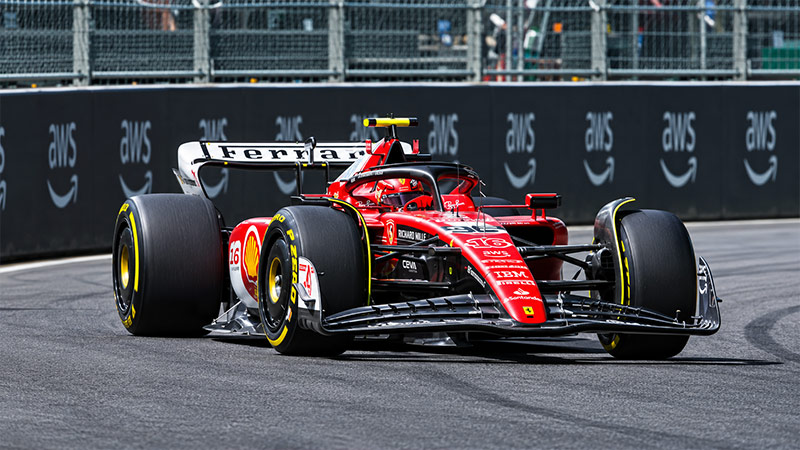
An F1 car is a carbon-fiber single-seater built around a hybrid power unit and shaped to press itself into the track. Each team designs and builds its own chassis, which is what makes F1 a contest of engineers as much as drivers.
| Performance measure | Approximate figure |
|---|---|
| Combined power output | Around 1,000 hp |
| Top speed | Over 350 km/h (about 220 mph) |
| Cornering and braking forces | Up to 5–6 g |
| Brake disc temperature | Above 1,000°C (1,800°F) |
| Minimum weight with driver (2026) | 768 kg (about 1,690 lb) |
The real secret is downforce. Wings and the car’s floor work like an upside-down airplane wing, pushing the car down onto the asphalt. This grip lets drivers take corners at speeds that would send a road car flying off the track.
What Changed in 2026
The 2026 season brought one of the biggest rule resets in the sport’s history.
- Electric power nearly triples. Power now splits close to 50/50 between the 1.6-liter V6 turbo engine and the electric motor, which delivers up to 350 kW.
- Fully sustainable fuel. Every car runs on advanced sustainable fuel, part of F1’s commitment to reach net zero carbon by 2030.
- Active aerodynamics. Movable front and rear wings switch between a high-downforce mode for corners and a low-drag mode for straights. The old DRS overtaking flap is gone.
- Overtake boost. A driver close behind a rival can deploy extra electrical energy to attempt a pass.
- Smaller, lighter cars. Cars are shorter, narrower and about 30 kg lighter than before.
The new rules also attracted fresh manufacturers. Audi arrived as a full works team, Ford partnered with Red Bull and Honda began supplying Aston Martin.
Many technologies tested in F1 have reached everyday cars, including energy recovery systems, carbon-fiber construction and paddle-shift gearboxes.
Teams and Drivers: Who Competes
In 2026 the grid grew to 11 teams, each running two cars. Cadillac became the first new team since 2016, and Audi took over the former Sauber outfit.
| Team | 2026 power unit |
|---|---|
| Alpine | Mercedes |
| Aston Martin | Honda |
| Audi | Audi |
| Cadillac | Ferrari |
| Ferrari | Ferrari |
| Haas | Ferrari |
| McLaren | Mercedes |
| Mercedes | Mercedes |
| Racing Bulls | Red Bull Ford |
| Red Bull Racing | Red Bull Ford |
| Williams | Mercedes |
How Teams Operate
A top F1 team is a high-tech manufacturer that happens to go racing. The largest teams employ more than 1,000 people, from aerodynamicists and data scientists to mechanics and logistics experts.
Since 2021, a budget cap has limited how much teams can spend on car performance. The goal is closer racing and a fairer fight between big and small teams.
The Road to an F1 Seat
Only 22 race seats exist, so reaching F1 is extremely hard. Most drivers start in karting as children, then climb through Formula 4, Formula 3 and Formula 2.
To race, a driver needs an FIA Super Licence. It requires at least 40 points earned in approved series over three seasons, and the driver must be at least 18.
Today’s grid blends legends and rising stars. It includes seven-time champion Lewis Hamilton, now at Ferrari, four-time champion Max Verstappen and 2025 champion Lando Norris. Meanwhile, F1 Academy, an all-female series, is building a pathway for women to reach the top.
Strategy on Track: Tires, Pit Stops and Flags
The fastest car does not always win. Smart strategy, perfect pit stops and quick reactions to changing conditions often decide the result.
Tires
Pirelli is the sole tire supplier. For each race, three dry compounds are chosen and marked by color: Soft (red) for maximum grip but short life, Medium (yellow) for balance and Hard (white) for durability. In wet conditions, teams switch to Intermediates (green) or Full Wets (blue).
In a dry race, each driver must normally use at least two different dry compounds. That rule forces at least one pit stop and opens the door to clever strategy.
Pit Stops
A modern pit stop is a masterpiece of teamwork. Around 20 crew members can change all four tires in about two seconds, and the fastest stops dip below that mark.
Timing is everything. An undercut means pitting earlier than a rival to gain time on fresh tires. An overcut means staying out longer, hoping clean air and track position pay off.
Flags and Safety
Marshals use flags to keep drivers informed and safe.
| Flag | Meaning |
|---|---|
| Green | Track clear; racing resumes |
| Yellow | Danger ahead; slow down, no overtaking |
| Red | Session stopped |
| Blue | Let a faster, lapping car pass |
| Black and white | Warning for unsporting behavior |
| Chequered | End of the session or race |
After a serious incident, officials may deploy the Safety Car to lead the field at reduced speed. A Virtual Safety Car does the same job electronically, requiring every driver to slow to a set pace.
Why Formula 1 Is Booming Worldwide
Formula 1 has transformed from a niche European pastime into one of the fastest-growing sports on the planet. Several forces are driving that rise.
- Storytelling that reaches new fans. Since 2019, Drive to Survive has shown the personalities, rivalries and pressure behind the visor. It turned casual viewers into loyal followers, especially in North America.
- A truly global calendar. The 2026 schedule visits 24 venues across Europe, Asia, the Middle East, Australia and the Americas. The United States alone hosts three races: Austin, Miami and Las Vegas.
- Digital-first access. Under Liberty Media, F1 opened up to social media, YouTube highlights, live timing apps and its own streaming service, F1 TV.
- Hollywood and pop culture. The 2025 film F1 brought the sport’s drama to cinema audiences worldwide.
- A younger, more diverse audience. Growth among younger fans and women has reshaped how the sport markets itself and who it attracts as partners.
- A sustainability mission. Fully sustainable fuels and the net zero by 2030 target help keep F1 relevant to car makers and global brands alike.
For businesses, this reach makes F1 a powerful platform. Global brands in technology, finance, luxury and consumer goods now compete for space on cars and trackside as fiercely as drivers compete for the lead.
How to Start Following Formula 1
You do not need a racing background to enjoy F1. These six steps will take you from curious newcomer to confident fan in a single season.
- Pick a driver or team. Having someone to cheer for makes every session matter. Choose based on personality, nationality, history or simply the car’s color.
- Watch qualifying and the race. Qualifying shows raw speed, while the race reveals strategy. Check your local broadcaster or F1 TV for coverage in your country.
- Learn the basics first. Master the points system, tire colors and flags before diving into technical detail. The rest will follow naturally.
- Use live timing. The official F1 app shows gaps, lap times and tire choices in real time, making every battle easier to read.
- Join the conversation. Fan forums, podcasts and fantasy F1 leagues make the sport more social and help you learn faster.
- Go to a race. Nothing compares to the sound and speed in person. Book early, and choose a grandstand near a heavy braking zone for the best overtaking views.
For schedules, standings and live updates, the official F1 website is the best place to start.
Conclusion
So, what is Formula 1? It is the world’s fastest team sport, where 22 drivers and 11 teams battle across 24 Grands Prix for two world titles.
Since its first championship race at Silverstone in 1950, it has grown from a European pastime into a global spectacle followed by millions.
Behind every lap sits a blend of human courage, engineering brilliance and split-second strategy.
The 2026 rules, with near 50/50 hybrid power, sustainable fuel and active aerodynamics, mark one of the biggest shifts in the sport’s history. That makes right now an ideal time to start watching.