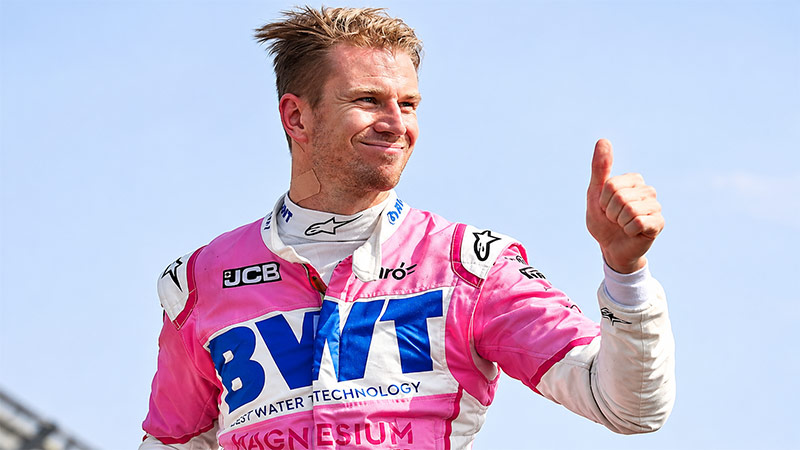
Yes, Nico Hülkenberg is good. In fact, he is one of the most technically gifted and consistently quick drivers of the modern Formula 1 era.
The harder question is whether he belongs among the sport’s true elite, and that debate has followed him for more than 15 years.
Few drivers split opinion quite like Hülkenberg. To his admirers, he is the best driver never to sit in a title-winning car. To his critics, he is a dependable midfield operator who had his chances and never fully turned them into results.
Both camps can point to real evidence, which is exactly why the question keeps coming up in paddock chatter, fan forums and pundit panels.
Nico Hülkenberg’s Career at a Glance
Hülkenberg arrived in Formula 1 with one of the strongest junior records of his generation. He won the 2006–07 A1GP title for Team Germany, the 2008 Formula 3 Euro Series and the 2009 GP2 Series as a rookie, then stepped straight into a Williams race seat for 2010.
Since then he has started more than 260 Grands Prix, making him one of the most experienced drivers on the current grid.
He now races for the Audi F1 Team, with a contract running through at least the 2027 season. His full journey is documented on his official F1 profile and his Wikipedia career record.
| Period | Team | Role and highlight |
|---|---|---|
| 2025–present | Sauber / Audi F1 Team | Race driver; first podium at the 2025 British GP |
| 2023–2024 | Haas | Race driver; regular Q3 appearances |
| 2022 | Aston Martin | Short-notice substitute for two races |
| 2020 | Racing Point | Short-notice substitute for three race weekends |
| 2017–2019 | Renault | Race driver; 7th in the 2018 championship |
| 2014–2016 | Force India | Race driver; won Le Mans with Porsche in 2015 |
| 2013 | Sauber | Race driver |
| 2012 | Force India | Race driver; led the Brazilian GP |
| 2010 | Williams | Race driver; pole at the Brazilian GP |
That 7th place in 2018 meant he finished as the best driver outside the three top teams, often called “best of the rest” in F1 terms. It is a useful reminder that his career has been built almost entirely in midfield machinery.
One-Lap Speed: Hülkenberg’s Greatest Weapon
If you want one reason teams keep calling Hülkenberg, it is qualifying. His ability to extract everything from a car over a single lap has been his calling card since his rookie season.
The headline example came at the 2010 Brazilian Grand Prix. Driving a Williams that was nowhere near the front of the field, he read a drying track perfectly and took pole position by more than a second. It remains one of the most famous laps by a rookie in modern F1.
That pattern has repeated throughout his career. At Haas in 2023 and 2024, he regularly hauled a car with poor tyre management into Q3, often qualifying well above where the machinery belonged. Across multiple teams, his teammates have found him a demanding benchmark on Saturdays.
For engineers, this matters more than it might seem. When a driver reliably gets the maximum out of a car, his lap times become an honest measure of the car’s true pace. That makes it far easier to judge whether a new upgrade is actually working.
Technical Feedback That Makes Teams Better
Speed alone does not explain a career that has lasted more than 15 years. Much of Hülkenberg’s value shows up away from the cameras, in the engineering debrief.
He is known for precise, honest car feedback and deep setup knowledge. Engineers at Force India, Renault, Haas and Sauber have leaned on that input to steer development in the right direction.
For a midfield team with a limited budget, a driver who can quickly pinpoint what the car needs is worth a great deal, because every wrong turn in development costs time and money.
The clearest proof is where teams have placed their trust. Haas brought him back in 2023 after three seasons without a full-time seat, and he repaid them by leading the team’s steady climb up the order. Sauber then signed him to spearhead its transition into the Audi works project.
Manufacturers do not hand a multi-year factory programme to a driver they consider ordinary. They hand it to someone they believe can help build a team, guide young teammates and set the standard in the garage.
Versatility: A Le Mans Winner and F1’s Go-To Substitute
Hülkenberg’s talent is not limited to one type of car. In 2015, while still racing for Force India in F1, he joined Porsche for the 24 Hours of Le Mans and won it outright on his first attempt, sharing the 919 Hybrid with Nick Tandy and Earl Bamber.
Winning the world’s most demanding endurance race at the first try is rare, even for sports car specialists.
His adaptability shows in Formula 1 too. In 2020, without a race seat, he stepped into the Racing Point as a short-notice substitute and qualified third at the 70th Anniversary Grand Prix.
At the Eifel Grand Prix later that year, he was called up hours before qualifying with no practice running, started last and finished eighth.
In 2022 he deputised again, this time for Aston Martin at the opening two races. Few drivers can climb into an unfamiliar car with almost no preparation and still run competitively. That ability says a great deal about his raw speed and his feel for a car’s limits.
The Podium Drought and the Silverstone Breakthrough
For years, one number dominated the debate: zero podiums. Hülkenberg held the unwanted record for the most Grands Prix started without a top-three finish, and critics often used that statistic as a one-line verdict on his entire career.
Context matters, though. Most of those races came in midfield cars that rarely had the pace to reach the podium on merit.
When chances did appear, luck often ran against him. At the 2012 Brazilian Grand Prix, he led for a long stretch of the race in a Force India before a collision with Lewis Hamilton ended his hopes.
The drought finally broke at the 2025 British Grand Prix. Starting 19th in the Sauber, he made smart calls in changing conditions and drove a near-faultless race to finish third. It came in his 239th start.
The reaction in the paddock said everything. Rivals, team bosses and fans celebrated the result as overdue recognition of a driver whose ability had long outrun his statistics.
What Fellow Drivers Say About Hülkenberg
Respect from rivals carries extra weight, because other drivers know exactly how hard it is to stand out in the midfield. On that measure, Hülkenberg scores highly.
Carlos Sainz, his teammate at Renault in 2018, has described him as a driver who always ranked among the top five on the grid, as covered in Sainz’s ESPN interview.
Two-time world champion Fernando Alonso has also spoken highly of his ability. Both argue that his lack of early podiums was mostly down to the cars he drove rather than his talent.
This kind of praise is telling. Drivers rarely talk up a rival without good reason, and those who have shared a garage or a race track with Hülkenberg consistently rate him well above his statistical record. You can follow the wider fan debate on his RacingNews365 driver page.
The Case Against: Why Some Stop Short of “Elite”
A fair verdict needs the other side of the argument. Critics tend to make four main points.
- No race wins. After more than 260 starts, he has never won a Grand Prix, and true greats usually find a way to win when a rare chance appears.
- Costly errors in big moments. His home race at Hockenheim in 2019 is the example most often cited. Running near the front in tricky wet conditions, he slid into the barrier and threw away a strong result.
- Beaten by a top-tier teammate. At Renault in 2019, Daniel Ricciardo outscored him across the season, which critics see as evidence of a ceiling.
- Sunday results versus Saturday pace. Some analysts feel his race results have not always matched his qualifying speed, particularly in wheel-to-wheel battles.
There is also the question of opportunity. A top team never signed him during their peak years. Supporters put that down to bad timing and politics. Critics counter that if he were truly elite, a front-running team would have found room for him.
The Verdict: Where Does Hülkenberg Rank?
Hülkenberg is an elite midfield driver and a genuinely top-tier qualifier, but not a proven race winner. That places him just below the sport’s generational stars and comfortably above most of the grid.
| Area | Rating | Evidence |
|---|---|---|
| Qualifying pace | Elite | Pole in Brazil 2010; regular Q3 runs in midfield cars |
| Technical feedback | Elite | Trusted to lead development at Haas and Audi |
| Versatility | Excellent | Le Mans winner on debut; strong short-notice substitute drives |
| Race results | Good | First podium only in 2025; no wins yet |
| Composure under pressure | Good | Reliable in most races, but costly errors such as Hockenheim 2019 |
The fairest summary is this: given a front-running car at his peak, he would very likely have won races. Whether he would have fought for world titles is the part no one can prove, and that uncertainty is what keeps the debate alive.
Conclusion: So, Is Nico Hülkenberg Good?
Yes, and the evidence is strong. Nico Hülkenberg is one of the fastest qualifiers of his era, a trusted technical leader and a Le Mans winner who has thrived in almost every car he has driven.
His long wait for a podium says more about the machinery he raced than about his ability, and his drive to third at Silverstone in 2025 proved he could deliver when the chance came.
He may never be ranked alongside the sport’s generational champions, but he has earned his place among Formula 1’s most respected drivers.