The landscape of the National Football League is often defined by strategic maneuvers that occur long before the first whistle of the regular season.
For the Detroit Lions, the most significant shift of the 2026 campaign is not a new free-agent signing or a high-profile draft pick, but a fundamental realignment of their most valuable asset.
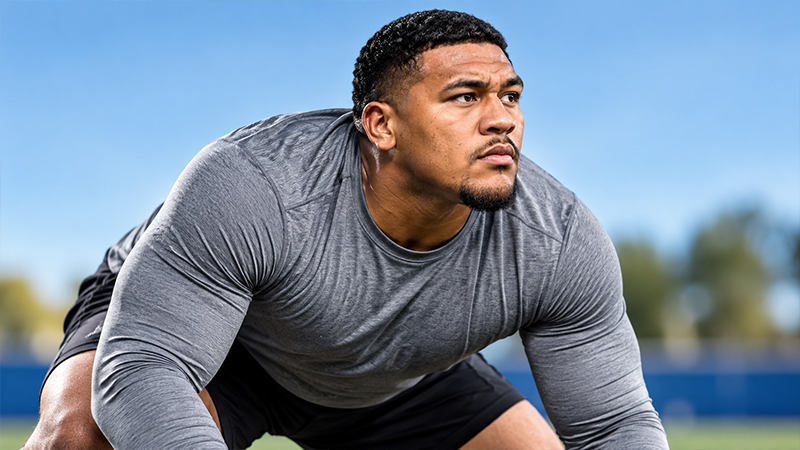
Penei Sewell has officially moved from right tackle to left tackle, a transition that signals the beginning of a new era for the Lions’ offensive front.
This decision follows the departure of long-time veteran Taylor Decker, whose presence on the blind side provided stability for nearly a decade.
By moving Sewell—an All-Pro who has spent the majority of his professional career dominating the right side—the Lions are betting on the “generational” talent that made him a top-ten pick.
The following analysis explores the technical, historical, and strategic layers of this move, examining why the organization believes their star protector is ready to redefine the left tackle position.
The Strategic Directive: Why the Move is Happening Now
The timing of this transition is anything but accidental. In the modern NFL, the left tackle remains the premier position on the offensive line, responsible for protecting the quarterback’s blind side from the league’s most explosive edge rushers.
While Sewell has been a “phenom” on the right side, the vacancy left by Decker created a choice: find a veteran replacement or elevate the best player on the roster to the most critical role.
Coach Dan Campbell has been the primary advocate for this change, famously asserting that Sewell’s move to the left side will be “seamless”.
This confidence is rooted in Sewell’s unique athletic profile and a football IQ that allows him to process complex defensive schemes at a speed rarely seen in players of his age.
The organization views this not as a gamble, but as a “natural return to his roots,” given his extensive history at the position before entering the professional ranks.
The Technical Challenge
Despite the optimism from the coaching staff, switching sides on the offensive line is one of the most difficult physical adjustments a professional athlete can make.
It is not merely a matter of standing on a different side of the center; it requires a complete inversion of every mechanical movement the body has perfected over thousands of repetitions.
The “Other Hand” Analogy
To understand the difficulty, one must look at the analogy often cited by elite linemen like Tristan Wirfs and Sewell himself: switching sides is like trying to “wipe with your other hand”.
- Lead Foot: On the right side, the right foot is the post, and the left foot is the power leg. On the left side, this is entirely reversed.
- Hand Placement: The “punch” timing changes. The dominant hand used to engage defenders must now become the secondary stabilizer.
- Weight Distribution: The center of gravity shifts during the kick-slide, requiring the brain to recalibrate balance in real-time under the duress of a 270-pound defensive end sprinting toward the pocket.
Sewell famously used this exact analogy when he first moved from left to right tackle during his rookie season, highlighting that even for a player of his caliber, the mental and physical friction is real.
However, unlike many who are forced into a position change due to an emergency, Sewell has spent the entire current offseason repping on the left side to ensure the mechanics are mastered before the season begins.
The Oregon Foundation and Rookie Re-Entry
The argument for Sewell’s success at left tackle is backed by a substantial data set from his collegiate and early professional career. While the NFL audience has primarily seen him as a right tackle, his formative years were spent on the blind side.
| Metric | Context/Position | Statistics |
|---|---|---|
| College Snaps (Oregon) | Left Tackle | 1,376 Snaps |
| Sacks Allowed (College) | Left Tackle | 1.0 Total |
| 2021 Rookie Starts | Left Tackle | 8 Games |
| Historical Status | Left Tackle | Youngest player to ever start at LT |
| Professional Recognition | Right Tackle | First Team All-Pro |
Sewell’s performance at the University of Oregon was nothing short of legendary. Allowing only a single sack across over 1,300 snaps is a statistical outlier that confirmed his “generational” status.
When he entered the NFL, he only moved to the right side because the Lions already had an established veteran in Decker.
His eight-game stint at left tackle in 2021 provided a glimpse of his potential, where he performed admirably despite having spent the entire training camp preparing to play on the right.
The Quest for Historical Versatility
By making this move, Sewell is chasing a level of prestige that few in the history of the league have ever attained. The ability to play both tackle positions at an All-Pro level is a rare feat that separates the great players from the Hall of Fame locks.
- The Tristan Wirfs Standard: Currently, Tristan Wirfs is the only player in NFL history to be named an All-Pro at both right tackle and left tackle. Analysts suggest that if any current player can join him in this exclusive club, it is Sewell.
- The Larry Allen Precedent: While rare, some legends have shown even greater versatility. Larry Allen, for instance, earned first-team All-Pro honors at left guard, right guard, and left tackle.
- The 2026 Expectation: Many around the league believe an “All-Pro LT season” is incoming for Sewell, which would solidify his argument as the best overall tackle in the game today.
Analyzing the “Gap”: Run Blocking vs. Pass Protection
While the consensus is overwhelmingly positive, analytical skeptics point to specific areas where Sewell must continue to evolve to meet the demands of the left side.
The responsibilities of a left tackle often prioritize pass protection over run dominance, a flip from the traditional expectations of the right side.
The run-blocking powerhouse
Sewell is widely regarded as the greatest run-blocking tackle in the NFL, often described as an “all-around weapon”.
His ability to pull, reach-block, and clear paths in the open field is unmatched. Some observers believe he is so athletic that he could move to running back and find success, simply because he is “so good at football”.
The Pass Protection Evolution
The “gap” in Sewell’s game, if one can call it that, lies in the nuances of pass blocking.
- Rankings: While he is elite in the run game, his pass-blocking metrics have historically placed him in the “top 5-10” range rather than the absolute top three.
- Historical Data: During his 2021 stint at left tackle, he posted a PFF grade of 58.8, ranking him 32nd out of 39 qualified tackles at the time.
- The Challenge: Left tackle requires a higher level of technical consistency in pass sets, as the quarterbacks cannot see the pressure coming from that side.
The Lions’ coaching staff, led by Hank Fraley, believes that Sewell’s growth since 2021 has rendered those old statistics irrelevant.
They argue that his refined hand-fighting techniques and improved leverage will allow him to maintain his “phenom” status on the blind side without a dip in performance.
The Domino Effect: Impact on the Detroit Roster
A move of this magnitude does not happen in a vacuum. By shifting Sewell to the left, the Lions have fundamentally altered the chemistry of their offensive line. This realignment requires other players to step into new roles to maintain the unit’s overall efficacy.
Filling the Void at Right Tackle
With Sewell vacating the right side, the competition for the starting RT spot has become the most watched battle in training camp.
- Larry Borom: A veteran presence who provides a baseline of stability and experience.
- Blake Miller: The rookie prospect who represents the future of the right side.
- Strategic Advantage: By putting Sewell at left tackle, the Lions can focus their schematic help (tight end chips and backfield stay-ins) on the right side to support the new starter.
The “Madden OVR” Theory
Fans and analysts often wonder if a player’s impact changes based on their position designation. In the case of Sewell, many believe he is a “plug-and-play” superstar whose overall impact remains unchanged regardless of where he lines up.
The expectation is that he will be “annoyingly good” at left tackle, much to the frustration of opposing defensive coordinators.
Establishing a Foundation for the Future
The Detroit Lions’ decision to move Penei Sewell to left tackle is a masterclass in long-term roster construction.
It acknowledges that while Sewell was an elite right tackle, his highest value to the franchise is as the primary protector of the blind side.
Key Takeaways for the 2026 Season
- Unmatched Pedigree: Sewell’s 1,376 snaps at Oregon with only one sack allowed remain the strongest evidence of his left-side potential.
- Calculated Preparation: This move was not a reaction to an injury; it was a planned transition facilitated by a full offseason of preparation.
- Leadership at the Core: Sewell’s influence extends beyond his blocking; his powerful pre-game speeches and restructured contract have made him the cultural heartbeat of the team.
- Historical Ceiling: The 2026 season could see Sewell become only the second player in history to earn All-Pro honors at both tackle spots.
The move signifies a commitment to excellence. While the technical hurdles of “wiping with the other hand” are real, Sewell’s history of overcoming challenges suggests that the transition will indeed be as “seamless” as Dan Campbell envisions.
As the Lions aim for a deep postseason run, they do so with the confidence that their blind side is anchored by a player who is not just filling a position, but redefining it.
The 2026 season will provide the final verdict, but if history is any indication, Penei Sewell is exactly where he belongs: on the left side, throwing defenders around and solidifying his legacy as the best tackle in football.