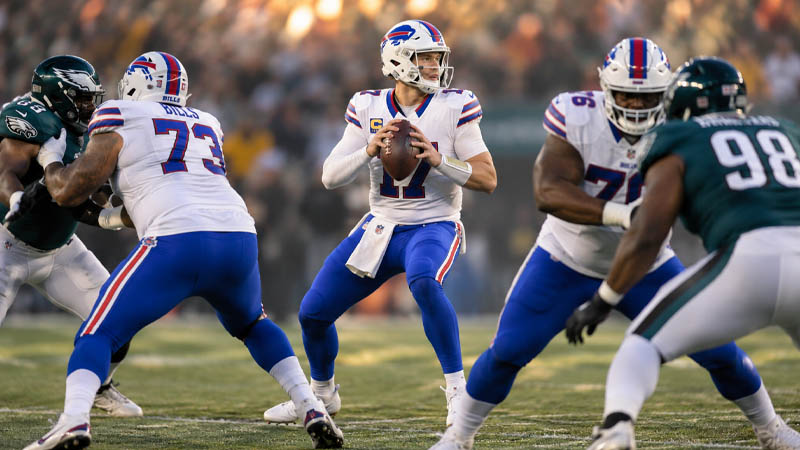
In the high-stakes arena of professional football, the pocket is a highly volatile environment. Within a fraction of a second, a clean pocket can collapse into a chaotic scramble of elite athletes collision-bound at extreme speeds.
For a quarterback, navigating this area is not merely a test of physical agility or arm strength; it is a test of spatial intelligence and psychological control.
The ultimate standard of quarterback play relies on finding the perfect equilibrium within this chaos.
There is an ideal operational sweet spot for an elite passer: they must remain entirely composed without becoming oblivious to the oncoming defensive rush, yet they cannot allow themselves to become overly panicked or frantic under pressure.
Striking this balance requires two distinct, frequently misunderstood traits: pocket presence and pocket poise.
While these terms are often used interchangeably in television broadcasts and scouting reports, they represent entirely different cognitive and physical disciplines.
Defining Pocket Presence: The Sensory Mapping of the Pass Rush
Pocket presence is fundamentally a quarterback’s sensory capability to perceive, interpret, and react to a collapsing defensive front while remaining calmly anchored within the protected boundary behind the offensive line.
A quarterback possessing elite presence does not panic when the pocket shrinks; instead, they execute micro-adjustments to neutralize the rush while keeping their eyes locked downfield on their targets.
                     [COLLAPSING POCKET]
                              │
             ┌────────────────┴────────────────┐
             ▼                                 ▼
      [POCKET PRESENCE]                 [POCKET POISE]
   The Sensory / Spatial             The Mental / Physical
   • Anticipates the rush            • Stands firm in chaos
   • Micro-shuffles feet             • Executes under impact
   • Feels blindside pressure        • Accepts the physical hit
   • Preserves downfield focus       • Minimizes mental erosion
This discipline is defined by three pillars:
Spatial Awareness and Blindside Instinct
Elite presence is the capacity to feel oncoming defenders without breaking eye contact with downfield receivers. It is often described as having an uncanny internal radar.
Rather than turning their head to identify an edge rusher, the quarterback relies on spatial orientation to recognize exactly when and where the defensive line is breaking through.
Micro-Movement and Footwork Efficiency
Amateur quarterbacks often panic at the first sign of pressure, abandoning a structurally sound pocket to scramble into the waiting arms of defensive ends.
In contrast, a master of pocket presence uses tiny, deliberate steps to slide away from edge rushers or step up cleanly into vacant spaces as the pocket compresses.
When defensive ends sweep wide around the tackle box, the quarterback steps forward; when the interior offensive guard is driven backward, the quarterback slides laterally or rolls outward to reset the passing platform. These subtle movements require minimal space but completely reset the defensive angles of pursuit.
Maintaining Downfield Focus
The absolute baseline of pocket presence is the refusal to look down at the pass rush. The moment a quarterback drops their eyes to watch the defensive linemen, the play is functionally dead.
Elite pocket managers train themselves to ignore the immediate physical threat, keeping their vision fixed on the secondary defensive shell to spot open receivers.
Pocket Poise: The Psychology of Composure Under Fire
Pocket poise is a quarterback’s ability to stay calm, stand firm, complete reads, and make accurate throws despite knowing a hard hit is coming.
Unlike simply avoiding pressure, poise means trusting the play, waiting for the right moment, and delivering the ball without rushing. Strong pocket poise helps prevent pressure from damaging a quarterback’s confidence, decision-making, and throwing mechanics.
[Relentless Physical Hits] ──► [Elevated Internal Clock] ──► [Loss of Composure & Mechanics]
                                                                     │
                                                                     ▼
                                                             ["David Carr" Effect]
Pocket poise is the shield against this mental degradation. It is demonstrated by quarterbacks who can process complex defensive coverages in a state of near-meditative calm.
A poised quarterback is constantly calculating a high-stakes trade-off: they must decide when to extend a play outside the pocket in hopes that a receiver will break open, and when to stand tall, deliver a precise throw, and absorb a heavy hit to move the chains.
The Cognitive Science Behind the Instinct: The Subconscious Spatial Map
One of the greatest gaps in traditional scouting is the assumption that pocket movement is a purely physical reaction to visible stimuli. Historically, coaches evaluated pocket navigation as a series of physical drills—shuffling through cones and stepping over bags.
However, cognitive science and athletic research suggest that elite pocket navigation is rooted in a highly advanced subconscious mapping system.
A landmark athletic study revealed that elite performers in fluid, spatial sports—such as football, basketball, hockey, and soccer—develop an extraordinarily sophisticated internal representation of their surroundings. This system allows them to predict and react to the movements of players they cannot actively see.
┌────────────────────────────────────────────────────────┐
│             THE SUBCONSCIOUS SPATIAL ENGINE            │
├────────────────────────────────────────────────────────┤
│  [Auditory Cues] ────► [Subconscious Map] ──► [Action]  │
│  [Positional Drift]      * Predicts movements         │
│  [Sensory Cues]          * Blind-side escapes         │
└────────────────────────────────────────────────────────┘
This subconscious engine operates through several key mechanisms:
- Predictive Tracking: The mind continuously calculates the speed, vector, and trajectory of surrounding players based on the last visible frame. If a quarterback sees an edge rusher speed past an offensive tackle at a specific angle, their subconscious brain calculates exactly when that defender will reach the launch point, even after the defender has entered the quarterback’s blind spot.
- Auditory and Sensory Processing: Quarterbacks process subtle auditory cues—such as the heavy footfalls of a defensive tackle or the rustle of jersey fabric—to update their internal spatial map in real time.
- Cross-Sport Parallels: This predictive system is identical to the spatial intelligence displayed by elite boxers who can instinctively “feel” the trajectory of an oncoming punch and slip it without conscious thought. It is also seen in legendary basketball players who execute entirely blind passes by calculating exactly where a teammate will be based on their speed and direction, rather than relying on peripheral vision.
This explains how highly elusive quarterbacks can spin out of completely blind sacks right before contact occurs, without ever turning their eyes toward the oncoming defender. They are not guessing; their subconscious mind has accurately calculated the intersection of their paths and triggered an evasive response.
Historical Case Studies: Deconstructing Elite Pocket Management
To fully understand how these traits manifest on the field, we can analyze the contrasting styles of several elite quarterbacks who represent the pinnacle of pocket control.
The Decisiveness Model: Tom Brady
Perhaps the greatest example of maximizing pocket efficiency is Tom Brady. Brady was never celebrated for his mobility, vertical leap, or speed. Yet, he is widely considered the gold standard of pocket management because of his absolute decisiveness.
                             [TOM BRADY'S OPERATIONAL CYCLE]
                                            │
               ┌────────────────────────────┼────────────────────────────┐
               ▼                            ▼                            ▼
     [Pre-Snap Diagnosis]           [Decisive Targeting]        [Rapid Target Attack]
    • Identifies weakness         • Focuses on primary route    • Executes quick release
    • Adjusts protection          • Limits to 3 progressions    • Minimizes hit exposure
Brady’s pocket presence was built on a structured operational cycle:
- Pre-Snap Diagnosis: He analyzed the defensive shell at the line of scrimmage and aligned his offense to attack the defense’s structural weakness.
- Decisive Targeting: He predetermined his primary and secondary options, rarely progressing past three reads before making a decision.
- Rapid Target Attack: If his initial reads were covered, he immediately checked the ball down or threw it away to protect the team’s field position.
By delivering the ball with extreme quickness, Brady ensured that defensive rushers rarely had the time to reach him, allowing him to preserve his health, avoid negative plays, and consistently move his offense forward.
The Structural Elusiveness Model: Young Ben Roethlisberger and Cam Newton
On the opposite end of the physical spectrum are quarterbacks who rely on sheer size, strength, and physical resilience to maintain poise. Early in their careers, Ben Roethlisberger and Cam Newton demonstrated a unique variation of pocket composure.
Because of their massive frames, they possessed the physical capacity to absorb and shake off direct hits that would easily bring down average passers.
This physical resilience allowed them to remain in a collapsing pocket far longer than their peers, trusting that they could withstand the initial wave of the pass rush to find a breaking receiver downfield.
The Meditative Composure Model: Sam Bradford
Sam Bradford represented an elite baseline of pure, fearless poise under pressure. Under heavy defensive fire, Bradford maintained an almost meditative state of calm, refusing to allow oncoming defenders to disrupt his mechanical release.
This was particularly evident on screen passes. While many quarterbacks tip off screens by looking at the running back too early when under pressure, Bradford would hold his eyes deep downfield to pull back the safeties and linebackers.
Only at the absolute final millisecond, with unblocked defenders directly in his face, would he flick the ball over the rush to his running back, converting a high-pressure situation into an explosive gain.
Can These Instincts Be Developed?
A major debate in front offices and coaching rooms is whether pocket poise and presence can be taught, or if they are entirely innate gifts.
While the raw, subconscious spatial mapping of elite athletes is difficult to replicate, strategic coaching can systematically build and protect a quarterback’s pocket composure.
Modern coaching departments employ several key developmental strategies to cultivate these traits:
Structural Confidence Building
To prevent a young quarterback from getting rattled early in their career, smart coaching staffs design early-game plans centered on rapid, high-probability completions.
By utilizing quick-release plays, screens, and short horizontal passes, the coaching staff ensures that defenders are kept far away from the passer.
This allows the quarterback to establish a rhythmic downfield scanning process and build confidence without the psychological disruption of taking early hits.
Simulated Spatial Drills
Coaches utilize specialized training regimens to sharpen a quarterback’s subconscious spatial map. By using blindside pressure drills, where defenders approach from angles outside the quarterback’s direct field of view, quarterbacks learn to rely on auditory cues and spatial prediction to slide away from pressure while keeping their eyes downfield.
Cognitive Load Reduction
The faster a quarterback can process defensive coverages, the slower the physical pass rush feels. By simplifying pre-snap reads and narrowing down progression choices, coaches reduce the cognitive load on a young player.
This mental clarity directly translates into physical poise, allowing the quarterback to stand tall in the pocket because they know exactly where their outlet receivers are located.
Strategic Conclusion
In professional football, pocket presence and pocket poise are the ultimate equalizers. They are the invisible traits that separate quarterbacks who merely execute plays from those who can control the entire game.
By combining highly developed subconscious spatial maps with the psychological resolve to stand tall in the face of oncoming physical contact, elite quarterbacks transform the pocket from a hazardous zone into a highly structured launchpad.
For franchises searching for their next quarterback, evaluating these cognitive and psychological traits is far more critical than measuring arm strength or 40-yard dash times.
The quarterbacks who master the spatial blueprint of the pocket are the ones who consistently keep their offenses moving forward, turning defensive pressure into offensive opportunity.