The passing game in modern football is an intricate game of chess played at terminal velocity. To consistently move the chains, offensive coordinators cannot rely solely on deep shots or simple perimeter screens.
They must attack the heart of the defense: the intermediate middle of the field. At the absolute center of this strategic battlefield sits one of the most reliable, timing-dependent, and tactically devastating passing patterns in the game: the dig route.
Also referred to as an “in” route or a “square-in,” the dig route is a fundamental pattern taught at every level of football, from youth leagues to the professional ranks.
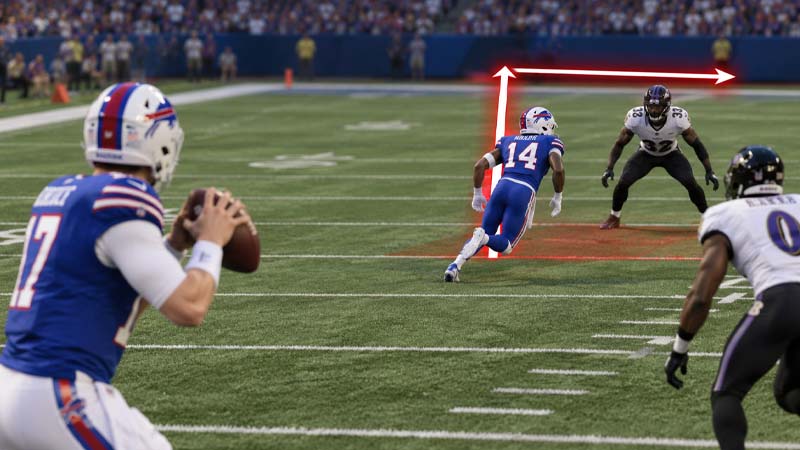
On paper, the diagram looks straightforward: a receiver runs vertically, plants a foot, and breaks at a sharp 90-degree angle horizontally across the field.
However, executing this pattern against elite defensive coverages requires master-level technique, immaculate timing, and a deep understanding of spatial relationships.
What is a Dig Route?
A dig route is an intermediate passing route where a receiver runs vertically downfield before making a sharp 90-degree cut toward the middle of the field. It typically breaks at 10–15 yards, although shorter versions can be used.
The name “dig” comes from the receiver’s need to plant their foot firmly into the turf to stop their forward momentum and make a sharp cut. A clean break creates separation and gives the quarterback a reliable throwing window.
Who Runs Dig Routes?
- Slot Receivers: Use their inside alignment to attack openings across the middle.
- Tight Ends: Use their size and strength to work through intermediate coverage.
- Outside Receivers: Often run digs as part of concepts designed to stretch and isolate defenders.
Step-by-Step Technical Execution: The Receiver’s Manual
An elite route-runner does not just run a path; they paint a masterpiece of deception. Running a highly successful dig route requires strict adherence to physical mechanics across three distinct phases: the vertical stem, the break, and the horizontal drive.
                Opposite Sideline
<------------------------------------------------------ [Horizontal Drive] (Parallel to Scrimmage)
|
|
|
| [The Break] (90-Degree Cut, Plant Outside Foot)
|
|
|
| [Vertical Stem] (Sprint at Full Speed)
|
|
|
|
|
[Line of Scrimmage / Alignment]
Step I: The Vertical Stem (The Illusion of the Go Route)
At the snap of the ball, the receiver must sprint straight downfield at absolute maximum speed. The primary objective of the vertical stem is to create the illusion of a vertical “Go” or “Streak” route.
- Selling the Deep Threat: If a receiver coasts or rounds their stem, the defensive back will immediately diagnose an intermediate break and sit on the route. By running at full speed, the receiver forces the defender to back up and respect the deep pass, opening up cushion underneath.
- Stem Depth: The receiver must run to their predetermined distance dictated by the play call. As they approach a point roughly one yard away from this distance, they prepare their body for deceleration.
Step II: The Break (The Deceleration and the Cut)
The break is the most physically demanding part of the pattern. It is the moment when separation is won or lost.
- The Plant and Push-Off: Upon reaching the break point, the receiver must plant their outside foot with immense force, “digging” it into the turf. This foot serves as the brake and the pivot point.
- Sinking the Hips: To decelerate from a full sprint without falling forward, the receiver must lower their center of gravity by sinking their hips. This rapid deceleration catch the defender off guard, as they must also try to stop their backward momentum.
- The 90-Degree Pivot: Pushing off that planted outside foot, the receiver snaps their hips and head around, turning at a sharp, crisp right angle. At this point, they must be facing directly toward the opposite sideline, running parallel to the line of scrimmage.
Step III: The Horizontal Drive (Running the Yard Line)
Once the cut is made, the route is only half finished. The horizontal portion of the dig requires discipline and straight-line speed.
- Staying on the Line: The receiver must avoid drifting upfield (toward the end zone) or sagging back downfield (toward the line of scrimmage). The golden rule is to run directly down the yard marker to give the quarterback a consistent, predictable line to throw to.
- Maintaining Velocity: Many receivers slow down after making their break, assuming the hard work is done. However, they must continue running at full speed across the middle to outrun trailing coverage and maximize separation.
- The Eye Transition: As the receiver makes their cut and begins driving horizontally, they must immediately snap their eyes toward the quarterback. Because the dig operates in tight windows, the ball is frequently thrown on anticipation, meaning it may be in the air before the receiver even completes their turn.
The Art of Separation: Deceiving and Shielding
Against elite man-to-man coverage, simply running the diagram is not enough to get open. A receiver must understand how to manipulate defensive leverage and use their physical frame to protect the football.
Moment of Deception: Manipulating the Defensive Back
The success of a dig route rests on two key moments, the first of which is the initiation of the break. A receiver can use two primary techniques to prevent the defender from guessing the cut:
- Maintaining the Blind Spot: Throughout the vertical stem, the receiver should aim to climb directly into the defender’s cushion, forcing them to turn their hips and run. By keeping their intentions completely hidden, the receiver ensures the defender is still in transition when the break occurs.
- The Out-Break Fake: To create additional separation, a receiver can execute a subtle head or upper-body fake to the outside, mimicking an “Out” route. If the defender bites on this fake and leans toward the sideline, the receiver can plant and cut back underneath to the middle of the field with several yards of separation.
The Shielding Technique: Protecting the Football
The second key moment of the dig route occurs during the horizontal phase across the middle of the field. Because this area is heavily congested with defenders, the receiver must learn to shield the defender from the football.
- Using the Body as a Barrier: The receiver must establish positioning that keeps the defender on their outside shoulder—effectively positioning the defender toward the end zone, while the receiver remains between the defender and the quarterback.
- Maximizing the Catch Radius: By maintaining inside leverage and keeping the defender on their back, the receiver creates a massive, clean target window for the quarterback. This positioning allows the receiver to make the catch unobstructed and protects them from heavy hits by trailing defenders.
Strategic Offense: Concepts, Pairings, and Spatial Clearing
Football is a game of spacing. Because the middle of the field is historically the most congested zone on the gridiron—home to linebackers, safeties, and underneath zone defenders—coaches must design play concepts that clear out these defenders to give the dig route room to breathe.
Defensive Deep Third            [Deep Safety] (Pulled Deep)
                                     ^
                                     | (Clear-Out Route)
Intermediate Zone                    |        [Dig Route Window]
                                [Receiver 1]  <================= [Receiver 2 (Dig)]
                                                     |
                                                     | (Underneath Defender Pulled Away)
                                                     v
Underneath Zone                 [Running Back] (Flat/Wheel Route)
The Spatial Challenge of the Middle Field
When a receiver cuts across the middle, they are entering a high-traffic area. In a typical defensive scheme, the path of a dig route can be occupied by three linebackers, at least one safety, and potentially a cornerback dropping into zone coverage.
If an offense runs a dig route in isolation, underneath zone defenders can easily sit in the passing lane and intercept the ball.
To solve this, offensive coaches employ clearing routes to pull defenders out of the intermediate middle.
Primary Strategic Combinations
1. Deep Clear-Out Concepts (Vertical Stretches)
Offenses frequently pair the dig route with deep vertical patterns run by outside receivers.
- The Mechanism: An outside receiver sprints deep on a Go route or a Post route. This deep push forces the cornerbacks and safeties to drop deep into the secondary to protect against the touchdown pass.
- The Result: As the deep secondary retreats, a massive void opens up in the intermediate level (10-15 yards downfield). The receiver running the dig can cross through this vacated space with zero safety interference.
2. Underneath Pull Concepts (Horizontal Stretches)
To handle the underneath linebackers who might drop into the passing lane of the dig, coaches utilize backfield targets.
- The Mechanism: A running back or a fullback executes a route to the flat or a wheel route up the sideline.
- The Result: The linebackers must react to this immediate short threat and sprint toward the boundary to make the tackle. This horizontal movement pulls the linebackers out of the middle of the field, leaving a vacant throwing window directly behind them for the crossing dig route.
The Quarterback’s Perspective: Anticipation, Timing, and Ball Placement
A perfectly run route is useless without a throw that matches its precision. For a quarterback, throwing the dig route is a masterclass in anticipation and velocity.
Throwing with Anticipation
Because the dig route crosses the middle of the field where windows open and close in milliseconds, quarterbacks cannot wait for the receiver to make their 90-degree cut before throwing the ball.
- The Timing Window: The quarterback must begin their throwing motion while the receiver is still in their vertical stem, projecting exactly where the receiver will be after the break.
- The Risk of Late Throws: If the quarterback waits to see the receiver run horizontally before throwing, the trailing defensive back or a zoning linebacker will have ample time to step into the passing lane, resulting in a deflected pass or an interception.
Ball Placement Rules
Proper ball placement on a dig route is critical for both completion percentage and player safety:
- Lead the Receiver: The pass must be thrown in front of the receiver, leading them down the yard line. This allows the receiver to maintain their horizontal speed and transition smoothly into a run-after-catch scenario.
- Keep It Low and Inside: The ball should be placed away from the trailing defender. If the defender is trailing on the receiver’s back/outside hip, the ball must be thrown low and inside, allowing the receiver’s body to act as a natural shield. High throws over the middle are incredibly dangerous, as they force the receiver to jump, exposing their ribs to devastating hits from incoming safeties.
Conclusion
The dig route remains a foundational passing concept because of its unique blend of simplicity and tactical effectiveness.
Although the design of the pattern is straightforward to learn, achieving true mastery demands precise route-running, sudden deceleration, and a physical, sharp change of direction.
By threatening defenders straight deep before cutting sharply across the intermediate middle, receivers can consistently exploit defensive weaknesses.
When combined with clear-out routes to stretch the secondary, the pattern becomes a highly reliable chain-mover.
Ultimately, dedication to technical footwork, quarterback timing, and relentless practice turns this basic play into an elite, unstoppable weapon on game day.