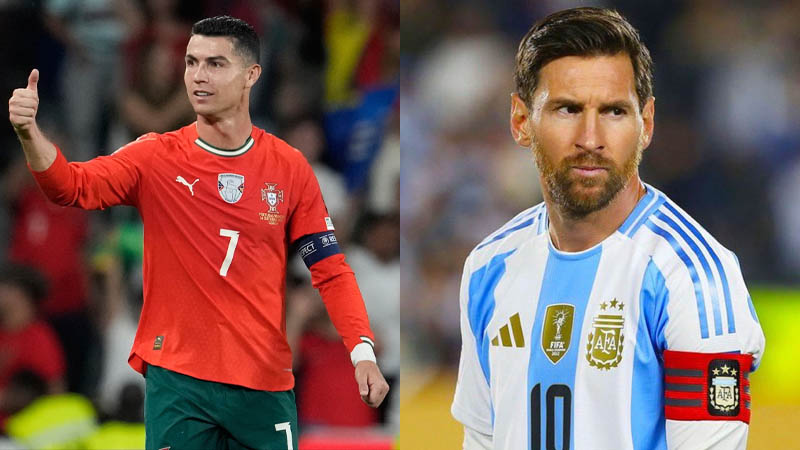
The football world stands on the precipice of history as the 2026 FIFA World Cup approaches. For the first time, fans will witness the “Last Dance” of the sport’s two most iconic figures: Lionel Messi and Cristiano Ronaldo.
Entering their record-breaking sixth World Cup, both legends are prepared to cement their legacies on North American soil. This tournament represents more than just a quest for a trophy; it is the ultimate resolution of a decades-long rivalry.
As they transition from their dominant years in Europe to the Americas and Middle East, their form remains elite, setting the stage for a truly unforgettable finale.
The Road to North America: Current Form and Domestic Success
Before the global spectacle begins, understanding the momentum both players bring from their respective clubs is essential for predicting their impact on the international stage.
Both athletes have taken unconventional paths following their storied careers in Europe, yet neither has seen a significant dip in their competitive drive.
As they prepare for the 2026 tournament, their domestic successes serve as a testament to their longevity. Cristiano Ronaldo enters the competition on the back of a triumphant season with Al-Nassr FC, where he secured the Saudi Pro League title.
His transition to the Middle East has been marked by a continued obsession with goal-scoring, proving that his physical conditioning remains at a peak level even in his late thirties.
Conversely, Lionel Messi has transformed the landscape of North American football, spearheading the attack for Inter Miami CF in Major League Soccer (MLS).
His presence in the United States has not only increased the league’s global profile but has also allowed him to maintain a high level of match fitness and playmaking creativity in the very country that will host the majority of the World Cup matches.
2026 Calendar Year Statistical Comparison
| Statistic | Lionel Messi | Cristiano Ronaldo |
|---|---|---|
| Appearances | 17 | 22 |
| Goals | 14 | 16 |
| Assists | 5 | 1 |
| Total Goal Contributions | 19 | 17 |
| Minutes Per Goal | 111.6 | 116.0 |
| Mins Per Goal/Assist | 74.4 | 109.2 |
| Free Kick Goals | 2 | 1 |
| Penalty Goals | 1/1 | 3/4 |
2026 Performance Metrics: A Deep Dive into the Numbers
To truly appreciate the level at which these icons are operating, we must analyze their statistical output throughout the 2026 calendar year leading up to the tournament.
These metrics offer a glimpse into their evolving roles—Ronaldo as the definitive finishing spearhead and Messi as the complete offensive engine.
While Ronaldo holds a slight advantage in total goals scored during the 2026 calendar year (16 to Messi’s 14), a closer look at the efficiency metrics reveals a different story.
Messi dominates in playmaking efficiency and total goal contributions per minute, showcasing his ability to influence a match even when he isn’t the one putting the ball in the back of the net.
This statistical divergence highlights the different tactical approaches their respective national teams, Argentina and Portugal, are likely to employ during the tournament.
Goal Scoring and Tactical Efficiency
The efficiency with which Messi operates is staggering; he averages a goal or assist every 74.4 minutes, significantly faster than Ronaldo’s 109.2 minutes.
This suggests that while Ronaldo may be more active in terms of appearances and raw goal count, Messi’s involvement leads to a higher frequency of scoring opportunities for his team.
Ronaldo, however, remains a more frequent threat from the penalty spot, having converted three of his four attempts in 2026, compared to Messi’s single successful attempt.
Set Piece Specialization and Playmaking
When it comes to dead-ball situations, Messi has maintained his reputation as the world’s premier free-kick taker, registering two free-kick goals in the early months of 2026. Ronaldo, while still a threat, has managed one.
The assist column further widens the gap, with Messi recording five assists in 17 appearances, whereas Ronaldo has managed one in 22 matches.
This reinforces the narrative that Messi has transitioned into a “Quarterback” role, dictating the tempo of the game, while Ronaldo remains the ultimate “Closer.”
Collision Course: Potential 2026 World Cup Matchups
The bracket layout for the 2026 tournament creates several tantalizing scenarios where these two giants could finally clash on the world stage, a meeting that has eluded the footballing world for two decades.
The placement of Argentina in Group J and Portugal in Group K sets a specific mathematical path for a potential knockout-stage collision.
Fans and analysts are already circling dates on the calendar, as the structure of the tournament allows for these legends to meet in the quarterfinals, the round of 16, or even a dream final.
The location of these potential matches—ranging from Texas to Kansas City—adds a layer of geographic intrigue to the narrative.
The Quarterfinal Path in Kansas City
The most statistically likely route for a meeting is the quarterfinal stage. If both Argentina and Portugal win their respective groups (Group J and Group K) and successfully navigate their first two knockout rounds, they will square off at Arrowhead Stadium in Kansas City on Saturday, July 11, 2026.
This venue, known for its intense atmosphere, would provide a fitting colosseum for the final competitive chapter of this rivalry.
Early Knockout and Final Scenarios
Should both nations struggle slightly and finish as runners-up in their groups, an early collision could occur in the Round of 16 on July 6, 2026, in Arlington, Texas.
Conversely, the “Ultimate Dream” scenario—a Messi vs. Ronaldo World Cup Final—is only possible if one team wins their group and the other finishes second.
This would place them on opposite sides of the bracket, ensuring they could only meet on the final day of the tournament to decide the world champion.
The Statistical Titanomachy: Career-Long Legacies
While the 2026 tournament is the immediate focus, their current battle is built upon a foundation of nearly two decades of unparalleled statistical dominance that has rewritten the record books.
To understand why the 2026 meeting is so significant, one must look at the “Titanomachy”—the clash of the titans—that has defined their careers.
They are the only two players in the history of modern football to break the incredible 900-goal barrier for both club and country.
This longevity is unprecedented, and the numbers they have produced are often compared to entire clubs’ historical outputs rather than individual players.
Comprehensive Career Statistics
| Statistic | Lionel Messi | Cristiano Ronaldo |
|---|---|---|
| Total Appearances | 1,154 | 1,322 |
| Total Goals | 910 | 971 |
| Total Assists | 411 | 261 |
| Total Goal Contributions | 1,321 | 1,232 |
| Goals Per Game Ratio | 0.79 | 0.73 |
| Career Hat-Tricks | 60 | 66 |
| Penalty Goals | 112 | 178 |
Club vs. Country: Analyzing Global Efficiency
The debate often shifts between their performance in club colors and their leadership on the international stage for Argentina and Portugal, where both have achieved legendary status.
In the realm of international football, Cristiano Ronaldo stands as the all-time leading goal scorer in the history of the men’s game, with 143 goals for Portugal.
His international career has been defined by his ability to carry his nation through difficult qualifying campaigns and major tournaments.
Messi, however, maintains a slightly higher scoring frequency in his club career, reflecting the surgical precision he displayed during his years at FC Barcelona and later at PSG and Inter Miami.
International Dominance and Scoring Rates
Ronaldo’s 143 international goals in 225 matches represent a level of consistency that is unlikely to be matched soon. Messi, with 114 goals in 195 matches for Argentina, is not far behind and holds a significant lead in international assists (60 to Ronaldo’s 37).
When analyzing their club careers, Messi’s efficiency remains superior; he has scored 777 goals in 936 games, whereas Ronaldo has scored 807 goals in a significantly higher 1,068 games. This gives Messi a better goals-per-game ratio across his entire club journey.
The Champions League Era
Before their departures from European football, the two completely dominated the UEFA Champions League. Ronaldo remains the undisputed “King of the UCL” with 140 goals and 5 trophies.
Messi, while having one fewer trophy (4), leads in group-stage scoring and has recorded 129 goals in the competition.
Their battles in the Champions League were the primary theatre for their rivalry for fifteen years, setting the standard for elite performance in the world’s most difficult club competition.
The Trophy Cabinet: Defining the G.O.A.T.
Beyond individual statistics, the collective success and individual accolades serve as the final metrics for many in the “Greatest of All Time” (G.O.A.T.) debate.
When the conversation moves away from goals and assists and toward silver and gold, the distinctions between the two becomes clearer. Messi currently holds a significant advantage in terms of both individual honors and collective team trophies.
For many, his victory in the 2022 FIFA World Cup was the deciding factor that elevated him above all others in football history.
- The Ballon d’Or Gap: Lionel Messi holds the all-time record with 8 Ballon d’Or titles, whereas Cristiano Ronaldo has secured the prestigious award 5 times.
- Major Team Silverware: Messi has secured a total of 46 official trophies throughout his career, making him the most decorated player in history. This includes the 2022 World Cup, multiple Copa Américas, and numerous league titles.
- Ronaldo’s Trophy Haul: Ronaldo has amassed 35 official trophies, including the UEFA European Championship (2016) and a record five Champions League titles.
- The Final Piece: As they enter 2026, the World Cup remains the only major trophy missing from Ronaldo’s cabinet, while Messi seeks to become one of the few players to ever win consecutive World Cups as a captain.
Frequently Asked Questions about Messi and Ronaldo in 2026
Who has more total goals heading into the 2026 World Cup?
As of the current 2026 stats, Cristiano Ronaldo leads with 971 career goals compared to Lionel Messi’s 910. However, Messi leads in total goal contributions (goals + assists) with 1,321 compared to Ronaldo’s 1,232.
What is the most likely date they could play each other?
If both teams win their groups and advance through the initial knockout stages, the most likely date for a clash is the Quarterfinal on Saturday, July 11, 2026, in Kansas City.
Is this really their last World Cup?
While both players have defied aging curves, 2026 is widely regarded as their “Last Dance.” By the 2030 tournament, Ronaldo would be 45 and Messi would be 43, making 2026 the final realistic opportunity for them to compete at the highest level of international football.
Who is more efficient in front of goal?
Statistically, Lionel Messi has a superior career goals-per-game ratio of 0.79, compared to Cristiano Ronaldo’s 0.73. In 2026 specifically, Messi has also been more efficient, requiring only 74.4 minutes per goal contribution compared to Ronaldo’s 109.2 minutes.
Conclusion: The Final Word on a Historic Era
The 2026 FIFA World Cup represents the closing chapter of a golden era. For two decades, Lionel Messi and Cristiano Ronaldo have pushed each other to heights previously thought impossible, turning the sport into a binary debate between two different styles of perfection.
One is the quintessential “living highlight reel” of dribbling and playmaking; the other is the most clinical goal-scoring machine the game has ever seen.
As they take the field in North America, the statistical gap between them is narrower than ever, yet their legacies are already secure.
Whether they meet in a sweltering quarterfinal in Kansas City or a historic final in New Jersey, the 2026 tournament is less about deciding who is “better” and more about celebrating the fact that we were here to witness them both.
Their “Last Dance” is not just a conclusion; it is a final gift to the world of sports.