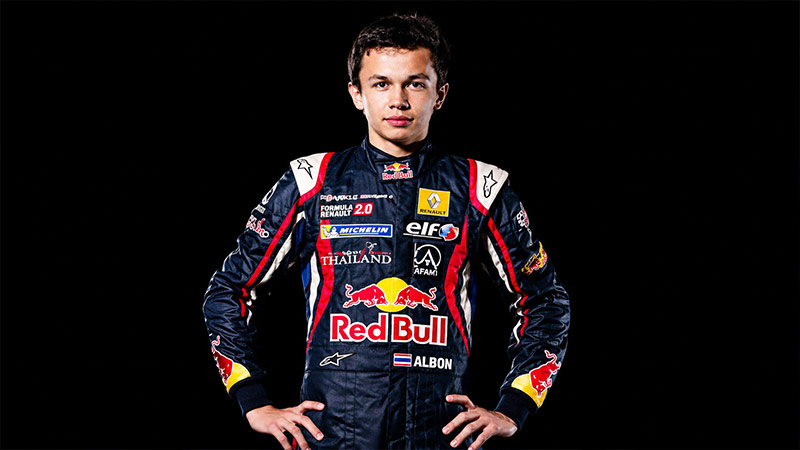
Alexander Albon left Red Bull Racing because he could not close the gap to teammate Max Verstappen in 2020. He scored 105 points to Verstappen’s 214 in a season when Red Bull was trying to beat Mercedes for world titles.
When Sergio Pérez became available after winning the 2020 Sakhir Grand Prix, Red Bull signed him for 2021. Albon was moved to a test and reserve role, then left the Red Bull family for good when Williams signed him for 2022.
That is the headline, but the full story is richer. It involves a rushed promotion, a car shaped around a generational talent, two costly collisions with Lewis Hamilton and a team running short on patience. It also sets up one of the best career rebuilds in modern Formula 1.
Who Is Alexander Albon?
Alexander Albon is a London-born racing driver who competes under the Thai flag, his mother’s nationality. He was born on 23 March 1996, and his father, Nigel Albon, raced in the British Touring Car Championship.
His relationship with Red Bull began long before Formula 1. Albon joined the Red Bull Junior Team in 2012, then was dropped after a single season in Formula Renault. Few drivers recover from that kind of setback.
Albon did. He finished second to Charles Leclerc in GP3 in 2016 and third in Formula 2 in 2018. By late 2018 he had signed to race in Formula E with Nissan e.dams.
Then Red Bull came back. Toro Rosso needed a driver for 2019, and Nissan released Albon so he could take the seat. This history matters: Albon was a driver Red Bull had already let go once. His second chance arrived fast, and it would end almost as fast.
From Rookie to Red Bull in 12 Races
Albon reached the senior Red Bull team after only 12 Grand Prix starts. He made his debut with Toro Rosso at the 2019 Australian Grand Prix and quickly showed calm racecraft and steady points finishes.
Meanwhile, Pierre Gasly was struggling alongside Verstappen at Red Bull Racing. During the 2019 summer break, the team swapped them. Albon took the senior seat from the Belgian Grand Prix, while Gasly returned to Toro Rosso.
His first half-season looked promising. Albon scored points in all but one of his nine races for Red Bull, with a best finish of fourth in Japan. In Brazil he was running second late in the race when contact with Lewis Hamilton cost him a likely first podium.
He ended 2019 eighth in the standings with 92 points, and Red Bull confirmed him for 2020. The promotion was a clear vote of confidence. It was also a gamble: a driver with less than one full season of experience would now be measured against Verstappen every weekend.
Reason 1: The Verstappen Benchmark
At Red Bull, the second driver is judged almost entirely against Max Verstappen. In 2020, Albon scored less than half of Verstappen’s points in the same car.
| 2020 season | Max Verstappen | Alexander Albon |
|---|---|---|
| Championship position | 3rd | 7th |
| Points | 214 | 105 |
| Wins | 2 | 0 |
| Podiums | 11 | 2 |
Red Bull finished second in the constructors’ championship with 319 points, far behind Mercedes on 573. Verstappen delivered roughly two-thirds of the team’s total on his own.
The gap showed most clearly on Saturdays. Albon was often several tenths of a second slower in qualifying, which left him starting in midfield traffic. From there, fighting back to the podium was hard, and the Mercedes drivers rarely had to worry about him.
A gap like this costs a team twice. It loses constructors’ points, which carry real prize money. It also loses strategic options, because a rival can cover one fast car far more easily than two.
Reason 2: A Car Shaped Around One Driver
The 2020 Red Bull RB16 was fast but famously hard to drive. It had a sharp, aggressive front end and a rear that could break away with little warning.
Verstappen thrives in a car like that. He likes instant turn-in and is comfortable catching a sliding rear at high speed. Most drivers prefer a stable, predictable platform that lets them build confidence lap by lap.
Team figures acknowledged during 2020 that the car’s balance was difficult, especially early in the season.
Development naturally followed the lead driver’s feedback, because Verstappen was the one fighting at the front. Each update made the car faster in his hands without necessarily making it easier for anyone else.
This does not fully excuse the points gap. Verstappen is a generational talent who would beat most teammates in any car. But the car’s character turned a normal gap into a very large one, and it helps explain why Gasly struggled in the same seat a year earlier.
Reason 3: Incidents, Pressure and Lost Confidence
Two collisions with Lewis Hamilton shaped how Albon’s Red Bull years were remembered. Both came while he was in strong positions, and both cost him results that might have changed the conversation.
The first was Brazil 2019, where contact while running second dropped him out of the points. The second came at the 2020 season opener in Austria. Albon, on fresher tyres, attacked Hamilton for second place late in the race, the two touched, and Albon later retired.
From there, the pressure grew. Red Bull adviser Helmut Marko regularly discussed Albon’s form in public, and speculation about his seat ran for most of the season. Spins, qualifying errors and quiet races added to the story.
Albon did respond. He earned his first Formula 1 podium with third place at the Tuscan Grand Prix at Mugello, then added another third in Bahrain. But two podiums in a season where his teammate scored 11 were not enough to secure his future.
Albon has since spoken openly about how the pressure affected his confidence. Stepping away, he has said, helped him rediscover his own way of driving rather than chasing someone else’s.
Reason 4: Title Ambitions and the Sergio Pérez Option
Red Bull’s decision was about 2021 as much as 2020. In October 2020, Honda announced it would leave Formula 1 after the 2021 season, which made the coming year the team’s best chance to beat Mercedes with its works engine partner.
To fight for both titles, Red Bull needed two cars at the front. Mercedes could split strategies between its drivers and force Red Bull into difficult choices. With only Verstappen in contention most weekends, Red Bull had no answer.
Normally, the team promotes from its own junior ranks. This time there was no obvious candidate. Gasly had already been moved out of the seat once, and Yuki Tsunoda was only about to make his Formula 1 debut.
Sergio Pérez changed the picture. Racing Point had chosen not to keep him for 2021, yet he finished the 2020 season fourth in the championship with 125 points, 20 more than Albon in a midfield car. He also won the Sakhir Grand Prix after dropping to last on the opening lap.
In mid-December 2020, Red Bull confirmed Pérez as Verstappen’s teammate. Albon stayed with the team as test and reserve driver. It was a rare break from Red Bull’s habit of filling its seats from within.
The 2021 Reserve Year and the Move to Williams
Albon spent 2021 on the sidelines of Formula 1 but stayed busy. As Red Bull’s test and reserve driver, he did simulator work that supported Verstappen’s successful title campaign.
He also raced in the DTM touring car series, driving an AF Corse Ferrari alongside fellow Red Bull junior Liam Lawson. Racing wheel to wheel every few weeks kept his skills sharp while he waited for a way back.
That way back came in September 2021, when Williams confirmed Albon for 2022 alongside Nicholas Latifi. He replaced George Russell, who was moving to Mercedes. Red Bull released him to take the seat, and this is the moment Albon truly left Red Bull.
The early results looked modest. Williams finished last in 2022, and Albon scored 4 points while also missing the Italian Grand Prix after appendicitis. The deeper story was his leadership. In 2023 he scored 27 of the team’s 28 points, lifting Williams to seventh in the constructors’ standings.
Williams rewarded him with a long-term contract extension and later paired him with Carlos Sainz from 2025. The driver Red Bull let go twice is now the cornerstone of one of the sport’s most famous teams.
Albon and Red Bull: Key Dates
Albon’s Red Bull story spans nearly a decade, from junior driver to senior team and back out again.
| Date | Milestone |
|---|---|
| 2012 | Joins the Red Bull Junior Team; dropped at the end of the season |
| 2016 | Finishes second to Charles Leclerc in GP3 |
| 2018 | Third in Formula 2; signs a Formula E deal with Nissan e.dams |
| March 2019 | Formula 1 debut with Toro Rosso in Australia |
| August 2019 | Promoted to Red Bull Racing from the Belgian Grand Prix |
| November 2019 | Contact with Hamilton in Brazil costs a likely first podium |
| July 2020 | Contact with Hamilton in Austria ends a podium bid |
| September 2020 | First Formula 1 podium: third at the Tuscan Grand Prix |
| November 2020 | Second podium: third at the Bahrain Grand Prix |
| December 2020 | Red Bull signs Sergio Pérez; Albon becomes test and reserve driver |
| September 2021 | Williams confirms Albon for 2022 |
| 2023 | Scores 27 of Williams’s 28 points |
Was It Albon’s Fault? The Red Bull Second-Seat Pattern
Albon’s exit looks less like a personal failure when you view it alongside the drivers who followed. The seat next to Verstappen has proved one of the hardest in modern Formula 1.
Pierre Gasly lasted 12 races in 2019 before being moved back to Toro Rosso. Back in a calmer environment, he won the 2020 Italian Grand Prix.
Sergio Pérez, Albon’s replacement, won races and supported two constructors’ titles, yet he too was replaced after a difficult 2024. In 2025, Liam Lawson was moved out after just two races, and Yuki Tsunoda found the seat equally demanding.
The common thread is clear. A car developed around Verstappen’s style, a team culture built on fast decisions and a teammate who sets an extreme benchmark combine to make the role uniquely tough.
That does not erase the real gap Albon showed in 2020. Red Bull had a title to chase and made a defensible business decision.
But the story offers a useful lesson for fans and analysts: judging a driver on one season in that seat alone tells you only part of the truth. Albon’s later form at Williams proved there was far more to his talent than the 2020 numbers suggested.
Conclusion
Alexander Albon left Red Bull because the numbers, the timing and the team’s ambitions all pointed the same way.
He reached the senior team after only 12 races, drove a car built around Max Verstappen and finished 2020 with less than half his teammate’s points.
With Honda leaving and Mercedes still dominant, Red Bull wanted a proven performer, and Sergio Pérez arrived at the right moment. Yet the story did not end there.
Albon used his reserve year to reset, joined Williams and became the leader of a famous team. His career shows that one difficult season in the toughest seat in Formula 1 rarely defines a driver. Context, confidence and the right environment matter as much as raw speed.