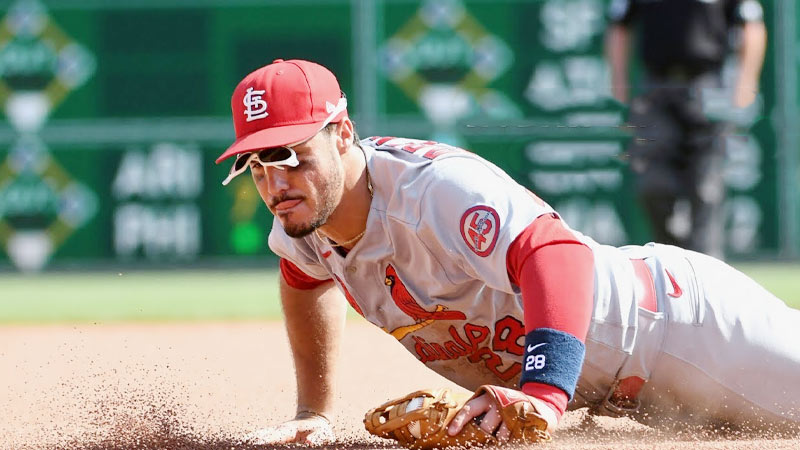
Nolan Arenado skipped the 2022 MLB All-Star Game because of lower-back soreness and tightness that had nagged him for three to four weeks.
Instead of flying to Los Angeles for the Midsummer Classic, he went home, rested, and worked with physical therapists and trainers. Atlanta Braves third baseman Austin Riley took his spot on the National League roster.
That is the quick answer. The fuller story is more interesting, because it says a lot about how a veteran star manages his body, how teams protect their most important players, and why one quiet decision in July can shape an entire season.
If you remember scanning the 2022 All-Star rosters and wondering where one of the best third basemen of his generation went, this breakdown walks through exactly what happened, why he made the call, who stepped in, and how the choice looks now that his career has carried him from St. Louis to Arizona.
The Short Answer: A Sore Back and a Smart Break
Arenado earned a spot on the 2022 National League All-Star team, the seventh selection of his career at that point.
He was not hurt badly enough to land on the injured list, and he was still playing every day for the St. Louis Cardinals. But he was not fully healthy either.
Here are the three facts that matter most:
- The reason: lower-back soreness and tightness he had been managing since early June 2022, roughly three to four weeks before the break.
- The decision: he chose to skip the All-Star festivities so he could go home, relax, and work with physical therapists and trainers during the four-day pause in the schedule.
- The replacement: Austin Riley of the Atlanta Braves was added to the National League roster in his place.
In other words, this was not a snub, a dispute, or a surprise injury. It was a planned recovery window. Arenado treated the All-Star break as what it is for most players: the only real rest stop in a six-month marathon.
How the Back Issue Built Up From June to the Break
The soreness did not appear overnight. It started in early June 2022 and lingered through the rest of the first half, which is exactly the kind of low-grade problem that can quietly wear a player down.
Early June
Arenado began feeling tightness in his lower back. He kept playing, which is typical for a veteran who prides himself on being in the lineup every day. Third base is a demanding position, and back stiffness affects everything from the first step on a ground ball to the rotation of a swing.
Mid-June to early July
The issue lingered. He managed it with treatment between games rather than taking time off, and his production stayed strong enough that his All-Star selection was never in doubt.
All-Star selection
When the rosters were announced, Arenado was on the National League team. For a player of his status, the invitation was almost expected. He had already been one of the faces of the sport at third base for nearly a decade.
The decision on the eve of the break
With three to four weeks of soreness behind him and a full second half ahead, Arenado chose recovery. He went home instead of heading to Dodger Stadium, where the game was played on July 19, 2022.
The key takeaway from the timeline is that this was a slow-burn issue. Problems like that rarely get better with more travel, more media sessions, and more time on a ballfield. They get better with rest, which is exactly what the break offered.
Why a Seven-Time All-Star Chose Rest Over the Spotlight
To a casual fan, skipping the All-Star Game can look like turning down an honor. To players, coaches, and athletic trainers, it often looks like good planning. Several factors made rest the logical call for Arenado in 2022.
The break is the only real recovery window
A Major League season runs about 162 games over roughly 186 days. Off days are scarce and often spent traveling.
The All-Star break is the one stretch where a player can string together several days without games, flights, or batting practice. For someone nursing a sore back, those days are worth more than almost anything else on the calendar.
All-Star week is not restful
The Midsummer Classic is a celebration, but it is also a busy work trip. Players fly in, attend media sessions, take part in workouts and events, and often play at least an inning or two. For a healthy player, that is a fun few days.
For a player whose back has been tight for nearly a month, it is several more days of stress on the same problem.
Third base puts heavy demands on the back
Arenado’s game is built on defense. His range, quick reactions, and strong throws from awkward angles made him one of the most decorated defenders in baseball history.
That style requires explosive bending, twisting, and diving, all of which load the lower back. Protecting that area protects the skill that defines him.
The Cardinals had a division race to win
St. Louis was in a tight National League Central race with the Milwaukee Brewers in the summer of 2022. Arenado was one of the team’s two most important players, alongside first baseman Paul Goldschmidt.
A healthy Arenado for the final two-plus months mattered far more to the club than a few innings in an exhibition.
Veterans think in seasons, not single events
By 2022, Arenado had already played in multiple All-Star Games. Experienced players tend to weigh short-term recognition against long-term durability. Missing one showcase to stay strong for August, September, and October is a trade most veterans would make without hesitation.
Austin Riley Steps In for the National League
When a selected player withdraws, the league names a replacement, usually at the same position. Atlanta Braves third baseman Austin Riley got the call to fill Arenado’s spot.
The choice made plenty of sense. Riley was in the middle of a breakout 2022 season and had been one of the most productive power hitters in the National League during the first half. Many fans felt he deserved a spot on the original roster, so Arenado’s withdrawal opened the door for a well-earned first All-Star appearance.
Riley went on to finish 2022 with 38 home runs, and the Braves signed him to a long-term contract extension that August. His addition turned what could have been a disappointing headline into a feel-good one: one star stepped back to heal, and a rising star stepped forward.
For Arenado, the swap also removed any pressure to play through discomfort. The National League still had an elite third baseman on the roster, and he could focus fully on recovery without feeling he had left the team short-handed.
Did Skipping the Game Pay Off? The 2022 Results Say Yes
The best way to judge the decision is to look at what came after it. By almost every measure, 2022 turned into one of the finest seasons of Arenado’s career.
- Durability: he played in 148 games, a heavy workload for any third baseman, let alone one who spent part of the summer managing back soreness.
- Production: he finished with a .293 batting average, 30 home runs, and 103 RBI, his best all-around offensive season in a Cardinals uniform.
- Recognition: he placed third in National League MVP voting behind teammate Paul Goldschmidt and San Diego’s Manny Machado.
- Defense: he won his 10th straight Gold Glove, extending a streak that began in his rookie season.
- Team success: the Cardinals pulled away from Milwaukee to win the National League Central.
No one can prove exactly how much those four quiet days in July contributed. What we can say is that the risk he was trying to avoid, a nagging back problem that worsened under more stress, never derailed his season. He stayed on the field, stayed productive, and helped carry his team into the postseason.
That outcome is the strongest argument that the decision was not about missing an honor. It was about protecting a season.
From St. Louis to Arizona: Arenado’s Workload and Output, 2022 to 2026
Arenado’s 2022 decision looks even more meaningful when you see how his workload and production have moved in the seasons since. Here is the five-year picture, ending with his first season in Arizona.
| Season | Team | Games Played | Batting Avg | Home Runs | RBI |
|---|---|---|---|---|---|
| 2026 | Arizona Diamondbacks | 152 | .255 | 30 | 86 |
| 2025 | St. Louis Cardinals | 107 | .237 | 12 | 52 |
| 2024 | St. Louis Cardinals | 152 | .272 | 16 | 71 |
| 2023 | St. Louis Cardinals | 144 | .266 | 26 | 93 |
| 2022 | St. Louis Cardinals | 148 | .293 | 30 | 103 |
A few clear patterns stand out.
2022 was the peak
His highest average, his most RBI, and a 30-homer season all came in the same year he chose rest over the All-Star stage.
Back trouble did not disappear
In 2023 he still played 144 games and drove in 93 runs, but back problems returned late in the season and ended his year early. That repeat episode reinforces why he was careful in 2022: lower-back issues tend to come back, and managing them early matters.
Power dipped as the workload stayed high
In 2024 he matched his 2026 total of 152 games, but his home runs fell to 16. Contact held up with a .272 average, while the power that made him a perennial middle-of-the-order threat faded.
2025 was the low point
An injury-shortened season limited him to 107 games, with a .237 average, 12 home runs, and 52 RBI. It was the clearest sign that age and wear were starting to catch up.
Arizona sparked a rebound
After moving to the Diamondbacks for 2026, Arenado played 152 games and returned to the 30-homer mark for the first time since 2022.
His average of .255 and 86 RBI show a player who adjusted his approach and regained his power stroke at age 35.
The through-line is durability. Across these five seasons, Arenado topped 140 games four times. That kind of availability does not happen by accident.
It comes from the same mindset that led him to skip the 2022 All-Star Game: listen to the body early, so you can be there for the long haul.
What Fans and Fantasy Players Can Learn From This
Arenado’s 2022 absence is a useful case study for anyone who follows baseball closely, whether you are a lifelong Cardinals fan, a new Diamondbacks follower, or someone setting a fantasy lineup.
- An All-Star withdrawal is not always a red flag. When a player skips the game but stays off the injured list, it usually signals caution, not a serious injury. Arenado kept playing almost every day after the break.
- Watch for recurring issues. Back problems in 2022 and again in 2023 formed a pattern. When a veteran has the same area flare up more than once, expect teams to manage his workload more carefully in the following seasons.
- Age changes the profile, not always the value. Arenado’s power faded in 2024 and 2025, then returned in 2026. Veterans who adjust their approach, or get a fresh start with a new club, can surprise people who wrote them off.
- Availability is a skill. Four seasons of 144 or more games in five years show how much a player’s own habits around rest and recovery matter. That availability is often worth as much as a few extra home runs.
- Context beats headlines. “Star skips All-Star Game” can sound dramatic. The real story is often a sensible, quiet choice made with the long season in mind.
The Bottom Line
Nolan Arenado was not playing in the 2022 All-Star Game because his lower back had been sore and tight for three to four weeks, and he chose to use the break to rest and receive treatment at home.
Austin Riley replaced him on the National League roster, earned his first All-Star nod, and the game went on without a hitch.
For Arenado, the payoff was clear. He went on to post a .293 average, 30 home runs, and 103 RBI, finished third in MVP voting, won another Gold Glove, and helped the Cardinals win their division.
Four years later, now with the Diamondbacks, he is still a durable everyday third baseman who just delivered another 30-homer season.
Sometimes the smartest move a star can make is the one that keeps him off the stage for a few days so he can own it for the rest of the year.