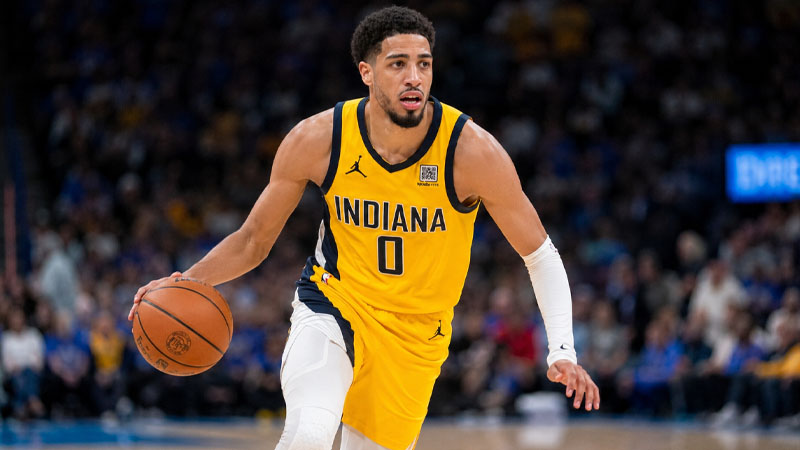
Tyrese Haliburton is considered a high-impact defender primarily due to his elite basketball intelligence, spatial awareness, and “event creation” abilities.
While he may struggle with lateral quickness in one-on-one, point-of-attack situations, his 6’8” wingspan and off-ball anticipation allow him to disrupt passing lanes and generate crucial turnovers.
Functioning effectively as a defensive “free safety,” Haliburton excels at tagging cutters, digging into driving lanes, and communicating rotations.
By prioritizing possession retention through steals and deflections, he transforms defensive stops into elite transition opportunities, making him a unique net-positive asset within a modern team defensive structure.
What Makes Tyrese Haliburton a Disruptive Defensive Asset?
The core of Haliburton’s defensive value lies in his ability to function as an “event creator” rather than a traditional lockdown stopper.
While many evaluate defense solely through individual isolation containment, the modern game rewards players who can manipulate the floor and force turnovers through high-level anticipation and reach.
The Power of Elite Positional Length
Standing at 6’5” with a 6’8” wingspan, Haliburton possesses a physical profile that is atypical for the point guard position. This length allows him to shrink passing windows and bother shooters even when he is not in a perfect defensive stance.
His height provides him the leverage to recover and contest shots effectively, often bothering an opponent’s vision even if they have initially beaten him on the perimeter.
Furthermore, this reach is a primary factor in his ability to average nearly 0.6 blocks per game, an upper-tier metric for a standard guard.
Anticipation and the “Free Safety” Mentality
Haliburton’s defensive philosophy is often compared to that of a free safety on a football field. He uses his high-level understanding of offensive plays to stay multiple steps ahead of his opponents, often predicting a pass before it is even released.
His twitchy, reactive hands allow him to jump cross-court passes and ignite fast breaks instantly. Rather than merely reacting to the ball, he proactively disrupts the flow of half-court sets, consistently ranking among the league leaders in raw deflections and steal rates.
This “steals-to-assists” mindset ensures that when he does secure a steal, it immediately translates into a lethal transition passing opportunity.
Career Statistical Profile: A Data-Driven Defense Analysis
Evaluating Haliburton’s defensive impact requires a look beyond the standard box score to understand how his presence influences the game’s tempo and possession count.
His statistical output reflects a player who prioritizes high-leverage defensive actions that shift the momentum of a game.
| Season | Team | Steals (SPG) | Blocks (BPG) | Def. Rebounds (DRPG) | Defensive Rating (DRtg) |
|---|---|---|---|---|---|
| 2024–25 | Indiana | 1.44 | 0.67 | 2.96 | 118.7 |
| 2023–24 | Indiana | 1.20 | 0.70 | 3.42 | 115.3 |
| 2022–23 | Indiana | 1.63 | 0.45 | 3.07 | 117.2 |
| 2021–22 | Indiana/SAC | 1.70* | 0.62* | 3.30* | 117.9* |
| 2020–21 | Sacramento | 1.33 | 0.48 | 2.31 | 118.1 |
| Career | Total | 1.45 | 0.59 | 3.05 | 116.9 |
The data highlights a consistent ability to generate “stocks” (steals + blocks). His lifetime average of 1.45 steals per game translates to over 490 career steals, keeping him routinely at the top of league leaderboards.
While his 116.9 career Defensive Rating might seem high to a casual observer, it is essential to contextualize this within the fast-paced, high-possession styles of play utilized by the Sacramento Kings and Indiana Pacers.
In these systems, a higher rating often reflects the volume of possessions in a game rather than individual defensive failure.
How Does Haliburton Impact Team Defense Schemes?
Beyond individual statistics, Haliburton’s value is found in his role as a rotational anchor. His ability to understand team-wide coverages makes him a “plus” contributor in help-side roles, even when his on-ball metrics are under scrutiny.
Master of the Help-Side Rotation
Haliburton excels at “digging” and “stunting” against driving ball-handlers. When an opponent drives to the basket, Haliburton will momentarily leave his assignment to disrupt the driver before sprinting back to his original position.
He is also highly reliable at “tagging” big men who roll to the rim or guards attempting backdoor cuts, stalling the play long enough for the primary defender to recover.
This rotational awareness allows coaches to design schemes that keep him off the ball, where his high-IQ help defense can shine most effectively.
Communication and Floor Leadership
As the focal point of his team’s system, Haliburton’s spatial awareness allows him to call out defensive rotations to teammates early.
Defensive coordination is as much about communication as it is about physical effort, and Haliburton has shown significant growth in his activity level and effort on that end.
By directing traffic and ensuring his teammates are in the correct positions, he mitigates some of his own physical limitations at the point of attack.
This synergy is further enhanced by elite rim protectors, such as Myles Turner, who help cover for Haliburton if an opponent manages to drive past him.
Addressing the Critique: Why is His On-Ball Defense Questioned?
While Haliburton is an elite team and off-ball defender, analysts and film studies consistently note that he is currently below average as an on-ball, point-of-attack defender.
Understanding why this is the case—and how it is being addressed—is key to evaluating his overall trajectory.
Physical Limitations and Lateral Quickness
The “critical catch” regarding Haliburton’s defense is his lack of elite lateral quickness and upper-body bulk. Physical perimeter scorers can frequently overpower him or use their speed to drive right past him in isolation situations.
He sometimes struggles with staying in front of the league’s most explosive guards, leading to some observers viewing him as a “minus” defender on that specific end of the floor.
However, there is a clear consensus among those who follow his development that he has moved from being one of the “worst in the league” on-ball to a more manageable level through sheer effort and scheme adherence.
The Path to Physical Maturity
History suggests that many elite guards undergo a physical transformation to improve their defensive floor.
A common comparison for Haliburton is Stephen Curry, who began his career as a defensive liability but added significant bulk and strength to become a reliable part of a championship-level defense.
At 6’5″, Haliburton has the frame to fill out significantly as he enters his physical prime in his late 20s. Analysts believe that as he adds muscle, he will be able to hold his own in physical actions and avoid being relentlessly targeted by opponents.
His intelligence is already at an elite level; once his physicality matches his brain, his defensive ceiling could rise from “solid” to “above average”.
Is Tyrese Haliburton a Good Defender?
When we look at the total package, the answer is a nuanced yes. He is not a “lockdown” defender who will take on the opponent’s best player for 40 minutes, but he is a “good” defender in the way that matters most for a modern point guard: he creates extra possessions and prevents easy baskets through intelligence.
- Effort is Trending Upward: Observers have noted that his effort and activity levels have been much improved, showing a commitment to the defensive end that often takes time for young offensive superstars to develop.
- Clutch Impact: His defense has been described as “clutch,” coming up with key stops or deflections in high-leverage playoff or late-game moments.
- Learning the Trade: There is evidence that his time with elite international competition, such as the Olympics, allowed him to learn “tricks of the trade” that he is now applying to his regular-season game.
- The Paradigm Shift: There is a growing momentum in the league where fans and players alike are valuing the “intellectual sentinel” role—guards who may not be physical specimens but who dominate through positioning and awareness.
Frequently Asked Questions About Haliburton’s Defense
Is Tyrese Haliburton considered a defensive liability?
No. While he has clear weaknesses in on-ball isolation containment due to lateral quickness, his elite off-ball help and ability to generate steals make him a net-positive in most team schemes. He is often categorized as an “event creator” rather than a liability.
How does his wingspan help him on defense?
His 6’8″ wingspan allows him to occupy more space than a typical guard. This helps him deflect passes, block shots at a high rate for his position, and bother the vision of shooters during close-outs.
Will he ever win a Defensive Player of the Year (DPOY) award?
It is highly unlikely he will win DPOY, as that award typically goes to dominant rim protectors or lockdown wing defenders.
However, his goal is to become a “plus” defender who can stay in front of the opponent’s worst offensive guard while wreaking havoc in passing lanes.
Does playing with Myles Turner help Haliburton’s defense?
Yes, significantly. Having an elite rim protector like Turner allows Haliburton to be more aggressive in the passing lanes and take risks. If Haliburton gets beaten on the perimeter, Turner is there to cover the mistake at the rim.
Conclusion: The Evolution of a Defensive Intellectual
Tyrese Haliburton’s defense is a masterclass in using IQ to overcome physical hurdles. By embracing his role as a disruptive help defender and a “free safety,” he provides the Indiana Pacers with a unique defensive edge that directly fuels their elite transition offense.
As he continues to add muscle and refine his on-ball technique, the gap between his legendary offensive production and his defensive contributions will continue to shrink.
For any championship-caliber team, having a point guard who can think the game at this level is not just a bonus—it is a necessity. If you are looking for a player who proves that defense is played with the mind as much as the feet, look no further than Haliburton.