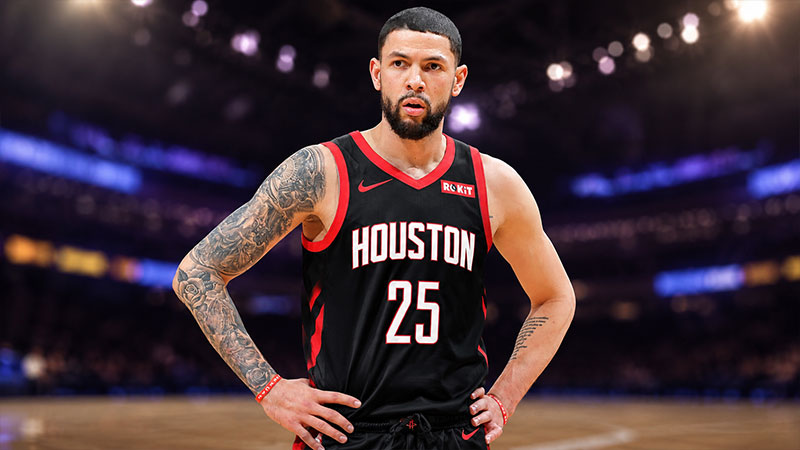
In the high-stakes ecosystem of the NBA, few figures have sparked as much financial debate as Austin Rivers. When he signed a three-year, $35.5 million contract extension in 2016, it sent shockwaves through the league.
Critics pointed to his modest scoring average of 8.9 points per game and the fact that his father, Doc Rivers, was the one signing the checks.
However, the truth behind his earnings is far more complex than simple nepotism. It involves a historic salary cap spike, strategic leverage, and the specialized value of an 11-year league veteran.
The 2016 Salary Cap Spike: A Macroeconomic Shift
To understand Rivers’ compensation, one must first analyze the unique financial environment of the 2016 NBA offseason. This period was characterized by an unprecedented economic anomaly that fundamentally altered the league’s pay scale.
The Multi-Billion Dollar TV Deal
The primary driver behind the massive contracts of 2016 was a new, multi-billion dollar national television deal. This influx of revenue caused the NBA salary cap to jump by a staggering $24 million in a single summer.
Teams were suddenly flooded with liquid capital and were required by collective bargaining agreements to meet a “salary floor,” leading to a frantic spending spree where mid-level talent received superstar-level valuations.
Contextualizing the Market Rate
Critics often view Rivers’ $11 million annual salary in a vacuum, but when compared to his peers that summer, the deal aligns with broader market trends. During this same window, several other role players secured even larger guaranteed totals:
| Player | Contract Total | Length |
|---|---|---|
| Chandler Parsons | $94 Million | 4 Years |
| Bismack Biyombo | $72 Million | 4 Years |
| Tyler Johnson | $50 Million | 4 Years |
| Austin Rivers | $35.4 Million | 3 Years |
As the data indicates, Rivers was actually on the lower end of the “inflated” role-player spectrum. The market dictated that serviceable guards were worth eight figures, and the Los Angeles Clippers paid the going rate to maintain their roster continuity.
Team Leverage and the “Early Bird” Technicality
Beyond the league-wide cap spike, the specific financial constraints of the Los Angeles Clippers played a pivotal role in Rivers’ high-earning years. At the time, the Clippers were a perennial playoff contender built around Chris Paul, Blake Griffin, and DeAndre Jordan.
The “Early Bird” Rights Trap
The Clippers held Austin Rivers’ “Early Bird” rights, a technicality in the NBA’s Collective Bargaining Agreement. Because the team was already over the salary cap, they could not go into the open market and sign a replacement for Rivers if he left in free agency.
They were essentially trapped: they could either pay Rivers his market value (roughly $11 million) or let him walk and be forced to replace him with a player on a league-minimum contract.
The Replacement Paradox
From a front-office perspective, letting a productive rotation player leave for nothing is a catastrophic failure in asset management.
Even with his father, Doc Rivers, serving as the President of Basketball Operations, the organizational logic was sound. They paid to keep a known quantity rather than weakening a championship-caliber roster.
However, this dynamic fueled the “nepotism” narrative, with peers like Chandler Parsons noting that it felt like favoritism when Rivers was chosen for key minutes over other veterans.
The Longevity Argument: Survival of the Fittest
A common misconception is that Austin Rivers only remained in the league due to his family connections. However, the data reveals a different story of professional endurance and specialized skill sets that allowed him to outlast many of his draft peers.
Surviving 11 Seasons Across Nine Franchises
Nepotism might get a player through the door, but it cannot sustain an 11-season career across nine different organizations.
After leaving his father’s team, Rivers signed contracts with the Houston Rockets, New York Knicks, Denver Nuggets, and Minnesota Timberwolves.
These teams had no incentive to do favors for Doc Rivers; they signed Austin because he provided specific, measurable value on the court.
Defining the “Serviceable Role Player”
Rivers carved out a niche by offering a “three-and-D” utility set that is highly coveted by modern coaches. His contributions were rarely found in the points-per-game column, but rather in the tactical nuances of the game:
- Perimeter Defense: He was consistently tasked with guarding elite opposing point guards.
- Secondary Ball-Handling: He provided “micro-burst” scoring and playmaking off the bench.
- Postseason Reliability: He appeared in 45 playoff games, proving he could perform under the highest pressure.
The Barrier to Entry: NBA vs. NFL Specialization
The debate over Rivers’ earnings reached a boiling point when he engaged in a public feud with former NFL wide receiver James Jones. The conflict highlighted the massive disparity in career earnings and the perceived “difficulty” of making it in the NBA.
The Specialized Skill Gap
The NBA is widely considered the most difficult professional sports league to enter and remain in.
Unlike the NFL, which requires specialized athletes for very specific roles (e.g., a “speed guy” or a “power guy”), the NBA demands a high level of proficiency in almost all facets of the game.
Commenters have noted that while some NBA players could potentially transition to the NFL due to their world-class athleticism, the reverse is rarely true because of the high technical skill barrier in basketball.
The Economics of Roster Size
A significant reason NBA players like Rivers are paid “so much” compared to NFL stars is simple math. An NBA roster has 15 players, while an NFL roster has 53.
The revenue-per-player in the NBA is significantly higher, meaning even a tenth-man like Rivers will out-earn many Pro Bowl-level football players.
This financial reality often leads to friction between athletes in different leagues, as seen in Rivers’ “tacky” response to Jones, where he explicitly refused to “talk finances” because the gap in their career earnings was so glaring.
Public Image: The Duke Pedigree and “Bravado”
Rivers’ high salary is often criticized because of his perceived personality and the “false sense of bravado” associated with his time at Duke University. This cultural perception has made him a lightning rod for criticism from both fans and fellow players.
The Media Persona
In the latter half of his career, Rivers has leaned into his role as a vocal media personality, appearing as a studio analyst for ESPN. His willingness to engage in high-profile feuds—such as his recent 1-on-1 challenge to Draymond Green—has kept him in the headlines.
Critics point to instances like Rivers sitting in front of “amateur fan art” of himself as evidence of an inflated ego, which makes his high salary a target for public resentment.
The “Nepo Baby” Label
Despite being a former high school legend and 10th overall draft pick, the “nepotism” tag has been difficult to shake.
While his father did provide him with his most lucrative contract, Austin’s ability to remain a “serviceable player on both ends of the floor” for over a decade suggests that he earned his place in the league through merit.
Enhanced FAQ: Understanding NBA Contracts
Why did Austin Rivers’ scoring not match his salary?
In the NBA, players are often paid for their defensive utility and “spacing” rather than just raw point totals. Rivers was a defensive specialist who could guard multiple positions, which is often valued more than high-volume, low-efficiency scoring.
Did Doc Rivers overpay his son?
While the $35 million figure was high, it was a “market rate” contract during the 2016 cap spike. Furthermore, the Clippers’ lack of salary cap space meant they had no other viable options to replace him.
How much did Austin Rivers earn in total?
Over his 11-season career, Rivers earned over $57 million in total salary. The bulk of this came from the 2016-2019 period.
What did Austin Rivers do after his big contract expired?
His pay eventually normalized to the market rate for veteran guards. He spent his final seasons signing veteran minimum contracts with teams like the Denver Nuggets and Minnesota Timberwolves.
Conclusion: A Case Study in Professional Leverage
The career of Austin Rivers serves as a masterclass in the importance of timing and positioning. He was a talented, former lottery-pick athlete who entered free agency at the exact moment the league’s revenue exploded.
While the familial connection to Doc Rivers provided the opportunity for a massive extension, it was the technicalities of the salary cap and his own defensive reliability that kept the checks coming for over a decade.
Ultimately, Rivers is not a “waste of a contract” but rather a beneficiary of a unique economic era in professional sports.
He represents the “middle class” of the NBA—players who aren’t stars but possess the specific, high-level skills necessary to survive in the world’s most exclusive basketball league.