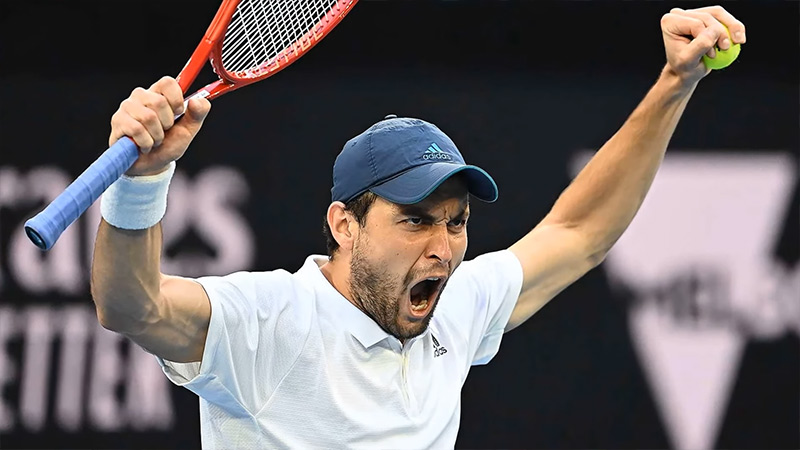
Aslan Karatsev is famous for his historic and unprecedented breakthrough at the 2021 Australian Open, where he became the first male player in the Open Era to reach a Grand Slam semifinal in his main draw debut.
At age 27, he emerged from a decade of obscurity on the lower-level Challenger circuit to reach a career-high world ranking of No. 14.
He is widely celebrated for his unique, ultra-aggressive playstyle, his stoic on-court personality, and his remarkably muscular calves, which turned him into an internet sensation known as “Lord Aslan” among a global fanbase.
How Did Aslan Karatsev Break Tennis Records in 2021?
The year 2021 marked a seismic shift in the landscape of professional tennis, and at the center of this eruption was a man who had spent his entire twenties struggling to break into the elite circle.
Before this turning point, he was a virtually unknown athlete. His entry into the Australian Open was not guaranteed; ranked No. 114 globally, he was forced to navigate the grueling qualifying rounds just to secure a spot in the main draw.
What followed was a “Cinderella run” that redefined the boundaries of what a debutant could achieve in the Open Era.
| Round | Opponent | Outcome |
|---|---|---|
| Qualifying | Multiple Players | Qualified for Main Draw |
| Round of 32 | Diego Schwartzman (Top Seed) | Karatsev Won |
| Round of 16 | Félix Auger-Aliassime | Karatsev Won |
| Quarterfinals | Grigor Dimitrov | Karatsev Won |
| Semifinals | Novak Djokovic | Djokovic Won |
A List of Aslan Karatsev’s Professional Achievements
While many players might have faded after a single deep run at a major tournament, Karatsev solidified his reputation by becoming a consistent threat on the ATP Tour.
He proved that his success in Melbourne was far from a fluke by amassing a collection of titles and medals over the subsequent twelve months.
His rise was so meteoric that it caught the attention of both fans and peers, leading to a surge in his professional standing and global recognition.
- Three ATP Singles Titles: He captured prestigious trophies at the Dubai Duty Free Tennis Championships (ATP 500), the Kremlin Cup in Moscow, and the Sydney Tennis Classic.
- Olympic Silver Medal: He achieved Olympic glory at the Tokyo 2020 Games, winning the silver medal in mixed doubles alongside Elena Vesnina.
- Davis Cup Champion: He was an integral part of the Russian squad that secured the Davis Cup team championship in 2021.
- ATP Most Improved Player: In a testament to his peers’ respect, he was voted the 2021 ATP Most Improved Player.
- Top 15 Ranking: He climbed from outside the top 250 to a peak world ranking of No. 14 in early 2022.
- Grand Slam Mixed Finalist: He reached the mixed doubles final at the 2021 French Open.
- ATP Doubles Title: He won the Qatar Open doubles trophy with Andrey Rublev.
Why is “Lord Aslan” Such a Cult Hero in Tennis?
The acclaim surrounding this Russian player goes far beyond his record-breaking statistics; it is anchored in a singular persona that has deeply resonated with modern sports culture.
Within the global tennis community, enthusiasts have embraced him with a unique devotion, often referring to him by prestigious nicknames like “Lord Aslan” or “King Aslan”.
This fascination was sparked by a combination of his remarkable physical conditioning—particularly his famously powerful physique—and a distinctive, high-octane playing style that has cultivated a legendary status few athletes ever achieve.
Through a mix of internet-famous physical traits and a fearless, “giant-killing” approach on the court, he has become a celebrated figure whose impact transcends the standard metrics of the sport.
The Iconic Muscular Calves and Internet Memes
One of the more lighthearted reasons for his widespread fame is his physical conditioning. He became an overnight internet sensation specifically for his extraordinarily muscular lower legs.
Fans across social media platforms created countless tributes and memes dedicated to his calves, which became a hallmark of his physical presence on the court.
This “calf-mania” helped humanize the stoic player and gave fans a unique way to engage with his journey, turning his physical traits into a recognizable brand within tennis subcultures.
A Stoic Demeanor Paired with Violent Power
What truly fascinates observers is the contrast between his temperament and his technique. On the court, he is known for a completely stoic and humble expression, rarely showing emotion even during high-stakes points.
However, this calm exterior hides a “ferocious” and “violent” power. He strikes the ball with incredible flatness from both wings, a style that often leaves even the best defenders in the world completely stationary as the ball zips past them.
This juxtaposition of a quiet personality and an explosive game made him one of the most exciting players to watch during his peak.
The Difficult Road: Injuries and Personal Sacrifices
Behind the glitz of Grand Slam semifinals and Olympic medals lies a narrative of profound hardship and resilience. His story is not just about tennis; it is about a decade-long struggle against obscurity and the physical limitations of the human body.
For many years, he was a “journeyman,” a term used for players who grind away in the lower-tier Challenger events without ever tasting mainstream success.
His breakthrough at age 27 served as a beacon of hope for millions, proving that success does not have a strict timeline.
Battling Chronic Knee Injuries and Retirement
The journey was nearly derailed multiple times by physical setbacks. Most notably, a devastating knee injury in 2017 threatened to end his career prematurely.
Battling chronic pain and the mental toll of being sidelined, he was on the brink of quitting the sport entirely.
The fact that he was able to return from such a low point and reach the top 15 in the world just a few years later is considered one of the most inspiring comeback stories in modern athletics.
Crossing Borders to Keep the Dream Alive
His resilience was also shaped by the sacrifices made by his family during his youth. Born in Vladikavkaz, his family moved to Israel when he was only three years old to seek better opportunities.
His father made immense personal sacrifices to fund his training, but the lack of local financial support eventually forced a difficult choice.
At age 12, he and his father moved back to Russia specifically to keep his tennis dreams alive. This history of relocation and sacrifice instilled in him a “lionhearted” spirit that would eventually define his professional legacy.
What is Aslan Karatsev’s Tennis Playstyle?
To understand his fame, one must analyze the technical brilliance that allowed him to dismantle top-tier opponents. His game is built on a foundation of high-risk, high-reward aggression that few players can replicate with such consistency.
By the time he reached the main stage, he had refined a style that was both aesthetically pleasing and brutally effective, allowing him to stand toe-to-toe with the legends of the sport.
The Art of Hitting Flat and Ferocious
Unlike many modern players who rely on heavy topspin to keep the ball in play, he is famous for hitting the ball with remarkable flatness.
This technique allows the ball to travel faster and stay lower after the bounce, making it incredibly difficult for opponents to time their returns.
When he is in “the zone,” his shots from both the forehand and backhand wings possess a raw power that can penetrate any defense. This “fearless” approach to hitting winners was a primary reason for his sudden rise through the rankings.
Tactical Aggression Against Elite Opponents
He earned the title of a “giant-killer” by refusing to be intimidated by the biggest names in the sport. One of his most famous victories occurred on the home soil of world No. 1 Novak Djokovic in Belgrade.
In an epic match, he demonstrated that his aggressive tactics could break down even the most impenetrable defensive walls.
He played with a level of confidence that suggested he belonged at the top, regardless of his previous years spent in the shadows of the Challenger circuit.
Frequently Asked Questions About Aslan Karatsev
What was Aslan Karatsev’s highest ranking?
His spectacular rise in late 2021 and early 2022 culminated in a career-high world ranking of No. 14, achieved in February 2022.
This was a massive leap for a player who, just a year prior, had been ranked outside the top 100 and had spent years struggling to break into the main tour.
Did Aslan Karatsev win an Olympic medal?
Yes, he is an Olympic medalist. He represented his country with distinction at the Tokyo 2020 Olympics, where he secured a silver medal in the mixed doubles category alongside partner Elena Vesnina.
This achievement is considered one of the highlights of his career and earned him formal state honors for his contribution to world sports.
Who did Karatsev beat at the 2021 Australian Open?
During his historic debut run in Melbourne, he defeated several highly-ranked and established players. His most notable victims included the eighth seed Diego Schwartzman, the rising star Félix Auger-Aliassime, and the experienced veteran Grigor Dimitrov.
These victories were significant because they showcased his ability to maintain high levels of play over five-set matches against world-class competition.
Why is he considered a symbol of hope?
He is viewed as an icon of perseverance because he achieved his greatest success much later than the average professional tennis player.
By spending his 20s “grinding” in lower-level events and overcoming career-threatening injuries, he proved to the athletic world that it is never too late to achieve one’s dreams. His story serves as a reminder that the path to success is rarely linear.
The Lasting Legacy of a Tennis Underdog
The story of “King Aslan” remains one of the most captivating chapters in recent tennis history.
While his time at the absolute pinnacle of the sport was relatively brief compared to some of his contemporaries—largely due to subsequent injuries—his impact remains indelible.
He is not merely remembered for the trophies he won, but for the way he won them: with a quiet dignity, a powerful game, and a refusal to be defined by his past struggles.
For those looking to draw inspiration from his journey, his rise serves as a blueprint for resilience. He transitioned from an unknown qualifier to a world-class champion through sheer force of will and an unwavering belief in his talent.
Whether he is being celebrated for his legendary calves or his “giant-killing” forehands, he will forever be etched into the record books as the man who turned the tennis world upside down in 2021.
His legacy continues to inspire those still struggling in the shadows of their own respective fields, proving that the breakthrough of a lifetime could be just one tournament away.