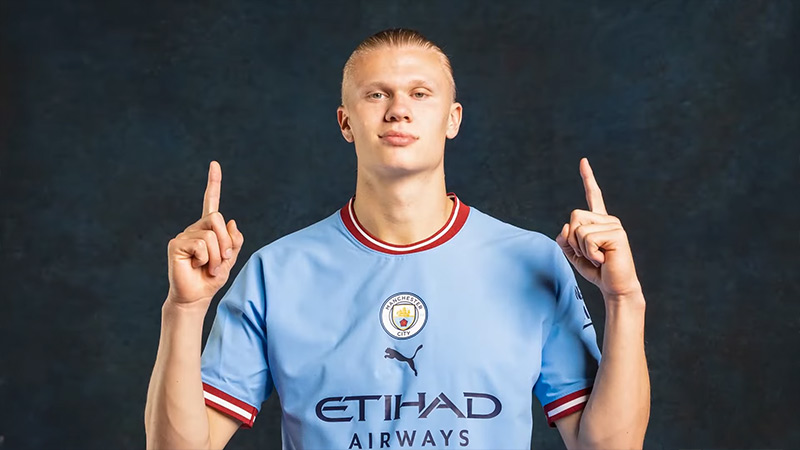
The summer of 2022 will be remembered as one of the most pivotal transfer windows in modern football history.
At the center of the storm was Erling Haaland, the Norwegian powerhouse who had outgrown Borussia Dortmund and was ready to inherit the mantle of the world’s most lethal striker.
While every elite club in Europe clamored for his signature, the race eventually narrowed down to two behemoths: Manchester City and Real Madrid.
To the casual observer, the allure of the Santiago Bernabéu and the “Galactico” legacy seemed insurmountable.
Yet, Haaland ultimately chose the blue half of Manchester. This decision was not a rejection of prestige, but a calculated, data-driven choice based on tactical necessity, financial focus, and medical caution.
Here is the deep dive into the four primary reasons why Erling Haaland did not join Real Madrid in 2022.
The “Points System”: A Scientific Approach to Career Planning
Unlike many players who choose clubs based on emotion or childhood dreams, the Haaland camp—led by his father, Alfie Haaland—approached the transfer with the clinical precision of a laboratory experiment.
In the documentary Haaland: The Choice, it was revealed that they utilized an objective scoring system to rank potential destinations.
Why Manchester City Scored 10/10
The most critical metric in this system was the “immediate need” for a striker. Following the departure of the legendary Sergio Agüero, Manchester City had spent a season playing primarily with a “false nine” system.
While successful, the team lacked a natural focal point for their attack. Consequently, the Haaland camp gave City a perfect 10/10 score because the squad essentially had a Haaland-shaped hole waiting to be filled.
Why Real Madrid Scored 5/10
In stark contrast, Real Madrid’s score was significantly lower, hovering around a 5/10 or 6/10. The reason was simple: Karim Benzema.
At the time, the French striker was in the midst of what would become a Ballon d’Or-winning season, playing the best football of his career. Benzema was the undisputed leader of the line, and there was no logical sporting reason to displace him.
Florentino Pérez, Real Madrid’s president, later echoed this sentiment, making it clear that the club would not sign a player of Haaland’s stature simply to have him sit on the bench while Benzema occupied the starting role.
The Mbappé Priority: A Strategic and Financial Pivot
During that same 2022 window, Real Madrid’s hierarchy was famously preoccupied with another generational talent: Kylian Mbappé. This “Mbappé-first” strategy created two significant hurdles for a potential Haaland deal.
Financial Concentration
The pursuit of Mbappé was an expensive endeavor. Real Madrid had centered their entire financial planning on the Frenchman, making it difficult to justify a simultaneous, massive financial outlay for Haaland.
Signing both would have required paying two sets of astronomical transfer fees, agent commissions, and wages, which could have stretched even Madrid’s formidable resources to the limit.
Maintaining the “Humble” Ecosystem
Beyond the balance sheet, there was a concern regarding the squad ecosystem. Real Madrid’s management reportedly feared that introducing two “Galactico” personalities—Mbappé and Haaland—in a single window could disrupt the “humble” and harmonious atmosphere of the dressing room.
The club directors preferred a more measured approach to squad building rather than a dual-superstar explosion.
The Medical Dossier: Caution Over Dortmund Injuries
One of the less-discussed but highly influential factors in Real Madrid’s hesitation involved Haaland’s medical history. While his goal-scoring record at Borussia Dortmund was undeniable, so too was his time spent on the treatment table.
Real Madrid reportedly conducted a thorough analysis of Haaland’s fitness during his final year in Germany. They were particularly wary of his repeated muscular problems, which had sidelined him for roughly three months during the 2021-22 season.
Given the high intensity of the Spanish league and the demands of Real Madrid’s schedule, the club’s medical and scouting staff were cautious about committing such a high investment to a player who showed early signs of physical fragility.
Tactical Evolution: The Quest for the “Service-Rich” Environment
Finally, Haaland’s decision was heavily influenced by the sporting project and the tactical framework of his future team. He wasn’t just looking for a famous shirt; he was looking for a system that would maximize his unique skill set.
The Guardiola Influence
While Haaland has stated that he rarely chooses a club solely based on the manager, the prospect of playing under Pep Guardiola was viewed as a major developmental advantage.
He saw an opportunity to refine his technical game under one of history’s greatest tactical minds.
Guaranteed Service
Haaland’s primary objective was to find a “service-rich” environment. He sought a team that dominated possession and created a high volume of scoring chances.
Manchester City’s relentless, possession-based style offered a guarantee of constant supply from world-class creators like Kevin De Bruyne, which Haaland believed would allow him to reach his maximum goal-scoring potential.
Conclusion: A Masterclass in Career Management
In the end, Erling Haaland didn’t join Real Madrid not because he lacked the quality, but because the timing and the circumstances were not aligned.
Manchester City offered a vacancy that needed filling, a tactical system designed for a striker, and a clear path to becoming the face of the Premier League.
Real Madrid’s focus on Mbappé, their loyalty to an in-form Benzema, and their concerns over Haaland’s injury record meant that the move simply didn’t make sense for either party in 2022.
By following a scientific “Points System” rather than following the bright lights of Madrid, Haaland secured a move that has already resulted in historic goal-scoring records and a Treble-winning debut season.