The offensive structures of professional football have undergone significant schematic shifts, yet few positions illustrate this tactical evolution more clearly than the fullback.
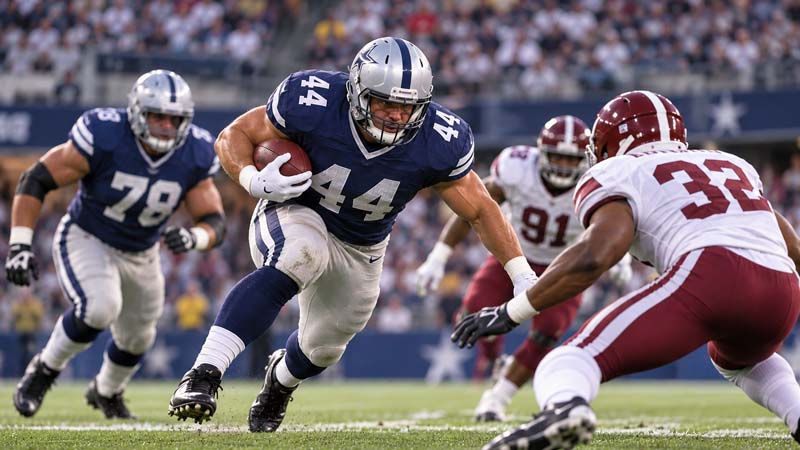
Historically a cornerstone of ground-oriented offenses, the fullback is defined as a heavy, physical offensive backfield player whose main job is to block for the running back and protect the quarterback.
In an era dominated by high-tempo passing systems, the survival of this position relies on a unique combination of brute physical force and modern schematic versatility.
To understand the value of this position, one must analyze the diverse mechanics of their assignments, their role in pass protection, their deployment in high-stakes short-yardage scenarios, and the structural reasons why their presence on modern rosters has become highly specialized.
The Anatomy of a Physical Force
At its core, the fullback position demands a highly specialized physical profile. Operating as a heavy, physical offensive backfield player, the fullback must possess the mass and structural density required to absorb and deliver high-velocity impacts on every snap.
Unlike the halfback, whose role prioritizes lateral agility, acceleration, and open-field speed, the fullback is built for interior leverage and head-on collisions.
The primary objective of this physical archetype is dual-purpose: creating forward momentum for the running game and establishing a physical barrier for the passing game.
This requires a player who can operate in confined spaces, quickly diagnose defensive fronts, and execute highly physical blocks against defenders who are often significantly larger.
The fullback is the interior engine of a physical offense, translating mass and leverage into space for the ball carrier.
The Tactical Mechanics of Lead Blocking
The most prominent assignment for any fullback is executing the lead block. Mechanically, the fullback’s job is to make sure there is a hole for the running back to run into.
This assignment requires the fullback to act as a physical spearhead, entering the line of scrimmage ahead of the primary ball carrier to clear out linebackers and defensive linemen.
[Offensive Line]  -->  Engages Defensive Line
       ^
[Fullback]        -->  Enters Gap / Clears Linebackers & Penetrating Linemen
       ^
[Running Back]    -->  Follows Fullback into the Created Hole
Clearing the Second Level
To successfully clear out linebackers, the fullback must exhibit exceptional spatial awareness. Linebackers are trained to flow quickly to the ball and fill open gaps in the defensive front. The fullback must:
- Identify the active defensive gap immediately upon the snap.
- Accelerate directly toward the targeted linebacker or defensive lineman.
- Maintain low pad level to win the leverage battle at the point of contact.
- Deliver a powerful strike that displaces the defender, creating a clear pathway or “hole” for the trailing running back to exploit.
Without this precise physical clearance, interior run plays are highly susceptible to early penetration by the defense. By neutralizing second-level defenders, the fullback directly determines the efficiency and consistency of the ground attack.
Backfield Protection and Pocket Integrity
While run blocking is highly visible, protecting the quarterback is an equally vital responsibility. During passing plays, the fullback acts as an interior shield, staying in the backfield to block rushing defenders and protect the quarterback from immediate pressure.
Neutralizing the Blitz
Modern defensive coordinators frequently utilize blitz packages to disrupt passing plays. These schemes send extra linebackers or defensive backs through interior gaps to overwhelm the offensive line. The fullback is the primary countermeasure against these strategies:
- Identification: The fullback must scan the defensive alignment pre-snap and diagnose potential blitzers.
- Positioning: By staying deep in the backfield, the fullback maintains a tactical vantage point to intercept free-running defenders.
- Execution: When a blitzer penetrates the line, the fullback must step up, absorb the rush, and maintain a firm block to prevent the pocket from collapsing.
By picking up blitzers during passes, the fullback provides the quarterback with the critical seconds needed to scan downfield and deliver accurate passes.
This protection role is essential for maintaining pocket integrity and preventing negative plays, such as sacks or forced turnovers.
High-Stakes Situations: Short-Yardage and Goal-Line Execution
In football, certain downs carry disproportionate strategic weight. On third or fourth down with minimal distance to gain, or when operating near the opponent’s goal line, offenses require high-probability plays.
In these critical moments, the fullback becomes a primary strategic asset, occasionally carrying the ball in short-yardage situations.
When a team needs a crucial first down or touchdown, the fullback is called upon to plunge forward for one or two yards.
Goal Line / First Down Marker
-------------------------------------------------- [Line of Scrimmage]
   ^  ^  ^  ^  ^
   [Fullback Plunge] --> Direct, high-impact run for 1-2 yards
This specific play style differs significantly from standard rushing attempts:
- Direct Pathing: The fullback does not search for lateral bounce lanes; instead, they take a direct, vertical path into the heart of the defensive line.
- Leverage Utilization: The fullback uses their heavy, physical build to lower their center of gravity, driving through interior defenders.
- Second-Effort Yards: Because these running lanes are highly congested, the fullback must rely on continuous leg drive to squeeze out the final one or two yards required to sustain the drive or score.
This capability makes the fullback a highly dependable short-yardage weapon, offering a physical option when finesse plays are tactically unviable.
The Passing Game: Serving as the Safety Valve
In addition to blocking and short-yardage rushing, the fullback serves a vital role in the passing game by catching passes out of the backfield. Specifically, they function as short, reliable safety-valve targets for the quarterback.
The Mechanics of the Safety-Valve
When an offensive play design calls for deeper downfield routes, defensive coverages often drop deep to protect the secondary. This spatial distribution leaves the short undercard zones vacant.
- The Release: After executing a brief check-block or delayed release, the fullback leaks out into the flat or short middle of the field.
- The Outlet: If the quarterback finds their primary downfield receivers tightly covered, or if the pass rush begins to close in, they can quickly check the ball down to the fullback.
- The Result: Because the fullback is a heavy, physical player, catching these short passes often allows them to turn upfield and break tackles, converting a potential sack into a positive gain and keeping the offense on schedule.
This multi-dimensional threat ensures that defenses cannot simply ignore the fullback in passing situations, forcing them to dedicate coverage resources to the shallow zones of the field.
The Structural Decline of the Position
Despite the clear utility of these responsibilities, the fullback has seen a significant shift in usage across the modern professional landscape.
Today, the fullback is far less common on roster sheets than in previous decades. This decline is driven by structural shifts in offensive philosophy.
The Shift from the I-Formation
Traditionally, professional offenses relied heavily on the I-formation, a system where the fullback lined up directly between the quarterback and the halfback. This structure was designed to establish a direct, physical running game. However, modern teams have largely transitioned away from these traditional alignments:
- The Rise of Spread Formations: Modern offensive coordinators prioritize horizontal spacing, using multiple wide receivers to stretch the defense from sideline to sideline.
- Single-Back Sets: By utilizing single-back sets, teams can deploy an extra receiver or pass-catching tight end, maximizing their vertical passing capabilities.
- Roster Efficiency: In a league focused on high-scoring, passing-oriented attacks, many franchises choose to allocate their limited roster spots to faster, more specialized receiving threats rather than a traditional, block-first fullback.
This evolution has made the traditional, single-dimensional fullback a rarity in the modern league.
The Formula for Survival: High Versatility
For the fullback position to persist in the modern era, players must adapt. The remaining fullbacks who successfully maintain active roles on professional rosters do so by offering high versatility across multiple phases of the game. They can no longer survive solely as lead blockers; they must be dynamic contributors.
The Modern Multi-Tool
The modern fullback archetype is exemplified by elite performers, such as the star fullback of the San Francisco 49ers. To justify their roster presence, these players must deliver elite value in several key areas:
| Area of Contribution | Tactical Execution |
|---|---|
| Elite Lead Blocking | Clearing running lanes for halfbacks by neutralizing linebackers and defensive linemen. |
| Dynamic Receiving | Running diverse route trees and serving as highly reliable safety-valve targets out of the backfield. |
| Special Teams Contributions | Utilizing their physical size and open-field tackling ability to cover punts and kickoffs. |
By combining these diverse skill sets, the modern fullback allows offensive coordinators to remain unpredictable.
When a versatile fullback is on the field, the defense cannot easily deduce whether the play will be a heavy run, a spread pass, or a short-yardage plunge.
This versatility transforms the fullback from a relic of the past into a highly sophisticated modern weapon.
Conclusion
The fullback position is not extinct; rather, it has undergone a profound evolutionary refinement. Once a standard requirement for every professional offense, the fullback has transitioned into a highly specialized strategic weapon.
While spread formations and single-back sets have made the position less common, the franchises that continue to utilize the fullback do so to achieve a high degree of physical superiority and tactical unpredictability.
By mastering the physical demands of lead blocking, executing disciplined pass protection, delivering in critical short-yardage situations, and showing elite versatility as receivers and special teams contributors, the modern fullback continues to prove that physical toughness and schematic adaptability are timeless assets on the gridiron.