In the modern landscape of professional sports, where the margin between victory and defeat is often measured in millimeters and milliseconds, the quest for the ultimate competitive advantage has led to some of the most creative—and occasionally absurd—discussions in fandom.
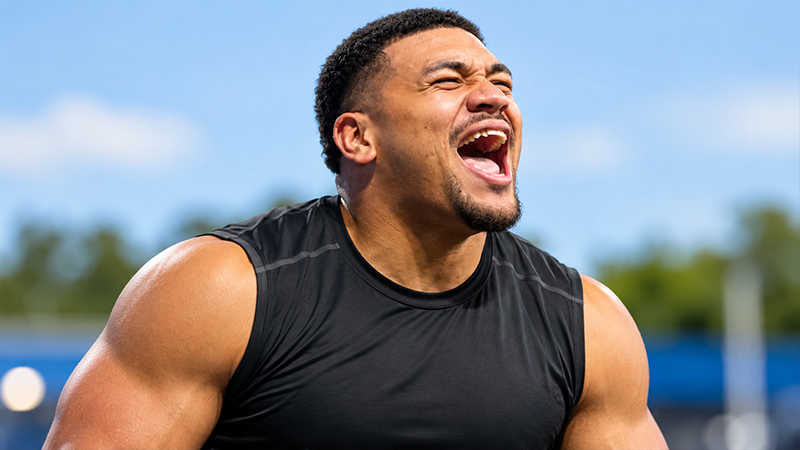
Within the passionate ecosystem of Detroit Lions supporters, a recurring thought experiment has emerged that challenges the boundaries of both sports strategy and biological science: Why don’t we just clone Penei Sewell?
While the suggestion often surfaces in digital forums with a touch of humor, it masks a profound truth about the current state of the Detroit Lions franchise.
Penei Sewell is not merely an offensive tackle; he is the literal and figurative “building block” upon which a championship culture is being constructed.
This analysis explores the hypothetical dominance of a Sewell-cloned roster, the insurmountable scientific barriers to such an endeavor, and why the singular nature of his talent makes him the most valuable asset in professional football today.
The Dominance of an All-Sewell Front
The primary driver behind the “Sewell Clone” theory is the sheer physical and technical dominance the young tackle displays on a weekly basis.
In the 2025 season alone, Sewell recorded the lowest blown block percentage in the league, a testament to his unerring consistency.
Furthermore, his track record includes a staggering streak of 586 straight pass blocks without allowing a single sack.
From a strategic standpoint, an offensive line comprised entirely of Penei Sewell clones would fundamentally break the game of football as we know it. The theoretical advantages are twofold:
1. Absolute Pocket Integrity and Time of Possession
An offensive line of five Sewells would provide Jared Goff with a level of protection never before seen in the history of the NFL. This “wall” would effectively grant the quarterback “all day to throw,” neutralizing even the most elite pass rushes.
More importantly, the dominance in the run game would allow the Lions to control the clock with surgical precision.
By consistently winning the battle at the line of scrimmage, a team of Sewells could effectively dictate the tempo, leading to a “complete surrender of the opposing defense by the second quarter” due to sheer physical exhaustion.
2. The “Guaranteed Ten” and the Evolution of the Tush Push
Fans have theorized that a roster featuring Sewell at every position—including quarterback and running back—would make traditional punting obsolete.
The concept of the “Tush Push” takes on a new dimension when the person being pushed, the person doing the pushing, and the entire line in front of them all possess Sewell’s 330-pound frame and elite athleticism.
In this scenario, gaining 10 yards on every play becomes a mathematical probability rather than a hope. This strategy would trade traditional explosiveness for an unstoppable, grinding momentum that forces the defense into a state of perpetual retreat.
The “Grand Army of the Detroit Lions”: Multi-Position Versatility
The allure of the Sewell clone extends beyond the offensive line. His “rare mix of size, sixth-sense instincts, and elite athleticism” suggests that a clone could successfully occupy almost any position on the field.
- Defensive Dominance: On the other side of the ball, a Sewell clone could be deployed as an interior defensive lineman to collapse the pocket or even as an Inside Linebacker (ILB) to stifle the run. Some have even suggested that his lateral quickness and recovery speed could allow a clone to “lock down a #1 receiver on the outside”.
- Utility and Special Teams: The hypothetical “Grand Army of the Detroit Lions” would see Sewell acting as tight ends, fullbacks, and even special teams contributors. The image of a 330-pound elite athlete “kicking a PAT after gaining 70 all-purpose yards in one drive” highlights the absurdity—and the terrifying potential—of his physical profile.
The Biological and Temporal Reality Gap
Despite the strategic perfection such a roster would offer, the “Sewell Solution” remains firmly in the realm of science fiction. The barriers to creating a “penni dish” capable of growing an elite offensive line are both scientific and legal.
The “Baby Problem” and the Luxury of Time
The most immediate hurdle in the cloning debate is the reality of human development. As pointed out by more grounded observers, a clone of Penei Sewell would not emerge from the lab as a 24-year-old All-Pro tackle; it would be an infant.
“No GM or HC has this kind of time,” as the window for NFL success is far shorter than the twenty years required to raise a clone to playing age.
Even with “Miracle Grow,” the biological constraints of human aging cannot be bypassed to meet the demands of a standard NFL draft cycle.
The Science and Ethics of Replication
From a technical standpoint, biological cloning is currently impossible for adult humans. While the technology to clone smaller mammals has existed for decades, the complexity of human biology—and specifically the replication of “generational talent”—remains out of reach.
Furthermore, human cloning is strictly banned by major ethical and scientific laws globally, making it a non-starter for any professional sports organization.
The NFL Regulatory Framework
Even if the scientific hurdles were cleared, the league’s governing documents provide a secondary wall. The NFL draft and roster rules specifically limit teams to “standard human players” on a 53-man roster.
The introduction of genetically engineered or cloned athletes would likely trigger a constitutional crisis within the league, leading to immediate bans or the disqualification of the franchise involved.
The Unclonable Intangibles: Instincts, Leadership, and Soul
Perhaps the most significant argument against cloning is the idea that Penei Sewell is more than the sum of his DNA.
There is a “sixth-sense” instinct for the game that Sewell possesses—a way of reading defensive alignments and reacting to blitzes—that is the result of years of high-level experience and personal dedication.
The Seamless Transition
Sewell’s ability to move between positions is a prime example of this intangible brilliance. When the Lions discussed moving him from Right Tackle to Left Tackle, Head Coach Dan Campbell described the potential transition as “seamless”.
This isn’t just about footwork; it’s about a deep, innate understanding of the geometry of the football field.
While a clone might share his wingspan and power, it would not automatically inherit the thousands of hours of film study and the “building block” mentality that Sewell has cultivated since his 2021 draft day.
Leadership in the Trenches
Since his arrival, Sewell has moved beyond being a top-tier performer to becoming the de facto leader of the offensive line position group.
Leadership is a social and psychological trait, forged in the heat of competition and through the building of trust with teammates like Jared Goff and Amon-Ra St. Brown.
A line of clones might lack the diverse personalities and collective chemistry required to navigate the emotional highs and lows of an NFL season.
Maximizing the Singular Asset: The “One Sewell” Strategy
Since the Detroit Lions cannot clone their star tackle, the organization has focused on the next best thing: maximizing the impact of the one they have.
This involves a sophisticated approach to roster management and financial planning that treats Sewell as the cornerstone of the entire operation.
Financial Engineering and Cap Management
The Lions’ front office has demonstrated elite-level proficiency in managing Sewell’s value off the field. By restructuring the contracts of Sewell and Amon-Ra St. Brown, the team recently created over $38 million in cap space.
This maneuver—second in the league only to the San Francisco 49ers—allows the team to surround their “unclonable” tackle with other high-level talents, effectively “cloning” his impact by enabling the acquisition of more elite players.
The Competitive Edge of Certainty
In a league defined by parity, having a player who consistently ranks in the Top 100 (moving from #13 in 2025 to #37 in 2026) provides a level of organizational certainty that is rare.
This certainty allows the coaching staff to be more aggressive in their play-calling, knowing that the blind side—or the right side—is essentially a “no-fly zone” for defenders.
The Cultural Legacy of the Building Block
The “cloning” conversation, while whimsical, serves as a high-water mark for fan appreciation. It signifies that the Detroit Lions have found a player so transcendent that the only perceived way to improve the team is to have more of him.
Sewell’s impact is visible in the way the city of Detroit has embraced the team’s “blue-collar” identity. He represents the “turnaround” that was promised during that initial draft day call.
Whether he is playing Left Tackle or Right Tackle, his presence ensures that the Lions remain Back-to-Back NFC North Champs and a perennial Super Bowl contender.
Ultimately, the paradox of the Penei Sewell clone army is that we don’t actually need eleven of him. The presence of just one elite, focused, and dedicated Penei Sewell has been enough to transform the trajectory of a franchise that was once searching for an identity. He is the “building block” that has proven strong enough to carry the weight of a city’s championship aspirations.
Closing Thoughts
While we may never see a “Grand Army of the Detroit Lions” marching down the field in synchronized Penei Sewell jerseys, the lesson of this thought experiment is clear: uniqueness is the ultimate currency in the NFL.
The combination of Sewell’s physical gifts, his 586-block sack-less streak, and his seamless leadership cannot be manufactured in a lab. It must be found, drafted, and nurtured. The Lions did exactly that in 2021, and the dividends continue to compound.
In the end, perhaps there should be only one Penei Sewell—it makes the moments where he dominates the line of scrimmage, or catches a “big man TD,” feel all the more like a rare, unrepeatable miracle of the sport.