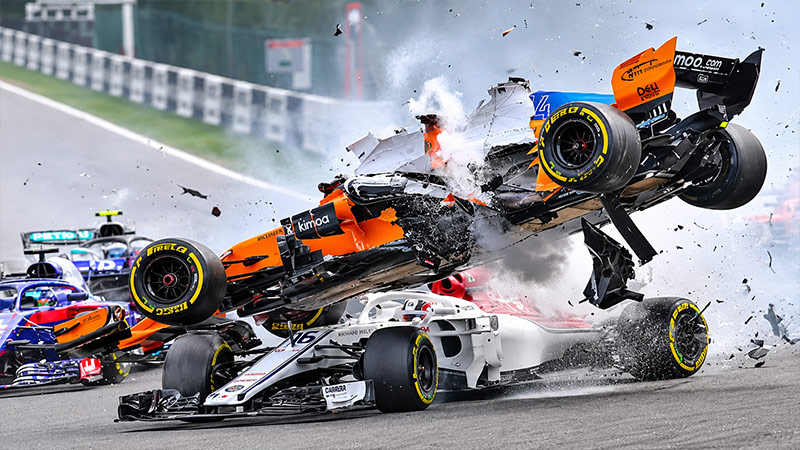
On 29 November 2020, Romain Grosjean’s Haas speared through a steel barrier on the opening lap of the Bahrain Grand Prix. The car split in two and erupted into a fireball. The impact peaked at 67G, roughly 67 times the force of gravity.
About half a minute later, Grosjean climbed out of the flames with burned hands and a damaged foot. Only a few years earlier, before the titanium halo became mandatory, that same crash would very likely have been fatal.
That image captures the central paradox of Formula 1. The sport has never been safer, yet it still asks human beings to race at more than 330 km/h, centimetres from concrete walls and 19 rivals. So how dangerous is Formula 1 today?
Is Formula 1 Still Dangerous? The Short Answer
Yes. Formula 1 remains one of the most dangerous professional sports on the planet, but the nature of that danger has changed completely. In the 1950s, 1960s and 1970s, a driver dying during a season was a grim expectation rather than a shock.
Today, death is rare and serious injury is uncommon. Between Ayrton Senna’s fatal crash at Imola in 1994 and Jules Bianchi’s accident at Suzuka in 2014, no Formula 1 driver died from injuries suffered at a Grand Prix weekend. That 20-year gap would have been unthinkable to the generation that raced before it.
Yet the risk has never gone away. In March 2026, Haas driver Oliver Bearman arrived at Suzuka’s Spoon Curve with a huge closing speed on Franco Colapinto’s Alpine. He swerved onto the grass, skated back across the track and slammed sideways into a barrier, limping away with an injured right ankle.
The honest verdict is this: Formula 1 has turned a fatal risk into a managed risk. Every lap is still a negotiation with physics, and the margin for error is measured in centimetres and milliseconds.
The Physics of Risk: Why Speed Is Only Half the Story
Top speed grabs the headlines, but energy is what kills. The kinetic energy of a moving car rises with the square of its speed, so doubling the speed quadruples the energy a crash must absorb.
Consider an 800 kg Formula 1 car travelling at 300 km/h. It carries roughly 2.8 megajoules of energy. Stopping it instantly is like dropping the same car from more than 350 metres, higher than the Eiffel Tower.
The forces a driver handles on a normal lap are almost as striking:
| Factor | Typical figure | What it means for the driver |
|---|---|---|
| Top speed | Over 330 km/h on long straights | Less than a second to react to debris or a stranded car |
| Braking load | 5G or more | The body is thrown forward against the harness at five times its weight |
| Cornering load | 4 to 6G in fast corners | Head and helmet, about 7 kg, can feel heavier than 30 kg |
| Heart rate | 160 to 190 beats per minute | Close to a marathon runner’s effort, sustained for up to two hours |
| Crash impact | Peaks above 50G in major accidents | Grosjean hit 67G in Bahrain 2020; Max Verstappen hit 51G at Silverstone in 2021 |
Those crash numbers are survivable only because they last a fraction of a second, and because modern cars are designed to spread the deceleration across crumpling structures rather than the driver’s body. Remove that engineering and the same physics becomes lethal.
A History Written in Tragedy
Formula 1’s safety culture was built on loss. From the first world championship in 1950 to the mid-1990s, dozens of drivers died at race weekends and tests, and many more were badly hurt.
For years, the attitude inside the paddock was fatalistic. That began to change after Jackie Stewart crashed at Spa in 1966 and lay trapped in his car, soaked in fuel, with no proper medical help nearby. He spent the rest of his career campaigning for barriers, medical centres and better protective gear, often against fierce resistance.
The accidents below each reshaped the sport:
| Year | Driver | Event | What happened | What changed |
|---|---|---|---|---|
| 2014 | Jules Bianchi | Japanese GP, Suzuka | Struck a recovery crane in heavy rain; died nine months later | Virtual Safety Car from 2015 and fresh momentum for head protection |
| 1994 | Roland Ratzenberger and Ayrton Senna | San Marino GP, Imola | Two fatal crashes on consecutive days | Circuits reshaped, crash tests tightened, cockpit sides raised |
| 1977 | Tom Pryce | South African GP, Kyalami | Struck a marshal crossing the track; both men died | Stricter rules on marshals entering a live track |
| 1973 | Roger Williamson | Dutch GP, Zandvoort | Trapped in a burning car while marshals lacked fireproof kit | Better fire training and equipment for trackside crews |
| 1961 | Wolfgang von Trips | Italian GP, Monza | His car flew into the crowd, killing 15 spectators | Greater separation between fans and the track |
The danger also persists on the ladder below Formula 1. Formula 2 driver Anthoine Hubert was killed at Spa in 2019, and Dilano van ‘t Hoff died at the same circuit in a Formula Regional race in 2023. Both tragedies are reminders that the same physics applies at every level.
The Hidden Dangers Nobody Sees on Television
Crashes are the visible danger. The quieter threats build up lap after lap, and they can trigger the mistake that causes a crash.
Heat and dehydration
Cockpit temperatures can climb above 40°C, and drivers wear several fireproof layers, gloves and a sealed helmet. In hot races they can lose up to 3 kg of body fluid.
At the 2023 Qatar Grand Prix, Logan Sargeant retired feeling unwell, Esteban Ocon was sick inside his helmet and Lance Stroll said he nearly blacked out.
That race led the FIA to create a heat hazard rule for 2025. When the forecast heat index tops 31°C, every car must carry a driver cooling system that pumps chilled liquid through a vest. Drivers who skip the vest must carry about 5 kg of ballast instead, so nobody gains a weight advantage.
Neck strain and concussion
Repeated 5G loads punish the neck, which is why drivers train it obsessively. Heavy impacts also carry concussion risk, so drivers face mandatory medical checks after big crashes before they can race again.
Mental fatigue
A Grand Prix demands near-perfect concentration for up to two hours. A single lapse at 300 km/h can end a race, or worse. Fatigue is the invisible link between physical strain and the accidents fans see on screen.
Beyond the Cockpit: Marshals, Mechanics and Fans
Drivers accept the risk knowingly. The people around them often face danger with far less protection.
Marshals
Trackside volunteers are the sport’s unsung heroes. Paolo Gislimberti was killed by a flying wheel at Monza in 2000, and Graham Beveridge died the same way in Melbourne in 2001. In 2013, Mark Robinson was struck by a recovery vehicle in Montreal. These deaths drove stronger wheel tethers and stricter recovery procedures.
Pit crews
The pit lane is a workplace where cars arrive at speed and leave in under three seconds. A pit lane speed limit arrived in 1994 after mechanics were hit at Imola. Mid-race refuelling, which caused frightening fires, was banned from 2010. Even so, a Ferrari mechanic suffered a broken leg in Bahrain in 2018 when Kimi Räikkönen’s car was released too early.
Spectators
Modern circuits use tall debris fencing and wide run-off areas to keep fans clear of the action. That separation was paid for in blood, most painfully at Monza in 1961.
The Safety Revolution: How Engineering Fought Back
Modern Formula 1 safety is not one invention but a layered system. Each layer exists because an earlier accident exposed a gap.
| Year | Innovation | How it protects |
|---|---|---|
| 2018 | Halo | A titanium arch over the cockpit that withstands a load of about 12 tonnes, deflecting cars, wheels and barriers away from the driver’s head |
| 2015 | Virtual Safety Car | Forces every driver to slow to a controlled pace while marshals work, without bunching the field |
| 2003 | HANS device | Tethers the helmet to the shoulders, cutting the violent head whip that causes neck and skull injuries |
| 1999 | Wheel tethers | High-strength cables that keep wheels attached to the car in a crash |
| 1996 | Raised cockpit sides | Padded walls around the driver’s head that absorb side impacts |
| 1981 | Carbon-fibre chassis | A rigid, lightweight survival cell that resists crushing far better than aluminium |
| 1978 | Dedicated medical team | Professor Sid Watkins built a system of trackside medics, a medical car and circuit medical centres |
The halo was mocked by some fans and drivers when it arrived. It has since been credited with saving Grosjean in Bahrain in 2020, Lewis Hamilton when Max Verstappen’s car landed on top of him at Monza in 2021, and Zhou Guanyu after his car flipped and slid upside down at Silverstone in 2022.
Around these headline features sit dozens of quieter safeguards. Every chassis must pass strict FIA crash and load tests before it can race. Drivers must prove they can escape the cockpit quickly. Fireproof suits, energy-absorbing barriers and wide run-off areas complete the picture.
The 2026 Era: New Cars, New Questions
The 2026 season brought the biggest rule change in a generation. The cars are narrower, with a 1,900 mm width and a 3,400 mm wheelbase, and draw almost half their power from electrical energy.
The FIA used the reset to raise safety standards again:
- Stronger roll hoop. The hoop behind the driver’s head must now withstand 20G instead of 16G, a direct response to Zhou’s crash at Silverstone, where his roll hoop failed.
- Better side protection. Intrusion protection around the cockpit is stronger, and protection along the side of the fuel cell is more than doubled.
- Two-stage nose. A new front impact structure is designed to absorb a second hit after the first collision.
- Side safety lights. Cars now carry lateral lights that must glow in wet conditions, helping drivers spot rivals in spray.
New machines also create new risks. The 2026 power units harvest and deploy energy in very different ways, which can leave one car far faster than the car ahead. Haas boss Ayao Komatsu blamed a huge closing speed for Bearman’s Suzuka crash, and several drivers have openly criticised how the new cars race.
This is how Formula 1 safety has always evolved. Engineers solve one problem, a new design exposes another, and the cycle begins again.
Why the Danger Will Never Fully Disappear
Speed is the product Formula 1 sells, and speed always carries risk. Several factors guarantee that no rulebook can reduce it to zero:
- Street circuits. Tracks such as Monaco, Baku, Singapore and Las Vegas place concrete walls just metres from the racing line, with little run-off.
- Weather. Rain cuts grip and visibility in seconds, as Bianchi’s crash in Suzuka tragically showed.
- Freak accidents. In 2009, Felipe Massa suffered a fractured skull in Hungary when a loose spring from another car struck his helmet.
- Human error. Drivers are elite athletes, but they still misjudge gaps, braking points and closing speeds.
- Mechanical failure. A broken wing, suspension arm or brake can turn a routine corner into a crash.
Every pass and ticket still carries the same blunt warning: motorsport is dangerous. That line is not a legal formality. It is an honest statement of what makes the sport both thrilling and serious.
Conclusion
So, how dangerous is Formula 1? It is far less deadly than it was, but it is still dangerous. Drivers race at more than 330 km/h, absorb forces that would floor most people and survive crashes that once killed.
They do so because of the halo, carbon-fibre survival cells, the HANS device and decades of hard lessons.
Yet heat, fatigue, closing speeds and sheer chance mean the risk can never reach zero. Marshals, mechanics and fans share part of that exposure.
The real achievement of modern Formula 1 is not eliminating danger but managing it with relentless discipline. Respect that balance, and every Grand Prix becomes more than a race. It becomes a test of human courage and engineering brilliance.