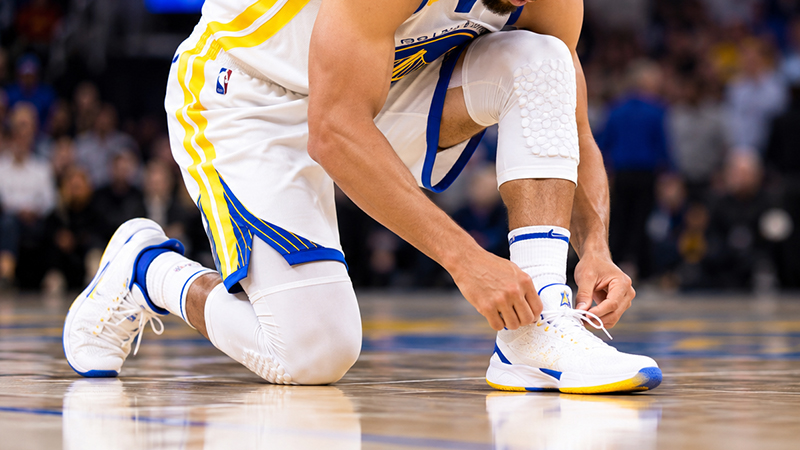
In the high-stakes environment of professional basketball, success is often determined by a series of micro-actions that occur in the split seconds between a crossover and a jump shot.
Among these, few gestures are as ubiquitous—or as frequently misunderstood by casual observers—as the act of a player reaching down to wipe the soles of their sneakers.
To the uninitiated, it may appear to be a nervous habit or a meaningless tic. However, a rigorous analysis of athletic performance, biomechanics, and court physics reveals that this gesture is a fundamental component of a player’s safety and performance strategy.
This analysis explores the technical, psychological, and physiological drivers behind why basketball players touch their shoes, examining how this simple routine mitigates risk and optimizes execution on the hardwood.
The Physics of Friction: Restoring Traction on the Hardwood
The primary driver behind the shoe-wipe ritual is the immediate restoration of traction. In a sport defined by explosive lateral movements, sudden stops, and rapid acceleration, the relationship between the rubber outsole of the sneaker and the polished wood of the court is the most critical link in a player’s physical chain.
The Accumulation of Debris
Indoor basketball courts, regardless of how meticulously they are maintained, are magnets for microscopic debris. Fine particles of dust, lint, and dried perspiration naturally settle on the floor over the course of a game.
As players move across the surface, the heat generated by the friction of their movement causes the rubber soles to become slightly more pliable and “tacky.” While this tackiness is essential for grip, it also acts as an adhesive for the dust present on the court.
Within minutes of play, a thin, slick layer of dust can coat the bottom of a sneaker, effectively acting as a lubricant between the shoe and the floor. This coating drastically reduces the coefficient of friction, leading to “slippage,” which can be catastrophic during high-intensity maneuvers.
The Restoration of “Tack”
When a player wipes the sole of their shoe with a moist or sweaty palm, they are performing a quick-response maintenance task. The moisture from the hand helps to break the bond between the dust and the rubber, while the physical motion of the hand clears away the debris.
This process exposes the clean rubber underneath, restoring its natural tackiness and ensuring that the player can pivot and cut with maximum reliability.
Biomechanics and Injury Prevention: The Safety Imperative
Beyond performance, the habit of touching shoe soles is a vital safety protocol. Basketball is a sport characterized by extreme torque and lateral stress on the lower extremities.
Mitigating Joint Stress
When a player attempts a “hard cut”—a sudden change of direction—their entire body weight, multiplied by the force of their acceleration, is transferred through their ankles and knees.
If the shoe fails to grip the floor due to dust accumulation, the foot may slide unexpectedly. This lack of predictable traction often leads to non-contact injuries, including sprains or more severe ligament tears, such as ACL or MCL ruptures.
By frequently clearing the soles of their shoes, players ensure that their footwear provides the consistent resistance necessary to support these high-torque movements.
The Role of Sweat as a Cleaning Agent
While it may seem counterintuitive to use sweat to “clean” a shoe, the saline content and moisture in perspiration are highly effective at lifting fine dust from rubber surfaces.
Professional athletes often have high sweat rates, and their palms are a readily available source of the moisture needed to “reset” the grip of their outsoles mid-game.
The Dual Benefit: Hand Moisture Management
While the primary focus is often on the footwear, the act of touching the shoes serves a secondary, equally important purpose: managing the moisture on a player’s hands.
Improving Ball Control
Basketball is a game of extreme precision. Whether a player is executing a finger-roll layup or a long-range three-point shot, the tactile connection between the fingertips and the ball is paramount.
Excess sweat on the palms can make the ball—which is typically made of leather or high-end synthetic composites—difficult to handle.
Players frequently use the soles of their shoes as an absorbent surface. By wiping their palms against the rubber, they can transfer excess moisture away from their hands, maintaining the dry, high-friction grip required for superior ball control, passing accuracy, and shooting consistency.
This “two-way exchange” optimizes both the player’s contact with the floor and their contact with the ball simultaneously.
The Psychological Anchor: Routine, Focus, and the “Bird” Legacy
In professional sports, the mental game is as important as the physical. Repetitive actions, often referred to as “pre-performance routines,” help athletes regulate their emotional state and maintain focus under pressure.
The Influence of Legends
The habit of wiping shoes has been passed down through generations of players. Historical icons, most notably Larry Bird, were famous for their meticulous routines at the free-throw line and during dead-ball situations.
Bird’s frequent use of this “tic” helped popularize the gesture among younger players who sought to emulate his focus and success. Over time, what began as a functional necessity for some became a standard part of the basketball culture.
Establishing a Mental Reset
For many modern players, the act of touching their shoes has become a deeply ingrained psychological anchor. In the chaos of a high-pressure game, this small, controlled movement provides a moment of “centering.”
Whether standing at the free-throw line or waiting for an inbound pass, the ritual signals to the brain that it is time to focus, helping the player stay grounded and present.
Equipment Maintenance and Mid-Game Adjustments
The physical demands of a basketball game can take a toll on a player’s gear. High-intensity sprinting, jumping, and shuffling can cause even the most advanced performance footwear to shift during play.
Fine-Tuning the Fit
A basketball shoe must fit perfectly to prevent blisters and ensure stability. During intense play, socks can bunch up, or the foot can shift slightly within the shoe’s interior.
Players often reach down to touch or tug on their shoes to subtly adjust the fit, straighten their socks, or ensure the lacing system is providing even pressure across the foot.
These micro-adjustments are essential for maintaining comfort and preventing distractions during the flow of the game.
Technical Frequently Asked Questions (FAQ)
Does wiping shoes with hands actually work better than using a traction mat?
While many teams use “sticky mats” (traction pads) located near the bench, these are only accessible during substitutions or timeouts. Wiping the shoes by hand provides an immediate, “on-the-fly” solution that players can use every few seconds without leaving the court.
Is there a specific part of the shoe that players target?
Players generally target the forefoot and the “pivot point” of the outsole. This is the area of the shoe that experiences the most friction during spins, crossovers, and jumps.
Why don’t players just use a towel?
In the middle of active play, a player does not have access to a towel. The soles of their shoes are the only surface they can reach without stopping their movement or calling for a trainer.
Does this habit vary based on the type of court?
Yes. Players are more likely to wipe their shoes on “dustier” courts or in humid environments where sweat accumulation on the floor is more prevalent. On highly maintained professional courts, the frequency might decrease, but it remains a standard preventative measure.
Conclusion: The Sophistication of a Simple Gesture
What appears to the casual viewer as a simple habit is, in reality, a sophisticated integration of physics, safety, and psychology.
By touching their shoes, basketball players are managing the delicate balance between friction and speed.
They are protecting their bodies from high-torque injuries, ensuring their hands are primed for ball control, and utilizing a historical psychological anchor to maintain their competitive edge.
In the world of elite athletics, every detail matters. The shoe-wipe is a testament to the fact that even the smallest routines are often grounded in a profound necessity for performance excellence.