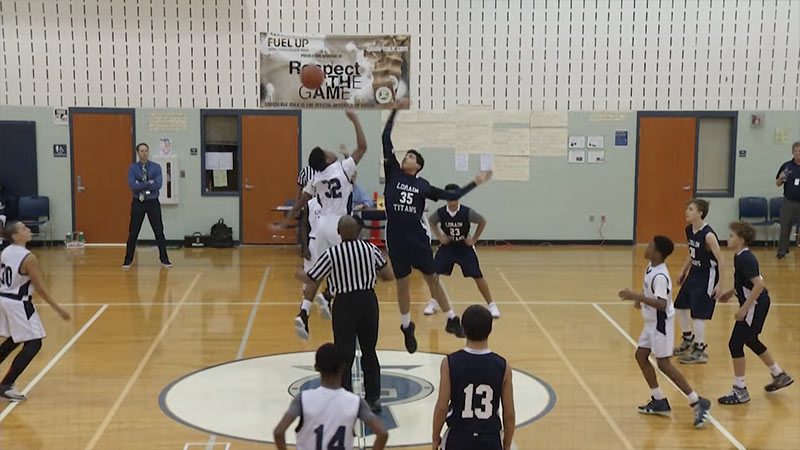
The transition into 7th grade marks a pivotal shift in a young athlete’s journey. It is the moment when youth recreational play matures into the structured, highly competitive environment of middle school athletics.
For many players, this year serves as the foundation for their future high school and potentially collegiate careers.
To compete at a high level, every detail must be aligned with official standards—none more so than the equipment used during daily training and sanctioned games.
Ensuring that a student-athlete is practicing with the correct basketball size is not merely a matter of following rules; it is a strategic decision that impacts muscle memory, shooting mechanics, and overall confidence on the court.
Using an improperly sized ball can lead to technical flaws that become difficult to correct as the competition intensifies.
Precise Dimensions: The Standard for 7th Grade Boys
For boys entering the 7th grade, the game adopts the same physical demands found at the highest levels of the sport. At this stage, boys utilize a Size 7 basketball, which features a 29.5-inch circumference.
This is a critical milestone, as the Size 7 ball is the official regulation size for men’s high school, collegiate, and professional basketball, including the NBA.
The adoption of the 29.5-inch ball in 7th grade is designed to mirror the physiological growth of young male athletes.
As hand spans increase and upper body strength develops, the larger surface area of the Size 7 ball allows for better control during high-speed dribbling and more sophisticated rotation during jump shots.
Practicing with this specific circumference ensures that as the athlete grows, their “feel” for the ball remains consistent through their senior year of high school and beyond.
Engineering the Game: Regulation for 7th Grade Girls
In the girls’ 7th-grade division, the standards are equally rigorous but tailored to the specific ergonomic requirements of the women’s game.
Girls in 7th grade use a Size 6 basketball, which has a 28.5-inch circumference. Just as with the boys’ regulations, this size remains the official standard through high school, college, and professional play in the WNBA.
The one-inch difference in circumference between the Size 7 and Size 6 balls is a deliberate design choice intended to optimize performance.
For female athletes, the 28.5-inch ball allows for a more secure grip and better leverage during the shooting motion.
Because the Size 6 is slightly smaller and lighter, it enables players to maintain proper form without overcompensating with their shoulders or off-hand, which is a common issue when players are forced to use a ball that is too large for their frame.
Why Regulation Size is the Foundation of Performance
Selecting the right basketball is an investment in an athlete’s technical development. When a 7th grader uses the correct equipment, they are training their nervous system to respond to specific weights and dimensions.
1. Shooting Mechanics and Muscle Memory
Basketball is a game of repetition. A jump shot relies on the consistent “flick” of the wrist and the proper placement of the guide hand. If a player practices with a ball that is even an inch off in circumference, their brain calculates the force required differently.
When they step onto a court for a school tryout or a championship game using regulation equipment, their shots may consistently fall short or fly long because their muscle memory is calibrated to the wrong weight and size.
2. Ball Handling and Control
Middle school basketball introduces higher defensive pressure, such as full-court presses and double teams. To navigate these challenges, a player must have absolute control over the ball.
The 29.5-inch and 28.5-inch standards are optimized for the average hand size of athletes at this developmental stage, ensuring that the ball stays “connected” to the palm and fingertips during crossovers and behind-the-back maneuvers.
3. Psychological Readiness
There is a profound psychological advantage to practicing with the same gear used by professionals.
When a 7th-grade boy knows he is handling the same size ball as his favorite NBA stars, or a 7th-grade girl uses the same dimensions as the WNBA’s elite, it fosters a sense of legitimacy and professional intent in their training sessions.
Material Selection: Preparing for the School Gym
While size is the primary factor, the material of the basketball is a close second in importance. For 7th-grade school ball, most games are played on hardwood courts.
- Composite Leather: This is the preferred choice for most middle school athletes. Composite balls offer a “broken-in” feel right out of the box, providing excellent grip and durability for indoor use. They are designed to withstand the rigors of a long season while maintaining a consistent bounce.
- Genuine Leather: Often used at the collegiate and pro levels, genuine leather requires a break-in period. While some elite middle school programs may use these, composite is generally more practical for the 7th-grade level.
- Rubber/Outdoor: These should be avoided for competitive 7th-grade preparation unless the player is strictly playing on asphalt. Rubber balls have a different bounce profile and can negatively impact a player’s touch when they return to a hardwood environment.
The Road to High School: Continuity in Equipment
One of the most significant benefits of the 7th-grade transition is that the ball sizes established here—Size 7 for boys and Size 6 for girls—do not change as the player moves through 8th grade and into high school.
This provides a multi-year window where the athlete can perfect their skills with a single set of dimensions. By identifying and using the correct regulation size now, parents and coaches are ensuring that the athlete’s progress is never hindered by unnecessary changes in equipment later in their career.
Frequently Asked Questions for 7th Grade Athletics
Is there a weight difference between the 29.5″ and 28.5″ balls?
Yes. A Size 7 ball typically weighs approximately 22 ounces, while a Size 6 ball weighs about 20 ounces. This slight weight reduction for the Size 6 is essential for maintaining proper shooting form in the women’s game.
Can a 7th-grade boy use a Size 6 ball for practice?
While a smaller ball might be easier to handle initially, it is counterproductive for competitive preparation. Since all 7th-grade boys’ sanctioned games will use a Size 7 (29.5″) ball, practicing with a smaller size will lead to inaccuracies in shooting and ball handling during live game play.
How do I know if a basketball is Size 6 or Size 7 when purchasing?
Most manufacturers print the size or circumference directly on the ball near the inflation valve. Look for “Size 7” or “29.5” for boys, and “Size 6” or “28.5” for girls.
Should 7th graders ever use a Size 5 ball?
No. Size 5 basketballs (27.5″) are designed for youth players ages 9 to 11. By 7th grade, athletes have matured beyond this size and should move up to the appropriate regulation ball to prepare for school-level competition.
Conclusion: Excellence Starts with the Right Equipment
Success in middle school sports is the result of talent, hard work, and proper preparation. For any 7th grader looking to make an impact on the court, using the correct basketball size is the first step toward athletic excellence.
By adhering to the Size 7 (29.5″) standard for boys and the Size 6 (28.5″) standard for girls, players align themselves with the regulations of high school, college, and professional leagues.
Invest in a high-quality, regulation-sized basketball today to ensure that every hour spent in the gym translates directly to success on game day.
The path to the varsity roster starts with the work put in during 7th grade—make sure that work is built on a foundation of professional standards.