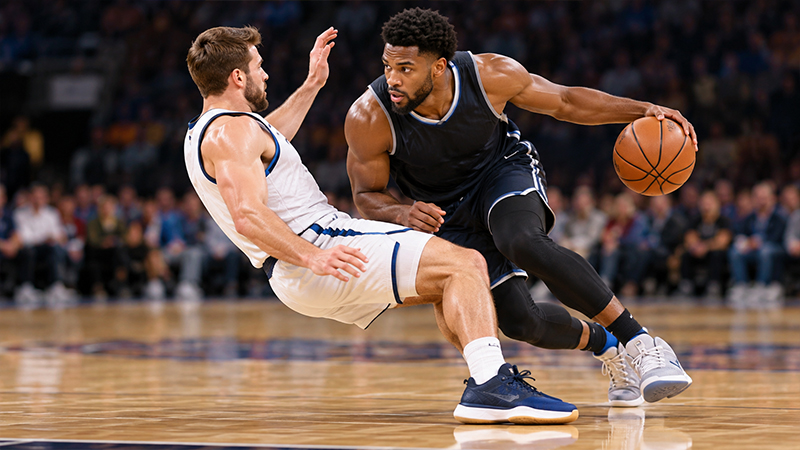
In the modern landscape of high-performance basketball, the ability to draw an offensive foul—commonly known as “taking a charge”—is perhaps the most underutilized tactical weapon.
While dunks and three-pointers capture the highlights, the defensive charge is the ultimate momentum shifter. It is a play that requires an unparalleled blend of spatial awareness, physical courage, and technical precision.
This guide provides a comprehensive breakdown of the mechanics required to execute this maneuver at a professional level, ensuring both competitive success and player safety.
The Strategic Foundation: Understanding Legal Guarding Position
The cornerstone of any successful charge is the establishment of a legal guarding position. This is not merely a suggestion of the rulebook but a strict architectural requirement for the play to be validated by officiating crews.
To take a charge, a defender must beat the offensive player to their spot. This requires anticipating the lane the attacker will take and arriving with enough time to become stationary.
The technical requirement is specific: you must arrive at the designated spot before the offensive player begins their upward or forward motion.
If a defender attempts to slide into the path of an opponent who has already left their feet or initiated a shooting motion, the official will almost certainly whistle a blocking foul.
Once you have arrived at the spot, your physical alignment is critical. You must plant both feet firmly on the floor. A common error among developing players is having “happy feet”—minor adjustments or shuffling right before impact.
For the charge to be legal, the feet must be set, and the torso must face the ball handler squarely. This square alignment signals to the referee that you have established a “wall” within your defensive cylinder.
Navigating the Restricted Area
In elite levels of play, including collegiate and professional leagues, the presence of the restricted area adds a layer of complexity to the architecture of the charge. This semi-circle located under the basket is a “no-fly zone” for primary defenders looking to draw contact.
If you are defending under the basket, you must ensure your feet are positioned entirely outside the restricted area semi-circle.
Even if your torso is perfectly square and your feet are set, if your heels are touching or inside that line, the play is automatically ruled a blocking foul.
High-level defenders develop a “kinesthetic map” of the court, allowing them to feel where they are in relation to the restricted area without looking down, ensuring they are legally positioned to receive the blow.
Maintaining the Defensive Cylinder
A defender’s “cylinder” is the invisible space extending from the floor to the ceiling, defined by the width of their body. To avoid being called for a reaching or pushing foul during the collision, you must keep your arms pulled in.
The most effective technique is to have the arms crossed over the chest or covering the groin. This serves two purposes:
- Legal Integrity: It ensures that your hands do not make illegal contact with the offensive player, keeping the focus entirely on the torso-to-torso collision.
- Physical Protection: It provides a buffer for your internal organs and sensitive areas during high-velocity impact.
The rule of thumb is simple: the offensive player must run directly into your torso for the charge to be called. Any movement of the arms toward the player will likely negate the charge and result in a whistle against the defense.
The Physics of the Moment of Impact
Taking charge is a lesson in applied physics. You are essentially acting as a stationary object absorbing the kinetic energy of a moving force. To do this effectively, you must take the blow squarely in your chest.
If the contact occurs on the shoulder or the side of the hip, it indicates that the defender was either not square or was attempting to “lean” into the path of the dribbler.
Both scenarios typically result in a blocking foul. By taking the impact in the center of the chest, you demonstrate that you occupied the space first and that the offensive player initiated the contact through your established position.
Advanced Safety Mechanics: The Art of the Fall
The primary deterrent for many players in taking a charge is the fear of injury. However, when executed with the correct “architecture,” the fall is a controlled deceleration that minimizes risk. Mastering the charge requires not just timing, but precise body control.
1. Protecting the Head and Neck
The most critical safety step is to tuck your chin to your chest the moment impact is imminent. This bracing action protects the head from the “whiplash” effect and prevents the back of the head from striking the hardwood floor upon landing.
2. The 45-Degree Descent
A mistake often made by beginners is stiffening the body in anticipation of the hit. Stiffening increases the risk of bone and joint injury.
Instead, you should allow yourself to fall backward at a 45-degree angle. This angle allows you to transition the vertical impact into horizontal momentum.
3. Distributing the Force
Rather than landing flat on your back, which can jar the spine, you should roll onto your back and buttocks. This rolling motion distributes the force of the fall across a larger surface area and uses the natural padding of the body to absorb the shock.
The Psychology of the Whistle: Communication with Officials
Basketball officiating is a high-speed endeavor. Referees often rely on both visual and auditory cues to make split-second decisions. Therefore, you must make the contact both visible and audible.
One highly effective technique used by veteran players is to exhale sharply or make a vocal noise upon impact. This sound cuts through the noise of the gym and signals to the official that a significant collision has occurred.
Furthermore, many elite defenders will slap the floor as they fall. This serves a dual purpose:
- Auditory Amplification: It creates a loud “crack” that mimics the sound of a heavy collision, drawing the official’s eyes to the play.
- Safety: It allows the hands to help break the fall, provided the palms make contact with the floor to dissipate energy.
When to Deploy the Charge: Tactical Situations
While the technical mechanics are vital, knowing when to take a charge is what separates elite defenders from the rest.
- The Fast Break: When an offensive player is sprinting in transition, they often have “tunnel vision” toward the rim. This is the prime opportunity for a help-side defender to step into the lane early and establish a legal position.
- The Over-Aggressive Driver: Some players rely purely on “bully ball,” using their shoulders to displace defenders. By setting a firm wall, you turn their greatest strength into a turnover.
- Late-Game Momentum Stops: A charge taken in the final two minutes can effectively end a run by the opposing team, providing your team with both a turnover and an emotional boost.
Frequently Asked Questions (FAQ)
Q: Can I take a charge while my feet are moving?
No. To be ruled a charge, you must have established a legal guarding position, which generally requires being stationary with both feet planted before the contact occurs.
Q: What if the offensive player jumps before I get there?
If the offensive player has already started their upward motion (the “jump”), you cannot legally step into their path. Doing so will result in a blocking foul.
Q: Is it a charge if I fall before the contact?
This is often referred to as “flopping.” Professional officials are trained to recognize when a player falls without sufficient contact. If you fall prematurely, you not only miss the call but also leave your team playing four-on-five defense.
Q: Does the restricted area apply to all levels of basketball?
The restricted area is common in NBA, FIBA, and NCAA play, but many high school and youth leagues do not use it. You should always verify the specific rules of your league.
Conclusion: The Selfless Play
Taking charge is an act of supreme basketball intelligence and selflessness. It requires you to sacrifice your body for the benefit of the team, trading a potential basket for a turnover and an opponent’s personal foul.
By mastering the architecture of the defensive charge—from the initial sprint to the spot to the controlled roll on the floor—you become a formidable obstacle that changes how the opposition approaches the game.