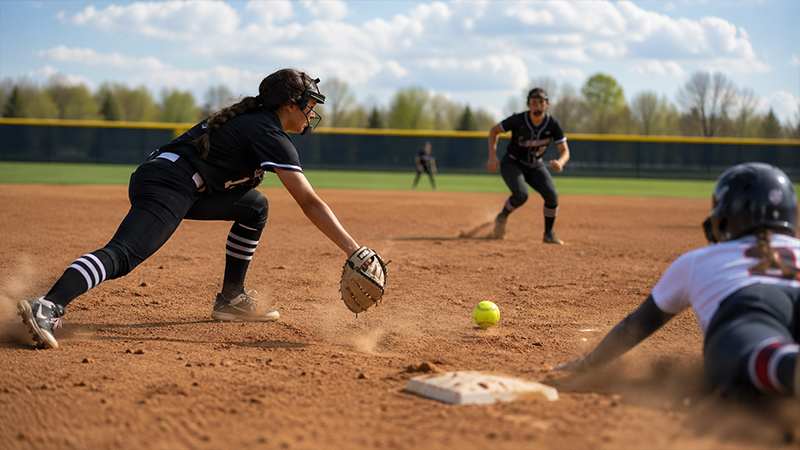
In the world of elite sports architecture, the “aesthetic” often takes a backseat to the “functional.”
To the casual observer viewing a softball diamond from the bleachers, the expansive brown of an all-dirt infield might appear as a “0 grade aesthetic” or a cost-cutting measure compared to the manicured grass of a Major League Baseball stadium.
However, this perception ignores the rigorous technical requirements of a sport defined by milliseconds and inches.
The decision to utilize an all-dirt infield is not merely a choice; it is a response to the unique physics of a 60-foot baseline and the extreme speed of the modern game.
The Velocity Variable: Why Grass is the Enemy of Speed
The primary driver behind the all-dirt infield is the sheer speed at which softball is played. While baseball is often described as a game of “patience and power,” softball is a “very fast game” that demands “much hand speed, foot speed, and coordination”.
1. Eliminating Friction and Drag
On a standard baseball diamond with 90-foot baselines, the grass serves as a natural dampener, slowing down ground balls and allowing fielders time to read the hop. In softball, where the bases are 30 feet closer, any amount of drag is catastrophic for the defense.
If there were grass in a softball infield, the ball would lose significant velocity, making it “almost impossible to throw a runner out”. On an all-dirt surface, the ball moves “significantly faster,” maintaining the kinetic energy necessary for the defense to compete with elite-level runners.
2. The “Bang-Bang” Play Dynamic
In elite fastpitch, the margin for error is nonexistent. Traditional insights from players suggest that nearly every play at first base is decided by a margin of only one to two steps.
On a grass surface, a fielder would have to wait for the ball to reach them through the friction of the blades; on dirt, the ball arrives with a velocity that forces a “highly skilled” reaction.
A routine grounder in softball does not allow for the “shuffle and throw” luxury often seen in the deep holes of a baseball infield.
Fielding Dynamics: The Science of Consistent Hops
One of the most persistent myths in sports turf management is that grass is inherently “safer” or “easier” to play on. In reality, the technical skill required to field on an all-dirt surface is higher, though the surface itself offers a more predictable environment for the athlete.
1. Surface Hierarchy and Predictability
When ranking infield surfaces based on fielding difficulty, experienced players and coaches categorize them as follows:
- Turf: The most consistent and easiest to field.
- All-Dirt: The second most consistent surface.
- Grass/Dirt Combo: Historically, the “toughest by far” due to the transition point.
Fielding a hard-hit grounder that moves from grass to dirt—the “skin” of the infield—is “crazy difficult” because the ball changes speed and trajectory at the point of transition.
By utilizing an all-dirt infield, softball removes this variable, allowing the infielder to rely on a “real dirt infield” for “consistent hops” similar to how grass behaves on a well-manicured outfield.
2. The Skill Ceiling
Because the ball moves faster on dirt, playing the infield becomes significantly more challenging. It requires a higher level of “hand-eye coordination” and quicker reaction times. For professional-grade development, the dirt surface is essential to push athletes to their physical limits, ensuring that the “speed and challenge” of the game are maintained at the highest level.
Economic and Maintenance Realities in Facility Management
While the tactical reasons for dirt infields represent 99% of the justification at the professional level, the economic and labor-management aspects cannot be ignored, particularly for multi-field complexes and public parks.
1. Labor Efficiency at Scale
In many municipal settings, maintenance teams manage “four softball fields sharing the same outfield with no fence”. From a facility management perspective, an all-dirt infield allows for a more efficient workflow.
Crews can “mow the whole thing in a riding mower” without needing to “manicure each infield” or manually groom the complex “cutouts around the bases” that are required when grass and dirt coexist.
2. The Maintenance Paradox
Interestingly, there is a debate regarding whether dirt is actually cheaper. Some experts argue that “cost of upkeep should be about the same,” and that grass might even require “less labor” because it doesn’t need constant raking or the daily “line marking” required for dirt.
However, the “0 grade aesthetic” of dirt often hides a high level of maintenance: dirt must be properly watered and dragged to prevent it from becoming “like powder or like cement,” which can be dangerous for players.
Global and Cultural Context: The Asian League Influence
The use of all-dirt infields is not unique to softball. In some Asian professional baseball leagues, all-dirt infields are used as a standard.
This suggests a cultural and tactical appreciation for the surface that transcends the specific rules of softball.
In these contexts, the dirt surface is seen as a way to prioritize a specific style of play—one focused on speed, precision, and the “fast” nature of the infield game.
Strategic Facility Planning: Safety vs. Performance
For youth or recreational leagues, the decision often shifts from “performance” to “safety.” On “crappy diamonds” or “school yard fields,” grass is often preferred because poorly maintained dirt becomes a hazard.
If the soil is not clay-based or properly hydrated, it can become dangerously hard, making ground balls unpredictable and hazardous.
Enhanced FAQ: Technical Inquiries for Sports Professionals
Q: Does an all-dirt infield actually save money for large sports complexes?
A: Not necessarily. While it allows for faster mowing of the outfield with a “riding mower,” the labor required for “raking and line marking” daily can be significant. The primary benefit is operational efficiency in shared-space environments.
Q: Is it harder to play infield in softball than in baseball?
A: Many players argue that it is. Because the “ball moves significantly faster” on dirt and the baselines are only 60 feet, players have a much smaller window to react, requiring superior “hand speed” and “foot speed”.
Q: Why don’t professional softball teams use grass/dirt combos like the MLB?
A: Because the transition from grass to dirt is “crazy difficult” in the field. Given the short distances in softball, an “all-dirt” or “all-turf” field is preferred to ensure “consistent hops” and maintain the speed of the game.
Q: What is the biggest danger of a dirt infield?
A: Poor maintenance. If dirt isn’t properly groomed, it can turn into “powder or cement,” which makes fielding grounders dangerous. High-end facilities often use “shale with clay under” to provide a better balance.
Conclusion: The Architecture of Excellence
The all-dirt infield in softball is a masterclass in functional design. By prioritizing ball velocity and surface consistency over the aesthetic appeal of a grass-lined diamond, the sport preserves its unique identity as a game of extreme speed and technical precision.
For those in the business of sports—from manufacturers to facility managers—the dirt is not “trash”; it is the foundation of the fastpitch game.