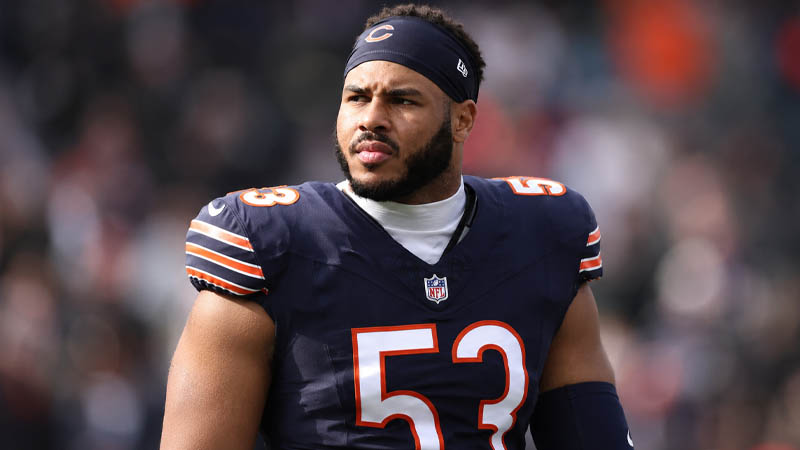
T.J. Edwards went undrafted in the 2019 NFL Draft due to a slow 4.77-second 40-yard dash, lack of prototypical arm length, and defensive coordinators’ fears that he would be a two-down liability in modern passing schemes.
Despite an extraordinarily productive career at Wisconsin where he amassed 367 tackles, talent evaluators prioritized raw athletic testing over game film.
Teams overlooked his elite diagnostic intelligence, resulting in one of the biggest draft misses of the decade.
Today, the star linebacker’s rise from an undrafted free agent to an elite defender for the Chicago Bears proves his pre-draft athletic projections were completely wrong.
What Were the Pre-Draft Red Flags on T.J. Edwards?
NFL draft rooms rely heavily on quantitative physical measurements to evaluate incoming prospects. For Edwards, a series of disappointing testing results and physical limitations overshadowed years of dominant college game film.
Below-Average Linebacker Speed in the 40-Yard Dash
At Wisconsin’s Pro Day, Edwards registered a 4.77-second 40-yard dash. This below-average speed immediately raised red flags for franchises seeking sideline-to-sideline defenders.
Scouts believed his lack of initial burst and recovery speed would prevent him from keeping pace with fast professional ball-carriers.
Missing Athletic Testing Verification at the Combine
Edwards decided not to participate in athletic testing drills during the official NFL Scouting Combine. This absence meant he could not establish official baseline metrics early in the process.
Consequently, teams defaulted to conservative projections about his athletic limitations rather than on-field productivity.
Sub-Prototypical Arm Length and Frame Restrictions
Standing just a hair over 6-foot-1 and weighing 230–242 pounds, Edwards did not have the physical frame that front offices desired.
Evaluators particularly worried about his shorter 31.25-inch arm length. They feared blockers would easily engage him, neutralizing his tackling ability.
Scheme Concerns and the Modern Defensive Space Dilemma
The modern professional game demands linebackers who can operate in wide-open spaces. Evaluators questioned whether a traditional defender could adapt to the rapid spread offense trends sweeping the league.
The Two-Down Linebacker Label in a Passing League
In 2019, offensive coordinators shifted heavily toward space-oriented passing attacks. Scouts classified Edwards as an old-school run-stuffer who could only play on early downs.
They predicted he would be heavily targeted on third downs by creative offensive play-callers.
Coverage Deficiencies in Man-to-Man Matchups
Evaluation profiles noted that Edwards struggled when forced to change direction quickly or match fluid route-runners.
Analysts believed he lacked the sideline-to-sideline coverage range to cover quick NFL tight ends and receiving backs. This perceived limitation severely damaged his overall draft value.
Where Would T.J. Edwards Go in an NFL Re-Draft?
Before analyzing his professional rise, it is helpful to look at how major scouting organizations evaluated his talent. The consensus outlook heavily discounted his potential to become an everyday starter.
| Evaluation Category | Details from 2019 Draft Reports |
|---|---|
| Elite Strengths | Highly instinctive in zone coverage, disciplined tackling technique, and elite diagnostic football IQ. |
| Perceived Weaknesses | Obvious lack of top-end physical speed, shorter arm length, and projected struggles in man coverage. |
| Initial Projection | Projected as a late 6th-to-7th round prospect, primary backup, or special teams player. |
| PFF Re-Draft Position | Re-evaluated as a legitimate first-round talent, landing at No. 27 overall. |
Scouting services, including Ourlads, categorized Edwards as a late-round flyer who would rely on special teams to make an active roster.
Draft rooms frequently focus on raw physical traits, such as height, weight, and elite speed, over consistent college tape.
This bias created a massive blind spot. Evaluators completely undervalued his remarkable production at Wisconsin, where he had registered 367 tackles and 10 interceptions, showing that his football intelligence could make up for raw athletic testing numbers.
By prioritizing physical attributes over cognitive traits, franchises passed on a player with elite zone instincts and flawless technique. The Philadelphia Eagles capitalized on this error, signing him as an undrafted free agent immediately after the draft.
Edwards quickly proved his detractors wrong, earning a starting role and eventually signing a lucrative contract with the Chicago Bears, illustrating the deep flaws in traditional evaluation methods.
Overlooked On-Field Football IQ and Wisconsin Legacy
While athletic metrics dominate pre-draft discussions, on-field production remains the ultimate indicator of success. Edwards’ stellar collegiate achievements at Wisconsin painted a vastly different story than his testing numbers suggested.
Collegiate Production for the Wisconsin Badgers
During his four-year career at Wisconsin, Edwards established himself as an elite linebacker, recording 367 tackles and 10 interceptions. This massive output proved his knack for finding the football and disrupting plays.
Despite these historic numbers, evaluators struggled to separate his collegiate tape from his mediocre testing metrics.
Undervaluing Football Intelligence and Diagnostic Skills
Edwards’ greatest assets were his elite football IQ, master diagnostic instincts, and flawless tackling technique.
He consistently diagnosed offensive concepts before the snap, allowing him to play much faster than his 40-yard dash indicated. Unfortunately, draft rooms struggled to quantify these cognitive traits during evaluation.
How Did Edwards Rise From Undrafted Free Agent to Bears Star?
Following the draft disappointment, Edwards set out to rewrite his professional legacy. His journey from an overlooked prospect to a cornerstone defender serves as a case study for modern scouting departments.
- Signing with the Philadelphia Eagles: Immediately after the draft, Edwards signed as an undrafted free agent, determined to make the active roster through sheer effort.
- Special Teams Dominance: He first excelled on special teams, displaying the discipline and tackling technique that scouts had undervalued.
- Cracking the Defensive Rotation: His high-level play forced coaches to insert him into the linebacker rotation, where he quickly proved he was much more than a backup.
- Hometown Contract with the Chicago Bears: After establishing himself as a top-tier middle linebacker, he signed a highly lucrative contract with his hometown team in Chicago.
- Re-Draft Vindication: Pro Football Focus’s analytical re-evaluation determined that Edwards deserved to go No. 27 overall in the first round.
This incredible redemption story highlights a systemic issue in talent evaluation: the over-reliance on pure athletic testing.
When teams prioritize a tenth of a second in the 40-yard dash over hundreds of collegiate snaps, they miss out on elite, highly intelligent football players.
Edwards’ success with both the Eagles and the Bears serves as a blueprint for identifying undervalued prospects who possess elite intangibles, changing how modern front offices view linebacker value.
Frequently Asked Questions About the T.J. Edwards NFL Draft Journey
What was T.J. Edwards’ 40-yard dash time?
Edwards ran a 4.77-second 40-yard dash at Wisconsin’s Pro Day in 2019. This slower speed, combined with his decision to skip athletic testing at the NFL Combine, created serious doubts among scouts regarding his ability to cover fast receivers.
Which college did T.J. Edwards play for?
Edwards played his college football for the University of Wisconsin Badgers. He put together a historically productive career, recording 367 tackles and 10 interceptions, solidifying himself as one of the most decorated linebackers in school history.
Which NFL team signed T.J. Edwards as an undrafted free agent?
The Philadelphia Eagles signed Edwards immediately following the 2019 NFL Draft. He earned his spot on the active roster by dominating on special teams, eventually cracking the starting lineup and developing into a defensive leader.
Where did Pro Football Focus project T.J. Edwards in their 2019 Re-Draft?
Based on his actual professional performance and elite play as a starting linebacker, Pro Football Focus determined in their re-draft that Edwards was a clear first-round talent, placing him at No. 27 overall.
The Blueprint for Scouting Undervalued Defensive Talent
The story of T.J. Edwards is a powerful reminder that elite diagnostic intelligence, master instincts, and flawless tackling cannot be measured by a stopwatch.
While physical metrics are important, they should never completely overshadow dominant on-field college tape.
Edwards’ incredible rise from an undrafted free agent to an elite defender for both the Philadelphia Eagles and the Chicago Bears serves as a blueprint for modern front offices.