
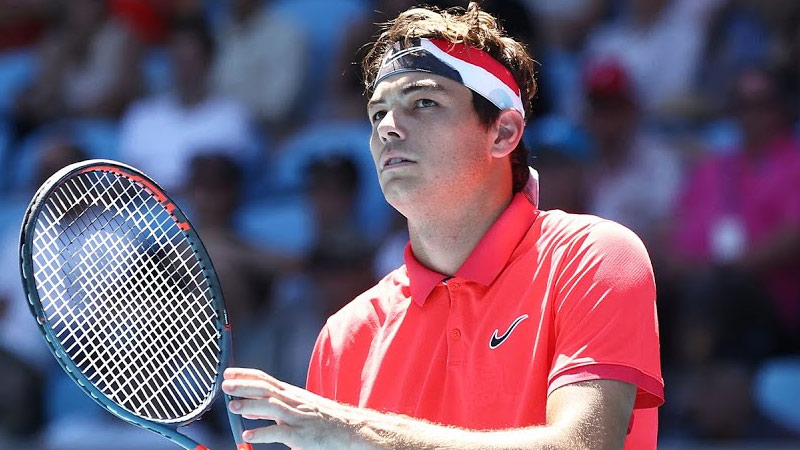
The 2022 Citi Open in Washington, D.C., was a tournament defined by its punishing atmosphere. Still, one moment remains etched in tennis fans’ memories: the sudden, distressing departure of top-ranked American Taylor Fritz.
In a match that began with a display of high-level shot-making, the world watched as a premier athlete was dismantled not by his opponent, but by the physical limits of the human body.
Understanding why Taylor Fritz retired against Dan Evans requires a deep dive into the physiological, environmental, and preparation-related factors that converged on that sweltering afternoon.
The Atmosphere: A Crucible in the Capital
The Citi Open is historically recognized as one of the most physically taxing stops on the ATP Tour. Held in early August, the tournament serves as a critical lead-up to the U.S.
Open, yet it presents a unique set of challenges that differ from the concrete jungles of New York. Washington, D.C., in the height of summer, is notorious for its oppressive humidity and stagnant air.
On the day of Fritz’s third-round encounter with Britain’s Dan Evans, the conditions were classified as extreme.
With temperatures climbing well above 95°F and a heat advisory in full effect, the court surface—a dark hardcourt—absorbed and radiated heat, creating a micro-environment far hotter than the ambient air temperature.
For a professional tennis player, who must maintain explosive movements for hours, these conditions represent a “pressure cooker” where the body’s cooling mechanisms are pushed to their absolute breaking point.
The Match Progression: From Dominance to Decline
The match itself was a story of two distinct phases. Initially, Taylor Fritz appeared to be in control. He secured the first set 6-3, utilizing his powerful serve and aggressive baseline play to keep Evans on the defensive. However, as the clock ticked past the two-hour mark, the environmental toll began to manifest.
The second set was a grueling battle of attrition. Evans, known for his variety and ability to extend rallies, forced Fritz into long, taxing exchanges.
The set pushed to a tiebreak, which Evans narrowly claimed 7-6(6). It was during this tiebreak and the subsequent transition to the third set that the visible decline in Fritz’s physical state became undeniable.
By the time the third set reached 4-1 in favor of Evans, Fritz was no longer moving with his characteristic agility.
The fluidity of his strokes had vanished, replaced by a labored, heavy-footed gait. The decision to stop playing was not a tactical one, but a necessary response to a body that had reached its physiological limit.
The Physiological Crisis: Why Fritz Had to Stop
Taylor Fritz later provided a candid and harrowing account of his experience on the court, describing symptoms that align with severe heat-related exhaustion and illness.
He reported that his vision was going “fuzzy” and that he felt a terrifying sensation of being on the verge of passing out.
These symptoms are clinical indicators of the body’s failure to regulate its core temperature.
When the body overheats, it prioritizes blood flow to the skin for cooling and to the essential organs, often at the expense of the brain and muscles.
- Fuzzy Vision: This is often caused by a drop in blood pressure or dehydration affecting the ocular nerves and brain processing.
- Near-Syncope (Feeling like passing out): This occurs when the cardiovascular system can no longer maintain adequate oxygen delivery to the brain while simultaneously trying to cool the body.
In such a state, continuing to compete is not just a matter of “toughing it out”; it is a medical emergency.
The risk of transitioning from heat exhaustion to heat stroke—a potentially fatal condition—is significant in professional sports where athletes are conditioned to ignore pain signals.
The Preparation Gap: The Role of the Foot Injury
A critical question emerged following the retirement: why was Fritz, an elite athlete known for his fitness, so uniquely affected by the heat on this occasion? The answer lay in his recent medical history.
Fritz revealed that he had been nursing a foot injury since his deep run at Wimbledon earlier that summer.
This injury had a cascading effect on his tournament readiness. Because of the foot issue, he had been unable to engage in the rigorous, high-volume training sessions typically required to maintain peak cardiovascular fitness.
More importantly, the injury prevented him from heat acclimation. Acclimatization is a biological process where an athlete spends 7 to 14 days training in high temperatures to trigger physiological adaptations, such as an increased sweat rate and better electrolyte retention.
Because Fritz’s training had been limited, he entered the D.C. heat without the necessary biological “shield” to withstand 95°F temperatures. He was, by his own admission, underprepared for the specific environmental demands of the Citi Open.
The Psychological Toll: Pride vs. Professionalism
One of the most striking aspects of this event was Fritz’s emotional response. Despite the clear medical necessity of his retirement, he expressed that he felt “embarrassed” by his inability to finish the match.
This sentiment highlights the intense pressure on top-tier professional athletes. In a sport like tennis, where individual toughness is celebrated, “retiring” is often viewed through a lens of failure, even when the cause is a legitimate medical crisis.
Fritz’s transparency about his embarrassment, combined with his explanation of the heat-related illness, provided a rare and valuable look into the mental health struggles associated with physical performance.
The Broader Context: Heat Protocols in Professional Tennis
The retirement of a high-profile player like Taylor Fritz at a major tournament sparked renewed discussions regarding the ATP’s “Extreme Heat Policy.”
Currently, the policy allows for extended breaks and, in some cases, the suspension of play, but it relies heavily on the “Wet Bulb Globe Temperature” (WBGT) index, which accounts for heat, humidity, wind, and solar radiation.
Fritz’s collapse serves as a reminder that even when conditions are technically within the “playable” range, the individual health status of a player—such as recent injury or lack of acclimation—can make those conditions lethal.
The 2022 Citi Open highlighted the need for a more nuanced approach to player safety that considers the cumulative physical load on athletes during the North American summer swing.
Strategic Analysis: Lessons for Future Performance
From a performance strategy perspective, Taylor Fritz’s 2022 retirement offers three vital lessons for elite athletes and their coaching teams:
- The Priority of Acclimation: In the modern era of climate extremes, heat training is as essential as tactical drills. For players returning from injury, the return-to-play protocol must include a phase for environmental re-adjustment.
- Listening to the “Internal Alarm”: Fritz’s decision to stop, despite his personal embarrassment, was the correct professional choice. It preserved his health for the remainder of the season and prevented a potentially catastrophic medical event.
- Transparency in Communication: By detailing his symptoms and the role of his foot injury, Fritz managed his brand effectively. He shifted the narrative from “lack of heart” to a “medical reality,” maintaining his authoritativeness as a top competitor.
Conclusion
The retirement of Taylor Fritz at the 2022 Citi Open was a stark reminder that even the most elite athletes are not immune to the laws of biology.
It was a perfect storm of extreme environmental conditions, a lack of recent acclimation due to a lingering injury, and the grueling nature of hardcourt tennis.
While Fritz felt a sense of embarrassment in the moment, history views the event differently: as a moment of professional maturity where health was prioritized over a single match result.
For fans and analysts, it serves as a case study in the physical demands of the ATP Tour and the thin line between peak performance and physical collapse.
As the sport continues to face rising global temperatures, the story of Taylor Fritz in D.C. remains a foundational reference point for player safety and the vital importance of preparation.






