
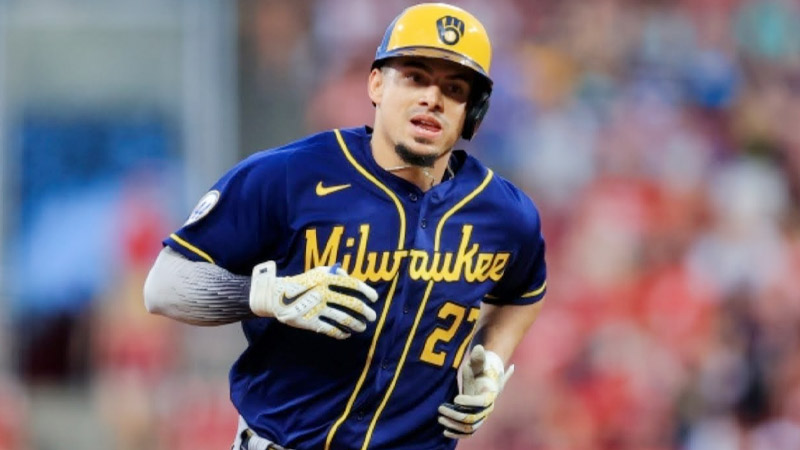
On May 21, 2021, the Tampa Bay Rays traded their starting shortstop, Willy Adames, to the Milwaukee Brewers.
Adames was 25, a World Series starter only months earlier, and one of the most energetic personalities in the Rays clubhouse. Tampa Bay sent him, along with reliever Trevor Richards, to Milwaukee for right-handed pitchers Drew Rasmussen and J.P. Feyereisen.
So why did Tampa Bay trade Willy Adames? The short answer: the Rays had more shortstops than they could play, Adames was slumping just as his salary was about to rise, and Milwaukee offered controllable pitching in return.
The longer answer reveals how one of baseball’s most disciplined front offices keeps winning on a limited budget.
This breakdown covers the deal itself, the three forces behind it, how every key player performed afterward, and what the trade teaches about smart roster strategy.
The Trade at a Glance
The deal was a two-for-two swap completed about seven weeks into the 2021 season.
| Team | Received | Role at the time |
|---|---|---|
| Milwaukee Brewers | Willy Adames | Starting shortstop |
| Milwaukee Brewers | Trevor Richards | Right-handed reliever |
| Tampa Bay Rays | Drew Rasmussen | Right-handed reliever |
| Tampa Bay Rays | J.P. Feyereisen | Right-handed reliever |
Adames had a long history with the organization. He arrived as a teenage prospect in the 2014 three-team trade that sent David Price to Detroit, debuted in May 2018, and started at shortstop for the 2020 American League pennant winners. Moving a homegrown regular with that résumé was not a casual decision.
Reason 1: A Surplus of Middle-Infield Talent
The biggest driver of the trade was depth: Tampa Bay had more capable shortstops than lineup spots. Wander Franco, then widely ranked as the top prospect in baseball, was tearing through Triple-A Durham and was weeks from his debut.
Taylor Walls, a slick-fielding infielder, had just been recalled and could handle shortstop immediately. Behind him sat Vidal Brujan, another highly ranked prospect who could play the middle infield, plus versatile big-league veterans like Joey Wendle.
For most clubs, that kind of depth is a luxury. For the Rays, it was an asset that needed to be converted into value before it sat idle.
Many fans in the r/tampabayrays community reached the same conclusion at the time: given the surplus, the deal made sense. Franco’s debut on June 22, 2021, roughly a month after the trade, confirmed that the front office was clearing a lane rather than creating a hole.
Reason 2: A Cold Start and the Cost-Control Clock
Adames’ early 2021 struggles gave the Rays a timely reason to act. Through 41 games he was hitting just .197 with a strikeout rate well above league average, a sharp drop from the steady production he had shown the year before.
Timing mattered as much as performance. Adames was approaching arbitration eligibility, the stage when a young player’s salary starts climbing every winter.
Tampa Bay, consistently one of the lowest-payroll clubs in Major League Baseball, has a long pattern of moving players a year or two before those raises arrive.
The logic is straightforward. Other teams pay the most for years of affordable control, so the Rays sell while that control is still intact. Waiting until a player is expensive, or until a slump deepens, only shrinks the return.
There was also a factor numbers alone don’t capture. Adames had historically hit better on the road than at Tropicana Field, which suggested a change of scenery could unlock his bat. That made him more valuable to a buyer than he looked on the Rays’ stat sheet.
Reason 3: Pitching, the Currency Tampa Bay Values Most
The return was built around what the Rays prize most: hard-throwing, controllable arms they believe they can improve. Drew Rasmussen, a right-hander with a mid-to-upper-90s fastball, was working out of Milwaukee’s bullpen after two elbow surgeries earlier in his career.
There was a twist to his story. Tampa Bay had drafted Rasmussen in the first round in 2017 but did not sign him after a medical review. Four years later, the Rays got him back with a far clearer picture of his health and potential.
J.P. Feyereisen brought a track record of missing bats and strong minor-league strikeout numbers. Neither pitcher made national headlines, which is typical of a Rays deal.
The organization’s player development and analytics staff are known for turning overlooked arms into high-leverage weapons through pitch-mix redesigns and careful workload management.
In plain terms, Tampa Bay traded one asset with rising costs for two assets with low costs and, in its view, untapped upside.
How the Deal Played Out for Both Clubs
In the short term, both teams got exactly what they wanted, which is the mark of a well-built trade. Adames’ bat came alive in Milwaukee: he hit .285 with 20 home runs in 99 games for the Brewers in 2021 and became a clubhouse leader for a team that won the National League Central.
Tampa Bay kept winning too. The Rays finished 2021 with 100 wins and the American League East title. Rasmussen moved into the rotation late that season, and in 2022 he posted a 2.84 ERA over 146 innings, including a perfect-game bid against Baltimore that lasted into the ninth inning.
Feyereisen gave the bullpen reliable innings in 2021 and opened 2022 with a long run of scoreless outings before a shoulder injury cut his season short. Rasmussen later battled elbow trouble again but returned to the Rays’ staff in 2024.
Adames, meanwhile, grew into one of the most productive power-hitting shortstops in the National League. After a 32-homer season in 2024, he signed a seven-year, $182 million contract with the San Francisco Giants, a payday Tampa Bay was never positioned to match.
Verdict: Was It a Win for Tampa Bay?
Judged by the Rays’ own goals, the trade worked, even though Adames quickly outgrew his 2021 slump. Tampa Bay opened a lane for Franco, added two cost-controlled arms, and won 100 games in the same season. Milwaukee landed a cornerstone shortstop for several years at a modest price.
The fairest reading is that this was a rare win-win. Critics note that Adames’ later power would have looked great in a Rays lineup, especially after Franco’s career was halted in 2023 by off-field legal proceedings. That hindsight is understandable, but none of it was knowable in May 2021.
Front offices should be graded on decisions made with the information available at the time. On that standard, the reasoning behind the Adames trade holds up well.
What the Adames Trade Teaches About the Rays’ Strategy
The Adames deal is a near-perfect case study in how Tampa Bay competes with far wealthier rivals. Four principles stand out.
- Sell from surplus, not from need. The Rays moved a shortstop only because they had several more ready to step in. They rarely trade a player whose departure leaves a true hole.
- Act before the salary curve steepens. Trading a player a year or two before arbitration raises captures peak value. Buyers pay for affordable years of control, not for past production.
- Buy upside you can develop. Tampa Bay targets arms its coaching and analytics staff believe they can improve. Rasmussen’s jump from reliever to front-line starter shows why that bet pays off.
- Accept short-term emotional cost. Trading a beloved clubhouse figure stings fans and teammates. The Rays consistently choose long-term flexibility over sentiment.
Readers outside baseball will recognize the same discipline in well-run businesses. Strong organizations rebalance their portfolios before an asset’s costs outpace its returns, and they reinvest in areas where their internal expertise creates an edge.
Final Thoughts
Tampa Bay traded Willy Adames because the depth chart, the calendar, and the stat sheet all pointed the same way.
Franco and Walls were ready, Adames’ cost was about to rise, and Milwaukee offered two pitchers the Rays believed they could unlock. The club won 100 games that season, and both pitchers delivered meaningful innings.
Adames also thrived, which is exactly how a fair trade should end. Milwaukee gained a leader and a power bat, Tampa Bay gained pitching and payroll flexibility, and the player found a home where his game took off.
