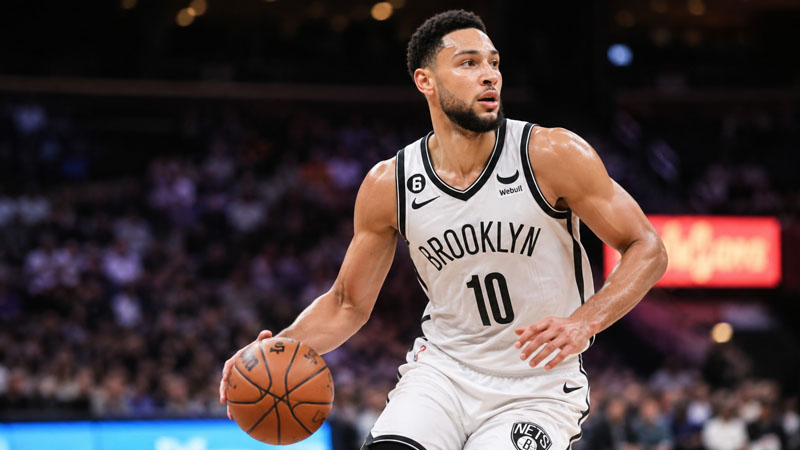
Ben Simmons’ inability to shoot stems from a complex intersection of technical mechanical flaws, psychological barriers, and debilitating physical injuries.
Fundamentally, he uses his non-dominant left hand for shooting, which causes significant “elbow flare” and disrupts his release timing. This mechanical mismatch is compounded by a perfectionist mindset that avoids high-risk shots to escape public criticism.
Following a historic collapse in the 2021 playoffs, these mental hurdles merged with severe nerve damage and multiple back surgeries.
This combination effectively stripped him of his elite athleticism, leaving an offensive liability whose statistical profile now mirrors a traditional paint-bound center.
The Technical Breakdown of the “Wrong Hand” Theory
Understanding why a player of such immense talent struggles with a fundamental skill requires looking at the biomechanics of his shooting motion.
The most prominent theory among analysts and shooting coaches is that Simmons is effectively shooting with the wrong hand.
While he is naturally right-hand dominant for almost every other life skill—including writing, throwing, and finishing at the rim—he has opted to shoot basketballs left-handed throughout his professional career.
This foundational mismatch creates a domino effect of mechanical errors that make consistency nearly impossible.
The Problem of Elbow Flare and Alignment
Because Simmons uses his non-dominant hand, his left elbow has a natural tendency to flare drastically outward rather than staying tucked in a “shot pocket”.
When the elbow flares, it creates an inconsistent path for the ball, often pushing it sideways across his face during the upward motion.
This lack of vertical alignment destroys accuracy because the shooting hand is fighting against the body’s natural mechanics to keep the ball on a straight trajectory toward the hoop.
Flawed Jump Timing and Energy Transfer
Beyond hand dominance, Simmons suffers from a critical error in “energy transfer” from his lower to upper body. In an efficient jump shot, the ball should be released just before or at the start of the jump to utilize the power from the legs.
However, Simmons typically releases the ball after reaching the absolute apex of his jump. This timing eliminates the upward momentum from his legs, forcing him to rely entirely on upper-body strength and arm flick to propel the ball.
This “heave” motion is significantly harder to replicate under pressure, leading to the erratic results seen throughout his career.
Statistical Anomalies: High Efficiency vs. Zero Range
To the casual observer, a career field goal percentage of 55.8% might suggest an efficient offensive player. However, the data reveals a stark paradox: his efficiency is a byproduct of extreme shot selection rather than skill diversity.
By almost exclusively attempting layups, dunks, and tip-ins, Simmons maintained high shooting percentages while his perimeter game completely vanished.
| Season | Team | FG% | 3PM-3PA | FT% | PPG |
|---|---|---|---|---|---|
| 2017-18 | PHI | 54.5% | 0-11 | 56.0% | 15.8 |
| 2018-19 | PHI | 56.3% | 0-6 | 60.0% | 16.9 |
| 2019-20 | PHI | 58.0% | 2-7 | 62.1% | 16.4 |
| 2020-21 | PHI | 55.7% | 3-10 | 61.3% | 14.3 |
| 2022-23 | BKN | 56.6% | 0-2 | 43.9% | 6.9 |
| 2023-24 | BKN | 58.1% | 0-0 | 40.0% | 6.1 |
| 2024-25 | BKN / LAC | 52.0% | 0-0 | 72.7% | 5.0 |
The table above illustrates a disturbing trend: as his career progressed, his willingness to even attempt a three-pointer plummeted to zero. In 383 regular-season games, he has made only five three-pointers out of 35 total attempts, a career average of 14.3%.
Furthermore, his Average Shot Distance (ASD) has consistently remained under six feet, placing him in the statistical company of traditional, paint-bound centers like Rudy Gobert rather than modern perimeter guards.
The Psychological Wall and the Fear of Failure
The decline of Ben Simmons is as much a psychological study as it is a physical one. Analysts often point to a “perfectionism trap” where the player’s preference for high-percentage plays morphed into a rigid aversion to any shot he might miss.
This was likely a defense mechanism; if he never took the shot, he could not be definitively labeled a “bad shooter” by the media or fans.
The 2021 Playoff Collapse
The tipping point for this psychological decline occurred during the Philadelphia 76ers’ 2021 playoff series against the Atlanta Hawks.
During this seven-game stretch, Simmons shot a historically poor 34.2% from the free-throw line, the lowest mark in NBA history for a player with at least 70 attempts.
This lack of confidence culminated in the infamous Game 7 moment where Simmons passed up an open, uncontested dunk to a teammate, seemingly out of fear of being fouled and sent to the charity stripe.
Free-Throw Anxiety and Passive Play
This event shattered his offensive aggression. Following the 2021 playoffs, Simmons began to play with extreme passivity, often refusing to attack the rim even when he had a physical advantage.
The fear of failure became a self-fulfilling prophecy; by trying to avoid mistakes, he became an offensive liability that opposing defenses could simply ignore.
By clogging the paint and refusing to shoot, he unintentionally sabotaged the spacing for teammates like Joel Embiid, leading to the eventual fracture of his relationship with the 76ers.
How Chronic Back Injuries Derailed His Career
While mechanics and mindset were early issues, the final blow to Simmons’ career was a series of debilitating physical injuries. Shortly after his trade to the Brooklyn Nets, he was diagnosed with a herniated disc and severe nerve impingement.
These were not minor setbacks; they were structural issues that fundamentally altered his physical trajectory and his ability to find a shooting rhythm.
Nerve Damage and the Nervous System Connection
Simmons has noted that his physical back issues were often deeply tied to high-stress situations, suggesting a link between his mental health and his physical recovery.
Severe nerve damage makes it incredibly difficult to maintain the fine motor skills required for a jump shot. When the body is in a constant state of rehabilitation, building a consistent physical “flow” becomes an impossible task.
The Loss of Elite Athleticism
The multiple back surgeries he underwent in the mid-2020s permanently sapped the elite speed, lateral quickness, and explosion that once made him an All-Defensive First Team player.
For a player who relied on his physical superiority to score at the rim—averaging 19.2 points per game in college at LSU—the loss of that first step was catastrophic.
By the 2024-25 season, his scoring had bottomed out to just 5.0 points per game before he eventually sat out the entire 2025-26 season to focus on a total physical reset.
Why NBA Teams Are Hesitant to Sign Simmons
As of the current offseason, the former All-Star remains unsigned, a stunning fall for a player once considered a generational talent. Teams are evaluating him through a lens of extreme risk management, and the current consensus among front offices is wary for several reasons.
- Availability Risk: Over the last five seasons, Simmons has missed significant time, including sitting out the entire 2021-22 and 2025-26 seasons. Committing a roster spot to a player with a chronically compromised spine is a gamble most competitive teams are unwilling to take.
- Offensive Liability: Modern NBA offenses rely on spacing. Because Simmons refuses to shoot jumpers, opposing defenses can “sag off” him, effectively playing 5-on-4 and making it harder for his teammates to score.
- Financial Mismatch: Prior to stepping away, Simmons reportedly rejected low-risk, one-year minimum contract offers from teams like the New York Knicks. His refusal to accept a “prove-it” deal has created a stalemate in negotiations.
Frequently Asked Questions About Ben Simmons’ Shooting
Did he ever try to change his shooting hand?
Despite calls from legendary coaches and “shot doctors” like Sam Cassell to switch to his dominant right hand, the foundational issues proved too deeply ingrained to fix mid-career.
Changing a shooting motion that has been practiced for decades is a monumental task that Simmons was either unable or unwilling to complete successfully.
How much money did he lose due to his shooting struggles?
The financial impact has been staggering. Had Simmons developed even a league-average jump shot (roughly 34% from three), he would likely be on his third consecutive supermax contract, worth well over $300 million.
Instead, he faced buyouts and a lack of interest in free agency, representing one of the largest “lost” career earnings in sports history.
Could he still make a comeback?
Simmons has publicly stated his intent to make a physical comeback for the upcoming season after his 2025-26 reset.
While his elite vision and passing remain, his success will depend entirely on whether his back can withstand the rigors of an NBA schedule and if he can finally overcome the psychological barrier to taking perimeter shots.
The Future and Legacy of an NBA Enigma
The story of Ben Simmons serves as a cautionary tale regarding the fragility of athletic success. At 6’10” with world-class transition passing and defensive versatility, he was often compared to a peak LeBron James or Giannis Antetokounmpo.
Had he unlocked a reliable pull-up jumper, he would have been an perennial MVP frontrunner and likely would have secured multiple championships for the Philadelphia 76ers.
Instead, he remains a statistical paradox—a perimeter player who doesn’t shoot and a superstar whose body and mind seemingly reached their limit at the same time.
His legacy will be defined by the “Great What-If”: what if the mechanics had been corrected in high school, or what if the 2021 collapse had never happened?
For now, the league waits to see if the once-unstoppable force can reinvent himself or if the mechanics of failure have permanently closed his window of opportunity.