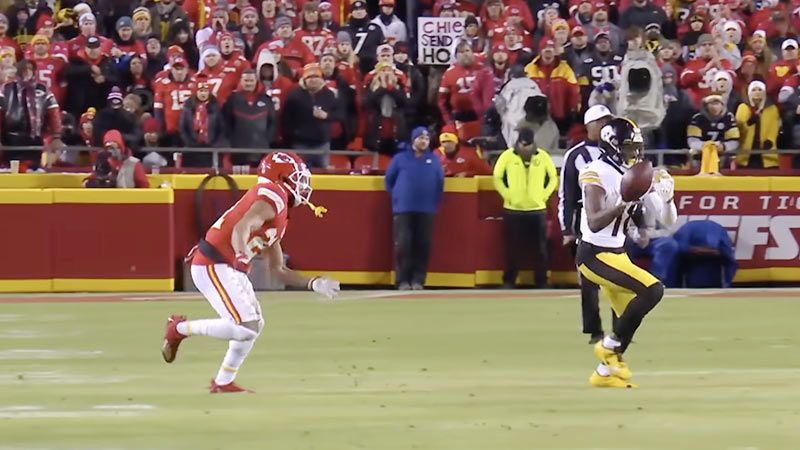
In the world of professional sports, we are obsessed with records. We celebrate the most touchdowns, the most passing yards, and the most Super Bowl rings.
However, there is a subculture of sports fandom that is equally fascinated by the “negative” records—the most interceptions thrown, the most fumbles lost, and perhaps the most frustrating of all: the most dropped passes.
When fans search for the “player with the most pass drops in NFL history,” they are often looking for a goat to blame or a name to tease.
Yet, a deep dive into the statistical archives of the NFL reveals a fascinating reality called the Longevity Paradox.
This paradox suggests that to accumulate a record-breaking number of “bad” stats, you must first be an exceptionally “good” player who has earned the trust of your coaches for a very long time.
The Data Gap: Why “Drops” Are Elusive
One of the first hurdles in identifying the all-time drop leader is the nature of the statistic itself. While StatMuse has season-level data for passing attempts dating back to the 1932 season, “dropped passes” have not always been an official or consistently tracked metric.
Unlike a yard gained or a touchdown scored, a “drop” is often a subjective judgment call made by a dynamic set of scouts and statisticians.
Because of this, when you search for the most drops in history, the data often redirects you to the players who had the most opportunities to drop the ball. In the NFL, volume is the precursor to both greatness and error.
The Volume Kings: Learning from Passing Attempts
To understand the potential for dropped passes, we must look at the quarterbacks who threw them. The sources highlight the “Titans of the Air,” the men who have stood in the pocket more than anyone else in history.
At the top of this list is Tom Brady, who holds the record for the most career passing attempts with 12,050. Over 335 games, Brady completed 7,753 passes.
Mathematically, this means thousands of Brady’s passes were either intercepted, batted down, or—crucially—dropped by his receivers. When you throw over 12,000 passes, your receivers will naturally lead the league in total drops simply because of the sheer volume of targets.
The list of high-volume quarterbacks reads like a Hall of Fame ballot:
- Drew Brees: 10,551 attempts
- Brett Favre: 10,169 attempts
- Peyton Manning: 9,380 attempts
- Matthew Stafford: 8,763 attempts
- Aaron Rodgers: 8,743 attempts
These men are the engines of their offenses. Because they played so many games—Favre with 302, Brees with 287, and Manning with 266—their wide receivers had the “luxury” of dropping passes year after year without being cut.
A marginal receiver who drops three passes in a game might be looking for a new job on Monday. A legend like Jerry Rice or Terrell Owens could drop passes and stay on the field because their overall production far outweighed the occasional mistake.
The Interception Proxy: Brett Favre’s Lesson
While the sources do not provide a specific name for the most career drops, they provide a perfect parallel in the form of career interceptions.
Brett Favre is the ultimate example of the Longevity Paradox. Favre ranks third all-time in passing attempts (10,169) but holds a staggering 336 career interceptions.
Favre’s interception percentage was 3.3%, which is significantly higher than his peers like Aaron Rodgers (1.4%) or Tom Brady (1.8%).
However, Favre’s willingness to take risks and his “gunslinger” mentality allowed him to rack up 508 touchdowns and 71,838 yards.
The same logic applies to dropped passes: the receivers with the most drops are usually the ones who are targeted 150 times a year because they are the only ones capable of getting open that often.
Modern Context: The 2025 High-Volume Era
Looking at the most recent data from the 2025 season, we see that high-volume passing continues to define the league’s most successful teams. Matthew Stafford led the league in 2025 with 4,707 passing yards and 46 touchdowns.
When a quarterback like Stafford is having a career year at age 37 or 38, his primary targets—like Puka Nacua, who earned 246 fantasy points in 2025—are seeing a massive influx of targets.
Nacua and Jaxon Smith-Njigba (who led the league with 1,793 receiving yards) are the types of players who will likely appear at the top of “most drops” lists for the 2025 season.
Is it because they have “bad hands”? No. It is because they are the focal points of offenses that pass the ball relentlessly.
The efficiency of the modern game is also highlighted by the Patriots’ rising star, Maye. In 2025, Maye led the league in QB Rating with 113.5, throwing for 4,394 yards and 31 touchdowns.
Despite his high rating, his receivers certainly accounted for their share of drops as the Patriots fought their way to a 14-3 record.
The Hierarchy of Error
The sources allow us to see a clear hierarchy of how “negative” stats accumulate over time. If we look at the top 10 quarterbacks by passing attempts, we see a direct correlation to their longevity:
- Tom Brady: 335 GP, 12,050 ATT
- Drew Brees: 287 GP, 10,551 ATT
- Brett Favre: 302 GP, 10,169 ATT
- Peyton Manning: 266 GP, 9,380 ATT
- Matthew Stafford: 239 GP, 8,763 ATT
- Aaron Rodgers: 264 GP, 8,743 ATT
- Matt Ryan: 234 GP, 8,464 ATT
- Ben Roethlisberger: 249 GP, 8,443 ATT
- Dan Marino: 242 GP, 8,358 ATT
- Philip Rivers: 247 GP, 8,226 ATT
Each of these quarterbacks has played over 230 games. In that span of time, they have each likely seen hundreds, if not thousands, of passes dropped by their teammates.
For example, Vinny Testaverde (who ranks 16th in attempts) threw 267 interceptions and had an interception rate of 4.0%.
Fran Tarkenton (17th in attempts) had a rate of 4.1%. These players survived high error rates because they provided enough value elsewhere to remain starters for decades.
Conclusion: A Badge of Honor
So, who has the most dropped passes in NFL history? While the “official” number may be buried in subjective scouting reports or incomplete historical databases, the statistical evidence points toward the legends.
To have the “most” of a negative stat in the NFL, you generally have to be a superstar. You have to be a player like Jerry Rice, Terrell Owens, or Larry Fitzgerald—players who were targeted so frequently that even a small percentage of drops added up to a massive career total.
The next time you see a receiver drop a pass, remember the names on the passing attempt leaderboard. From Tom Brady’s 12,050 attempts to Matthew Stafford’s league-leading 4,707 yards in 2025, the story of the NFL is a story of volume.
Dropped passes are not just mistakes; they are the inevitable byproduct of being one of the greatest to ever play the game. You can’t drop a ball you weren’t good enough to be targeted with in the first place.