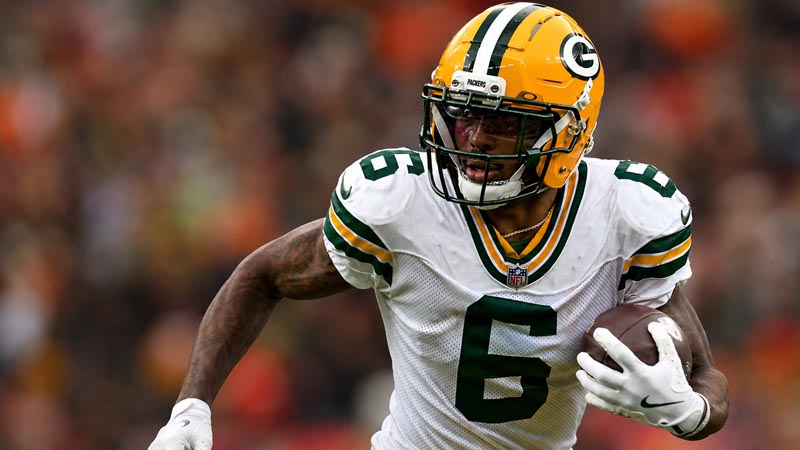
In the modern professional football landscape, player movement is often viewed through the narrow lens of individual performance and personal ambition.
However, beneath the surface of weekly highlight reels lies a complex matrix of salary cap management, roster prioritization, and strategic financial trade-offs.
The career trajectory of wide receiver Mecole Hardman serves as a masterclass in how these elements intersect on the grandest stage of professional sports.
Hardman’s movement across multiple franchises provides a compelling look into the real-world operations of front offices trying to balance championship aspirations with harsh economic realities.
By analyzing his departure from Kansas City, his brief stint in New York, his subsequent return, and his eventual transition to other franchises, we gain a deeper understanding of the business of football.
The Expiration of the Rookie Contract: A Strategic Crossroads
The fundamental driver of Hardman’s initial departure from Kansas City was the natural progression of the NFL contract cycle.
In March 2023, Hardman reached the end of his four-year rookie contract, officially entering the market as an unrestricted free agent.
For NFL franchises, rookie contracts—especially those of high-round draft picks—represent the most valuable economic assets in the sport.
They provide high-level athletic production at a fixed, below-market cost. Once a rookie contract expires, both the player and the franchise find themselves at a strategic crossroads:
- The Player’s Perspective: Having completed four years of service, a player’s primary objective is typically to maximize their lifetime earning potential on the open market. This is the moment to secure a substantial multi-year deal or a highly guaranteed contract that protects against future injury risks and establishes their market value.
- The Team’s Perspective: For a championship-winning team, the roster is often saturated with highly paid superstar contracts. The front office must make cold, analytical decisions about which middle-tier players can be extended and which must be allowed to leave in favor of cheaper, younger alternatives.
In Hardman’s case, the Kansas City front office opted to let the wide receiver explore the open market rather than rushing to offer a lucrative contract extension.
This decision was not necessarily a reflection of Hardman’s talent, but rather a calculated assessment of positional valuation and available financial resources.
The Impact of Injuries on Market Position and Player Leverage
A player’s leverage in free agency is directly tied to their recent health and on-field production. Unfortunately for Hardman, his contract year coincided with a highly challenging season.
Following the departure of superstar wide receiver Tyreek Hill in 2022, Hardman was positioned to take on a significantly expanded role in the offense.
However, his progress was severely disrupted by a core muscle injury that forced him to miss a substantial portion of the 2022 regular season. Because of this physical setback, he finished the year with just 25 catches.
This drop in production created a difficult dynamic:
- Suppressed Market Value: An injury-plagued season inevitably raises flags for prospective teams, making them hesitant to commit to long-term, high-value contracts.
- The Desire for a Fresh Start: From the player’s perspective, joining a new offensive system with a clean bill of health can serve as a platform to rebuild market value and prove capability as a primary offensive threat.
Hardman viewed the New York Jets as exactly this type of fresh opportunity. The Jets were actively reconstructing their roster and offensive philosophy, presenting a promising landscape for a speed-based wide receiver looking to establish a dominant role in a major market.
Evaluating the New York Jets’ Financial Strategy and Team Constraints
The financial details of Hardman’s contract with the New York Jets illustrate the economic gap that often exists between competing NFL front offices.
The Jets extended a one-year offer worth up to $6.5 million, which featured $3.58 million in fully guaranteed money.
In professional football, guaranteed money is the true measure of a franchise’s commitment.
While the “up to” value of a contract includes performance-based incentives and play-time milestones, the guaranteed figure represents the money the team is legally obligated to pay, regardless of injury or roster cuts.
For Kansas City, matching this offer was financially unfeasible:
- The Salary Cap Bind: Champion teams routinely operate at the absolute limit of the NFL’s hard salary cap. With high-percentage cap allocations dedicated to core superstar positions, committing over $3.5 million in guaranteed money to a returning role-player was a luxury the team could not afford.
- Resource Allocation: The front office calculated that they could find comparable speed and depth through lower-cost veterans or early-round draft picks, maintaining their long-term financial flexibility.
Consequently, Hardman signed with the New York Jets, driven by both the attractive financial package and the chance to play alongside newly acquired future Hall of Fame quarterback Aaron Rodgers.
The Realities of Roster Depth and Scheme Fit
Despite the initial optimism, the partnership between Hardman and the New York Jets quickly deteriorated. The transition highlighted a crucial, often overlooked aspect of the business: scheme fit and depth chart dynamics.
A player’s success is never solely dependent on their individual athletic traits; it is deeply contingent on how the coaching staff integrates those traits into their weekly game plans.
In New York, Hardman rapidly fell down the offensive depth chart. Over the course of five games, he was on the field for a mere 28 offensive snaps.
This extremely limited usage was a clear indicator of a mismatch in strategic vision. When a team invests millions in a free agent only to keep them sidelined, it usually points to a failure in scheme alignment or a shift in coaching staff priorities.
Disgruntled with his lack of playing time, Hardman’s position on the roster became untenable, prompting both parties to look for an exit strategy.
The Mid-Season Rescue: Familiarity and Championship Redemption
The resolution to Hardman’s New York struggles came in October 2023, when the Jets traded him back to Kansas City. Mid-season trades in the NFL are highly transactional, often serving to solve immediate problems for both organizations:
- The Jets freed up a roster spot and shed a player who was no longer in their active plans.
- Kansas City acquired a familiar asset who already possessed a deep, intuitive understanding of their complex offensive playbook.
The integration was seamless. Unlike a new receiver who would require weeks to learn the terminology, pre-snap shifts, and timing routes of the offense, Hardman was able to contribute immediately.
This reunion reached its ultimate climax in February 2024. In Super Bowl LVIII, Hardman secured his place in football history by catching the game-winning touchdown pass in overtime.
This single play perfectly illustrated the circular nature of the business: a player who was deemed expendable in March and underutilized in New York by September, ended up delivering the ultimate prize to his original franchise in February.
The Economics of the Veteran Minimum and Roster Prioritization
Following the championship run, Hardman once again entered free agency in the spring of 2024. However, his market reality had shifted significantly.
Despite his high-profile Super Bowl play, the broader market remained cautious about offering a high-salary, long-term commitment.
Recognizing the mutual benefit of continued association, Hardman re-signed with Kansas City. This contract was a far cry from the $6.5 million deal he signed with the Jets a year prior. Instead, he accepted a highly cost-effective, one-year veteran minimum contract worth $1.125 million.
For the front office, this was an incredibly efficient transaction:
- Low Financial Risk: At $1.125 million, Hardman’s contract carried almost zero risk for the team’s overall cap space.
- Proven Depth: The team secured a proven postseason performer who could provide valuable depth and insurance against injuries in the receiver room.
- Mutual Protection: Hardman remained in a world-class system where he was highly comfortable, keeping himself visible to the league while playing for a perennial contender.
The Permanent Move: Roster Rejuvenation and Long-Term Viability
The professional football cycle eventually came to its natural conclusion following the 2024 season. Every successful organization must constantly balance the present with the future.
A critical mistake made by many front offices is holding onto veteran contributors for too long, which can clog the salary cap and block the development of younger, cheaper players.
Following the 2024 campaign, Kansas City made the strategic decision to prioritize younger talent on their rookie contracts, opting not to offer Hardman a new contract. This marked his permanent departure from the franchise.
The subsequent steps in Hardman’s career in early 2025 further emphasize the volatility of the veteran market:
- The Green Bay Opportunity: Hardman initially signed with the Green Bay Packers in early 2025.
- The Roster Cut Reality: In the NFL, veteran contracts signed in the spring often contain very little guaranteed money. If a younger player outperforms a veteran during training camp, the veteran is often released. This is precisely what happened to Hardman, who was released during final roster cuts by the Packers.
- The Next Chapter: Proving his resilience, Hardman quickly found a new home, signing with the Buffalo Bills to continue his career as a depth receiver and return specialist.
Strategic FAQ
Why did Mecole Hardman initially leave Kansas City in March 2023?
Hardman left primarily because his four-year rookie contract expired, allowing him to enter unrestricted free agency.
Coming off an injury-restricted 2022 season, he wanted a larger offensive role and a more lucrative contract than the cap-constrained front office was willing to offer at the time.
What were the financial details of Hardman’s contract with the New York Jets?
Hardman signed a one-year deal with the Jets worth up to $6.5 million. Crucially, the contract included $3.58 million in fully guaranteed money, which was a figure the cap-strapped front office in Kansas City chose not to match.
Why did Hardman’s tenure with the New York Jets fail so quickly?
Hardman struggled to find a role in the Jets’ offensive system, quickly falling down the team’s depth chart. Across five games, he played only 28 offensive snaps before being traded back to Kansas City in October 2023.
Why did Kansas City decide to let Hardman go permanently after the 2024 season?
Following the 2024 season, the front office prioritized roster rejuvenation and younger talent. To maintain long-term financial health and develop cheap, high-potential assets, they opted not to re-sign the veteran receiver.
Conclusion: The Enduring Lessons of the Roster Cycle
Mecole Hardman’s journey through the ranks of professional football is a vivid illustration of the business realities that govern the league.
Talent and on-field chemistry are vital, but they are constantly managed within the strict boundaries of salary cap math, contract structures, and age-related roster building.
From rookie contract expiration to the high-stakes gamble of free agency, and from mid-season trades to veteran minimum contracts, Hardman’s career timeline represents the standard lifecycle of a modern professional athlete.
For fans and analysts alike, his story serves as a reminder that the decisions made in quiet front office meeting rooms are just as critical to winning championships as the plays executed on Sunday afternoons.