The NFL Scouting Combine is an elite, high-stakes environment where fractions of a second can redefine a young athlete’s professional trajectory and financial future.
Among the variety of physical tests conducted in Indianapolis, no single drill captures the attention of front offices, head coaches, and global sports enthusiasts quite like the 40-yard dash.
It serves as the ultimate benchmark for straight-line speed, offering a standardized metric to evaluate whether a prospect possesses the raw acceleration necessary to survive on the perimeter in the National Football League.
When cornerback Trevon Diggs entered the draft evaluation cycle out of the University of Alabama, scouts were highly focused on how his physical attributes would translate to the professional level.
As a converted wide receiver, Diggs brought a unique blend of size and ball-tracking skills, but questions remained regarding his top-end recovery speed.
The answer came on the turf of Lucas Oil Stadium during the 2020 NFL Scouting Combine, where Diggs posted an official 40-yard dash time that would establish the baseline for his professional career.
The Core Metric: Analyzing Trevon Diggs’ 40-Yard Dash Time
At the 2020 NFL Scouting Combine, Trevon Diggs clocked an official 40-yard dash time of 4.42 seconds. For a cornerback measuring over six feet tall, a 4.42-second mark represents an exceptional level of straight-line speed and explosive athleticism.
This time confirmed to personnel executives that Diggs possessed the recovery gear necessary to match up against vertical threats in the NFL, preventing opposing offenses from routinely exploiting the deep third of the field.
To fully appreciate the significance of this performance, it is helpful to place Diggs’ time within a broader historical and positional context. While a 4.42-second 40-yard dash is highly competitive, it does not sit at the absolute historic limit of the position.
For example, legendary Hall of Fame cornerback Deion Sanders recorded a legendary 4.27-second 40-yard dash during his pre-draft evaluation.
The table below outlines how Diggs’ speed and key career metrics compare to elite defensive benchmarks:
| Evaluation Metric | Trevon Diggs’ Performance | Elite Historical Benchmark | On-Field Significance |
|---|---|---|---|
| Official 40-Yard Dash | 4.42 Seconds | 4.27 Seconds (Deion Sanders) | Provides the recovery speed to shadow deep vertical routes and close down passing windows. |
| Single-Season Takeaways | 11 Interceptions (2021) | 11 Interceptions (Modern Record era) | Marked the highest single-season interception total in the NFL since 1981. |
| Total Career Takeaways | 18 Interceptions (since entry) | Active Leader (since draft entry) | Establishes Diggs as the most productive turnover-generating cornerback in the league over this span. |
| Coverage Risk Factor | 18.7 Yards Per Catch Allowed (2021) | Low-risk lockdown standard (<11.0 YPC) | Highlights a high-risk, high-reward playstyle where big plays are surrendered in exchange for turnovers. |
Translating Track Speed to Turf: The On-Field Impact
A track metric like the 40-yard dash is only valuable if an athlete can translate those sterile numbers into functional football speed.
For Diggs, this transition has been highly successful. His quick feet and raw acceleration are immediately apparent when analyzing his tape with the Dallas Cowboys.
1. Preventing the Deep Threat
Modern NFL offenses rely heavily on vertical stretch concepts designed to isolate cornerbacks in single coverage down the sideline.
Diggs uses his 4.42-second speed to run stride-for-stride with primary receivers, effectively capping deep routes and limiting the space quarterbacks have to drop in high-leverage passes.
His speed serves as a vital insurance policy, allowing him to recover even if a receiver gains a step at the line of scrimmage.
2. Elite Closing Burst
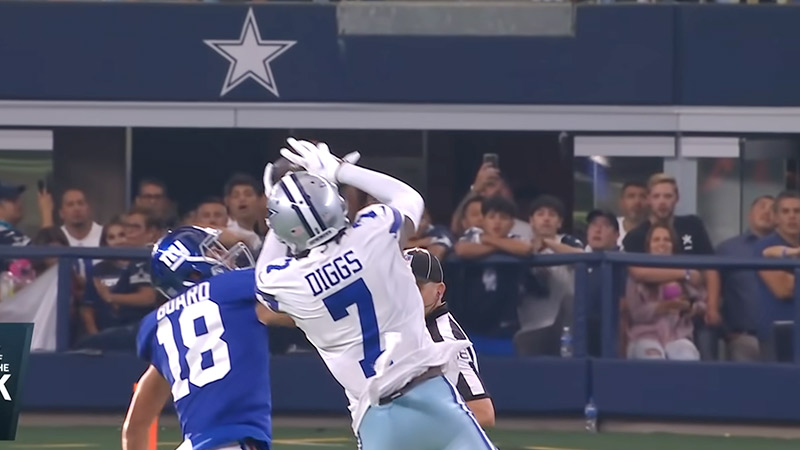
Interceptions are rarely a product of luck; they require a defensive back to close the distance between themselves and the ball in a matter of milliseconds.
Diggs’ track-tested acceleration enables him to bait quarterbacks into throwing toward seemingly open receivers, only for him to plant his feet and explode into the passing lane.
This closing speed is a primary reason why he has captured 18 interceptions since entering the league—more than any other player over that exact timeframe.
The High-Risk, High-Reward Paradox
While Diggs’ speed and ball-hawking tendencies have made him a household name, they have also sparked an intense debate among defensive coordinators, analysts, and fans.
The central question surrounding his playstyle is simple: Do his spectacular, game-changing turnovers outweigh the yards he surrenders when his gambles fail?
This debate is anchored in highly contrasting statistical realities:
- The Reward (Turnover Dominance): In 2021, Diggs put together a historic campaign, leading the entire NFL with 11 interceptions. This was the highest single-season takeaway total recorded by any player since 1981, earning him a first-team All-Pro selection and the first of his two Pro Bowl nods. His rare ability to read quarterbacks, anticipate throws, and act as a true ballhawk drew immediate comparisons to the legendary Deion Sanders.
- The Risk (Coverage Vulnerability): Conversely, during that identical 2021 campaign, Diggs surrendered an average of 18.7 yards per catch to opposing receivers. Because he consistently plays with an aggressive, intercept-first mentality, he was heavily targeted by offensive coordinators, ranking as the 7th most targeted player during coverages across the league.
Technical Gaps in Diggs’ Defensive Profile
Traditional defensive analysts point out that Diggs is still a raw talent who is actively working to find true consistency every week. His aggressive tendencies can occasionally be turned against him by clever offensive play-callers:
- Vulnerability to Double Moves: Knowing that Diggs wants to jump short and intermediate routes, wide receivers will frequently employ stutter-steps or “sluggo” (slant-and-go) routes to bypass him deep.
- Positional Discipline: In his eagerness to make a play on the ball, Diggs can occasionally find himself caught out of position, leaving a vacant zone for the offense to exploit.
- Defensive Penalties: When caught slightly trailing a receiver due to an incorrect initial read, Diggs occasionally commits holding or pass interference infractions, resulting in costly penalties for the Cowboys’ defense.
Despite these technical limitations, the Dallas coaching staff has consistently determined that the trade-off is heavily in their favor.
An interception completely halts an opponent’s drive and shifts momentum in a way that standard pass breakups cannot replicate. In a league defined by possession count, having a cornerback who can generate 18 turnovers in a short span is a luxury few franchises possess.
Navigating Adversity: The Road Back from Injury
The trajectory of Diggs’ career faced a significant obstacle during the 2023 season. During a practice session, Diggs suffered a torn anterior cruciate ligament (ACL), abruptly ending his season and sidelining him for the remainder of the year.
                                 [2023 Practice Injury]
                                           │
                                           ▼
                                    [Torn ACL]
                                           │
                    ┌──────────────────────┴──────────────────────┐
                    ▼                                             ▼
       [Physical Rehabilitation]                       [Cowboys Team Impact]
                    │                                             │
                    ▼                                             ▼
   • Focus on lateral agility                     • Defense adjusted schemes
   • Restoring 4.42 acceleration              • Retained 2nd in NFC East
   • Rebuilding single-leg stability              • Prepared for star's return
An ACL tear is a challenging injury for any professional athlete, but it is uniquely demanding for an NFL cornerback. The position requires constant, violent lateral cutting, backpedaling, and sudden changes of direction.
Restoring the explosive acceleration that allowed Diggs to clock a 4.42-yard dash at the combine requires months of meticulously planned physical therapy and strength conditioning.
While losing their star defensive back was a major blow, the Cowboys’ defensive unit demonstrated remarkable resilience. The defense adjusted its schemes, relied on its depth, and managed to finish the season ranked second in the NFC East.
This collective performance kept the team highly competitive, setting the stage for Diggs to rejoin a defensive unit capable of making deep postseason runs once he is fully restored to physical peak performance.
Conclusion
Trevon Diggs’ 4.42-second 40-yard dash is much more than just a metric on a draft profile. It is the physical engine that enables his aggressive, takeaway-driven style of play.
While critics will continue to point to the yards he surrenders and his vulnerability to double moves, his unmatched knack for generating turnovers has cemented his status as one of the most dynamic defensive players in modern professional football.
As he continues to refine his technique and recover from physical adversity, Diggs’ unique blend of raw speed and offensive receiver instincts will remain a cornerstone of the Dallas defensive strategy.