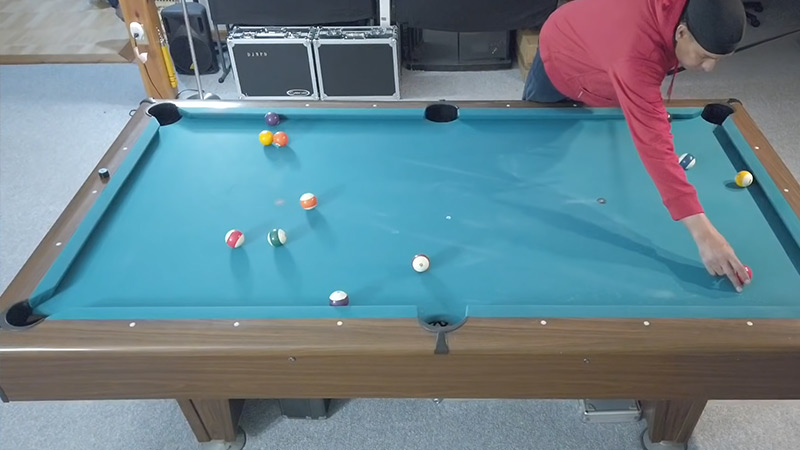
In the world of billiards, few things are as frustrating as watching your cue ball—the “white ball”—slowly roll toward a corner pocket after a perfectly executed shot on the object ball.
This mistake, known as a scratch, is a game foul that can instantly shift the momentum of a match. Whether you are a casual player at a local bar or an aspiring professional, understanding the exact rules of where the ball goes after a scratch is vital to settling disputes and playing a fair game.
While many amateurs rely on “house rules” or “bar rules,” official regulations from organizations like the Billiard Congress of America (BCA) or the American Poolplayers Association (APA) provide a clear, standardized framework for handling these fouls.
Drawing on insights from billiards expert Michael Lin, this guide explores the technical definition of a scratch, the modern “ball in hand” penalty, and professional techniques to keep your cue ball on the table.
Scratching 101: Understanding the Different Types of Fouls
A scratch is generally defined as a foul involving the cue ball. While most people associate scratching with the cue ball falling into a pocket, there are actually several ways to commit this foul, some of which leave the cue ball right on the table.
Pocket Scratches vs. Table Scratches
The most recognizable scratch is the pocket scratch, which occurs when the cue ball enters any of the six pockets on the table. It does not matter what the cue ball strikes first or if it strikes anything at all; if it ends up in a pocket, it is a scratch.
However, there are also table scratches, which are fouls where the cue ball remains on the table but a rule has been violated. According to Michael Lin, these are some of the most common ways to foul in competitive play:
Striking the Illegal Object Ball
In 8-ball, you must hit your assigned suit (solids or stripes) first. If you are shooting solids and your cue ball strikes a stripe first, it is a foul. In 9-ball, the cue ball must always strike the lowest-numbered ball on the table first.
Failing to Hit a Ball
You must make contact with an object ball. If the cue ball hits only the rails and nothing else, it is a scratch.
The “No Rail” Rule
This is perhaps the most obscure rule for casual players. After the cue ball makes legal contact with an object ball, either the cue ball or an object ball must strike a rail or be pocketed. If the balls just come to a stop in the middle of the table without touching a rail, it is a scratch.
Technical and Handling Scratches
Fouls aren’t always about where the balls roll; sometimes they are about how the player handles the equipment.
- Accidental Manipulation: If you accidentally brush the cue ball with your hand, clothing, or the side of your cue stick, it is considered a scratch.
- The Double Hit: A double hit occurs when the cue tip strikes the cue ball twice in a single stroke. This usually happens when the cue ball is very close to the object ball. You can often identify a double hit if both balls travel away at the same speed or if you hear a “thick” thumping sound instead of a clean “clink”.
- Illegal Jumps (The Scoop): Jumping the ball by “scooping” the cue under it is illegal. A legal jump shot must be performed by striking the top of the cue ball at a downward angle.
- Leaving the Table: If the cue ball is hit so hard it flies off the table, it is a scratch. However, if it bounces onto a rail and rolls back onto the playing surface, it is a legal shot.
Penalties: Where Do You Put the Ball?
Once a scratch has occurred, the penalty determines the next player’s advantage. In modern 8-ball and 9-ball, the standard penalty is “ball in hand”.
The Power of the Ball in Hand
When a player scratches, they must leave the table. The opposing player then gets to pick up the cue ball and place it anywhere on the table. This is a massive strategic advantage. “Ball in hand” allows a player to:
- Place the cue ball directly in front of their toughest ball for an easy shot.
- Set themselves up for a “run out” (clearing the remaining balls).
- Play a defensive safety shot to trap their opponent.
8-Ball Specific Scratches: Loss of Game
In 8-ball, the stakes are much higher when the game is nearing its end.
- Pocketing the 8-ball and Scratching: If you pocket the 8-ball but the cue ball also goes into a pocket or leaves the table, you immediately lose the game.
- Early 8-ball: Hitting the 8-ball into a pocket before you have cleared your suit is a loss.
- Wrong Pocket: Pocketing the 8-ball in a pocket other than the one you called is also a game loss.
9-Ball Nuances: The Spotted Ball
Unlike 8-ball, scratching on the final ball in 9-ball is not an automatic loss. If you pocket the 9-ball but scratch, the 9-ball is “spotted”. This means the 9-ball is removed from the pocket and placed on the headspot (the spot where the apex ball sits during a rack). The opponent then receives ball in hand, which usually results in them winning the game shortly after.
Variations: One Pocket and Straight Pool
Some older or more specialized formats do not use full-table ball in hand:
- One Pocket: There is no ball in hand for table scratches. For pocket scratches, the ball is played from behind the head string (the “kitchen”). Additionally, the player who scratched “owes a ball,” meaning they subtract one point from their score.
- Straight Pool (14.1): Like One Pocket, pocket scratches are played from behind the head string. Scratches result in point deductions: -1 for the first, -2 for a consecutive second, and a heavy -15 penalty for three scratches in a row.
Debunking Common Myths (Official Rules vs. Bar Rules)
Many arguments at the pool table stem from “bar rules” that contradict professional standards. Michael Lin notes that everyone plays differently in a bar, but official rules are quite specific.
Myth 1: You must always play from “behind the line” after a scratch. In official 8-ball and 9-ball, you only play from behind the head string if the scratch occurs on the break. For any other scratch during the game, the opponent gets full-table ball in hand.
Myth 2: The 3-Bank Rule. Some casual players believe that if the cue ball hits three rails but no object ball, it isn’t a scratch. This is fictional; no official format recognizes this as a legal shot.
Myth 3: Failing to call a shot is a scratch. In 8-ball, you should call your shots, but failing to do so is a foul that ends your turn—it is not a ball-in-hand scratch. In 9-ball, you don’t need to call shots at all, as it is considered a “slop” game.
Pro Tips: How to Avoid the Scratch
Avoiding scratches is essential to winning, as giving an opponent ball in hand often leads to an immediate loss. Here are four professional techniques to improve your cue ball control.
1. Master the Tangent Line
The tangent line is an imaginary line perpendicular to the point where the cue ball hits the object ball. If you hit the cue ball in the center without any spin, it will always travel along this line. By visualizing this path before you shoot, you can predict if the cue ball is heading toward a pocket and adjust your aim accordingly.
2. Use “Draw” and “Follow.”
You can manipulate the cue ball’s path to deviate from the tangent line using vertical spin.
- Draw (Backspin): Hitting the bottom half of the cue ball makes it spin backward after contact, pulling it away from the pocket.
- Follow (Topspin): Hitting the top half of the cue ball makes it roll forward after contact, which can help it clear a pocket area.
- Note: English (side spin) does not change the tangent line path; it only affects how the ball bounces after hitting a rail.
3. “Cheat the Pocket.”
When an object ball is sitting right next to a pocket, many players scratch because the cue ball follows it right in. To avoid this, you can “cheat the pocket” by hitting the object ball at a 30-degree angle to the side of the pocket rather than dead center. Because pockets are wider than balls, the object ball will still go in, but the cue ball will strike the rail instead of falling in.
4. Control Your Speed
New players often hit the ball much harder than necessary. High speed increases the distance the cue ball travels, raising the odds it will find a pocket. Michael Lin suggests practicing slow shots to see how little power is actually needed to sink a ball. Slower shots result in more predictable cue ball movement and fewer scratches.
Conclusion: Play Like a Pro
Understanding where to put the white ball after a scratch is more than just a rule—it’s a fundamental part of pool strategy. In modern games like 8-ball and 9-ball, the ball in hand rule is designed to penalize the fouler and reward the opponent with a significant advantage.
By mastering the technical rules of what constitutes a scratch—including the often-overlooked “no rail” and “double hit” rules—you can ensure your games are played fairly and competitively.
Ultimately, the best way to handle a scratch is to prevent it from happening in the first place. By utilizing the tangent line, practicing speed control, and learning to cheat the pocket, you can keep the cue ball under your control and keep your opponent in their chair.
Knowing the official rules prevents unnecessary arguments and allows you to focus on what matters most: your next shot.