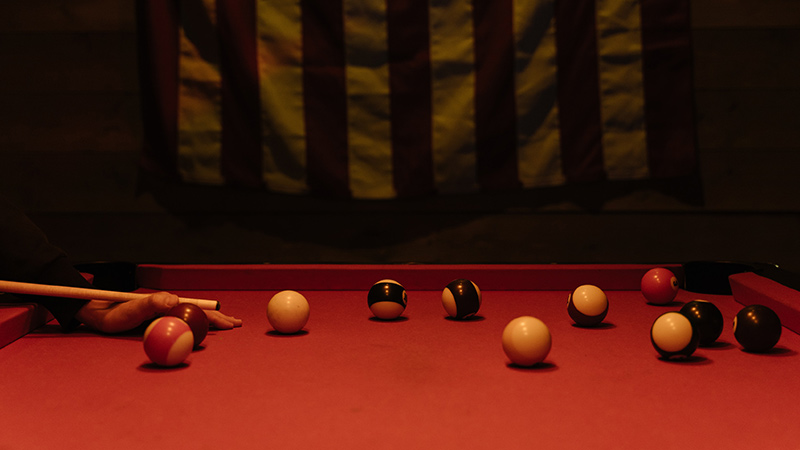
In the world of cue sports, few images are as instantly recognizable as the solid black 8-ball. Whether you are in a professional arena in Las Vegas or a local pub in London, the 8-ball stands as the ultimate arbiter of victory and defeat.
While the other fifteen object balls on the table are divided into vibrant groups of solids and stripes, the 8-ball remains solitary in its darkness. But why is it black?
The answer lies in a mixture of historical innovation, spectator needs, and the evolution of game rules that transformed a casual parlor game into a global professional discipline.
The Historical Evolution: From Pyramid Pool to the 1925 Innovation
To understand why the 8-ball is black, we must first look at where the game of eight-ball began. The game arose around 1900 in the United States as a development of an earlier game called pyramid pool.
In pyramid pool, any eight of the fifteen object balls could be pocketed to win the game. This earlier version lacked the specific “money ball” dynamic we recognize today.
The shift occurred when two fundamental changes were made to the rules: first, that the 8-ball must be pocketed last to win; and second, that each player could only pocket half of the other object balls.
As these rules gained traction, a practical problem emerged for those watching the games. In the early 20th century, billiard sets were not as standardized as they are today. Identifying which ball belonged to which player—and which ball was the final target—was often difficult for the crowd.
In 1925, the Brunswick-Balke-Collender Company stepped in to solve this visibility issue. They introduced purpose-made ball sets specifically designed for this emerging game.
These sets included seven red balls, seven yellow balls, and one black ball. The introduction of the black ball was a calculated move to ensure that spectators could more easily see which suit each ball belonged to and, more importantly, track the progress of the final, game-deciding ball.
While the colors of the other balls would eventually evolve into the solids and stripes we see in American-style pool today, the black color of the 8-ball became a permanent fixture of the sport.
Functional Design: Distinction and Visibility
The primary reason the 8-ball remains black is its unique role in the game’s mechanics. In a standard game of American-style eight-ball, there are sixteen balls: seven solids (numbered 1–7), seven stripes (numbered 9–15), a white cue ball, and the black 8-ball.
The color black provides the ultimate visual distinction against the two groups. In professional play, and especially for television broadcasts, clarity is paramount.
While some “television sets” substitute pink for the dark purple of the 4 and 12 balls or light tan for the maroon 7 and 15 balls to enhance visibility, the 8-ball remains solid black in nearly every variation.
This visual distinction serves several purposes:
Safety During Play
Because hitting the 8-ball first when you still have other balls on the table is a foul, the high-contrast black color prevents players from accidentally targeting the wrong ball.
The “Money Ball” Status
The 8-ball is often called the “money ball” because the game is not over until it is no longer on the table. Its unique color signifies its status as the final objective.
Spectator Clarity
Just as Brunswick intended in 1925, the black ball allows anyone in the room to immediately assess the “state of the game”—how close a player is to the finish line.
The 8-Ball’s Place in the Rack
The 8-ball’s importance is signaled even before the first shot is taken. According to standardized rules, the balls are placed in a triangular rack with the apex ball on the foot spot. However, the 8-ball must be placed specifically in the center of the rack—the middle of the third row.
This placement ensures that the 8-ball is protected during the break shot. Because pocketing the 8-ball on the break can lead to complex rules (such as re-spotting the ball or re-breaking), placing it in the center makes it less likely to be pocketed accidentally during the initial scatter.
Its central position in the rack mirrored by its unique color reinforces the idea that the 8-ball is the heart of the game.
The Psychology and Symbolism of Black
Note: The following section regarding the symbolism of the color black and the “behind the eight-ball” idiom is based on general cultural knowledge and is not explicitly detailed in the provided Wikipedia excerpts.
While the sources focus on the practical 1925 innovation for spectators, the choice of black also carries significant psychological weight. In many cultures, black represents finality, power, and danger.
This aligns perfectly with the 8-ball’s role: it is the ball that ends the game, but it is also the ball that can cause an instant loss if pocketed prematurely or illegally.
The cultural impact of the black 8-ball is perhaps most evident in the common idiom “behind the eight-ball,” which refers to being in a difficult or precarious position.
This likely stems from the rule that the 8-ball is a “forbidden” target for most of the game; if the white cue ball is stuck behind the 8-ball, the player is in a “snookered” or difficult spot where they cannot easily hit their own suit.
Variations Across the Globe
While the black 8-ball is a universal constant, the balls surrounding it often change depending on where in the world you are playing.
1. British Blackball
In the United Kingdom, Ireland, and Australia, a popular variation known as blackball or “British eight-ball” is played. Instead of the numbered solids and stripes used in the American game, this version typically uses un矿numbered red and yellow balls.
Despite these changes to the other object balls, the 8-ball remains black. Interestingly, in this version, the 8-ball is placed on the “spot” during racking, rather than the apex ball.
2. Chinese Eight-Ball (Heyball)
In China, a hybrid version called Heyball has become the most popular cue sport. It uses standard American-style solids and stripes and a black 8-ball, but it is played on 9-foot tables that resemble snooker tables with rounded pocket openings and napped cloth.
3. Specialty Rotations
Even in variants like eight-ball rotation, where players must pocket their suit in numerical order (solids 1 through 7 and stripes 15 down to 9), the 8-ball remains the final black target that must be pocketed last.
Rules of the Black Ball: Victory and Defeat
The black 8-ball is the only ball on the table that carries the power to end the game instantly. To win legally, a player must first clear all of their assigned balls (solids or stripes) and then designate a specific pocket for the 8-ball.
However, the 8-ball is also a minefield of potential losses. A player loses the game if they:
- Pocket the 8-ball and commit a foul (like scratching the cue ball) on the same shot.
- Pocket the 8-ball in a pocket other than the one they designated.
- Knock the 8-ball off the table.
- Pocket the 8-ball before clearing all the balls in their suit.
These high stakes are why the 8-ball is often referred to as the “money ball”—everything leads up to that final, high-pressure black ball shot.
Conclusion: A Century of Black and White
The black 8-ball is more than just a piece of equipment; it is a historical artifact. Born from the need to make pyramid pool more organized and spectator-friendly in the early 1900s, its color was cemented by the Brunswick-Balke-Collender Company in 1925.
Today, it remains the most iconic ball in any pool hall. It represents the transition from an “open” table where anything is possible to the final, “called” shot that demands absolute precision.
Whether you are playing American solids and stripes, British reds and yellows, or Chinese Heyball, the black 8-ball stands as the ultimate goal—the final hurdle between a player and victory.