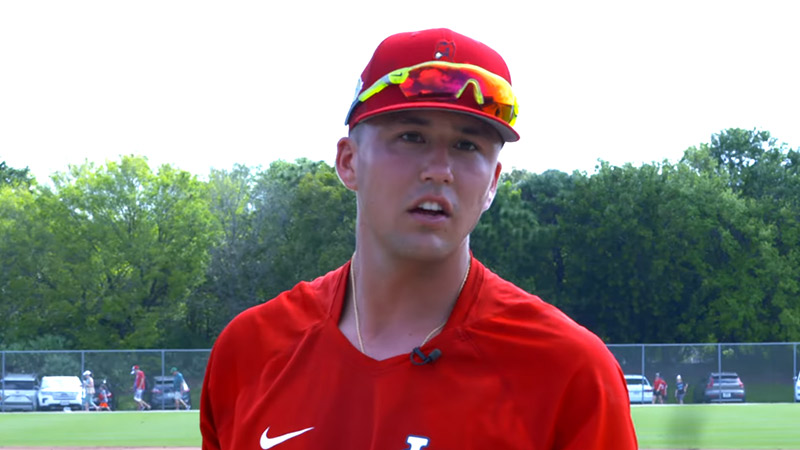
One must first look at the legal and geographical facts of his entry into the world. Lars Nootbaar is American by nationality.
This status is rooted in his birth and subsequent upbringing in El Segundo, California, a coastal city known for its deep-rooted sports culture and proximity to the hub of Major League Baseball.
In the context of international law and sports governance, birthplace typically dictates primary allegiance. Growing up within the United States school system and developing his athletic prowess on American soil, Nootbaar’s formative years were defined by the American experience.
He attended local schools and navigated the competitive California baseball circuit, eventually rising through the ranks of collegiate athletics before entering the professional sphere.
His American citizenship is the bedrock of his legal identity, granting him all the rights and responsibilities associated with being a United States citizen.
A Multilevel Heritage: The Dutch and Japanese Connection
While his passport defines his legal status, his lineage introduces a complex and multicultural narrative. Identity is rarely a singular data point, and in Nootbaar’s case, it is a tapestry woven from diverse ancestral threads. He is of mixed heritage, reflecting a blend of Western and Eastern influences.
His father, Charlie Nootbaar, is an American of Dutch descent. This European ancestry provides a historical link to the Netherlands, though it is the more immediate connection to his mother’s homeland that has garnered significant international attention. His mother, Kumiko Enokida, is Japanese.
This maternal link is not merely a footnote in his biography; it is the catalyst for his unique standing in the world of professional baseball.
Redefining Representation: The 2023 World Baseball Classic
The distinction between legal nationality and athletic representation became a global talking point during the 2023 World Baseball Classic.
In professional sports, particularly within the framework of the World Baseball Classic (WBC), eligibility requirements often extend beyond simple citizenship to include ancestral heritage.
Because of his mother’s Japanese heritage, Nootbaar became eligible to represent the Samurai Japan national baseball team.
This was not a routine roster addition; it was a historic milestone. Nootbaar made history as the first American-born player to play for Japan in international competition.
This decision was a departure from the traditional composition of the Japanese national team, which had historically relied on players born and raised within the Japanese domestic leagues.
Nootbaar’s inclusion signaled a shift in how national teams view talent and identity, prioritizing heritage and skill over strict birthplace requirements. His presence on the team was a bridge between two distinct baseball cultures, merging the aggressive, high-energy style of the American game with the disciplined, precision-oriented approach of the Japanese “Samurai” tradition.
The Economic and Cultural Impact of Dual Identity
From a strategic perspective, Nootbaar’s dual identity has created a unique “brand” that transcends traditional marketing boundaries.
In the United States, he is viewed as a rising star in Major League Baseball, specifically within the St. Louis Cardinals organization. In Japan, however, he has ascended to a level of celebrity that few foreign-born athletes ever achieve.
The phenomenon surrounding his “pepper grinder” celebration and his sudden ubiquity in Japanese advertising highlights a gap in how we traditionally define “national” icons.
Nootbaar’s success suggests that audiences are increasingly willing to embrace athletes who represent their heritage, even if they do not share a common birthplace or primary language.
This has significant implications for global sports organizations looking to expand their footprint. By leveraging players with multicultural backgrounds, teams can tap into secondary markets with an authenticity that traditional marketing cannot replicate.
The Evolution of the “National” Athlete
Nootbaar’s story is emblematic of a broader trend in the 21st century: the rise of the “global citizen” athlete. As migration patterns become more complex and families more multicultural, the rigid lines of national teams are beginning to blur.
In previous decades, an athlete’s nationality was often viewed as a fixed, immutable trait. You played for the country where you were born, or perhaps the country where you held primary residency. Today, the criteria used by organizations like the WBC allow for a more nuanced expression of identity.
This flexibility recognizes that a player can feel a deep, legitimate connection to a nation they did not grow up in, provided they have the documented lineage to support it.
Nootbaar’s case is particularly compelling because he did not just “participate” for Japan; he became a core component of their championship-winning culture.
This demonstrates that heritage-based eligibility is not merely a loophole for talent acquisition, but a way for athletes to honor their family history on a global stage.
Technical Breakdown: Citizenship vs. Eligibility
To provide a professional-grade analysis, it is necessary to distinguish between the legal definition of nationality and the athletic definition of eligibility.
- Legal Nationality: This is a matter of state law. For Nootbaar, this is American, dictated by his birth in California. It involves passports, voting rights, and legal residency.
- Athletic Eligibility: This is governed by the bylaws of international sports federations. In the case of the WBC, eligibility can be granted if a player has a parent born in the country they wish to represent. This is what allowed an American citizen to suit up for Samurai Japan.
This distinction is crucial for understanding why Nootbaar is referred to as “American” in some contexts and “a Japanese representative” in others. Both are true, but they apply to different spheres of his life.
The Psychological Aspect of Dual Representation
Beyond the legalities and the marketing, there is a human element to Nootbaar’s nationality. Representing a mother’s homeland requires a level of cultural humility and a willingness to adapt.
For an American-born player to enter one of the most tradition-bound clubhouses in the world—Samurai Japan—and be embraced requires more than just athletic talent. It requires an understanding of the values that the team represents.
Nootbaar’s ability to bridge this gap suggests that his “Japanese heritage” was more than just a box checked on an eligibility form; it was a lived part of his family dynamic that prepared him for this historic role.
Conclusion: A Legacy of Connectivity
Lars Nootbaar’s nationality is technically American, but his identity is expansive. He represents the modern reality of professional sports, where the borders of the field are far more fluid than the borders on a map.
By honoring his Japanese mother and his Dutch-American father, Nootbaar has managed to become a hero in two hemispheres simultaneously.
His journey serves as a blueprint for future athletes who find themselves at the intersection of multiple cultures.
It proves that one does not have to choose a single identity to be a “national” icon. Instead, an athlete can be a bridge, bringing different parts of the world together through a shared love of the game.
As we look toward future international competitions, the “Nootbaar model” will likely become the standard for how we view, market, and celebrate the global athlete.
His historic status as the first American-born player for Japan is not just a trivia point; it is a signifier of a world that is becoming smaller, more connected, and more inclusive of the diverse backgrounds that players bring to the diamond.
Key Data Summary:
- Primary Nationality: American
- Birthplace: El Segundo, California
- Maternal Heritage: Japanese (Mother: Kumiko Enokida)
- Paternal Heritage: American of Dutch descent
- Historic Achievement: First American-born player for Samurai Japan (2023 WBC)