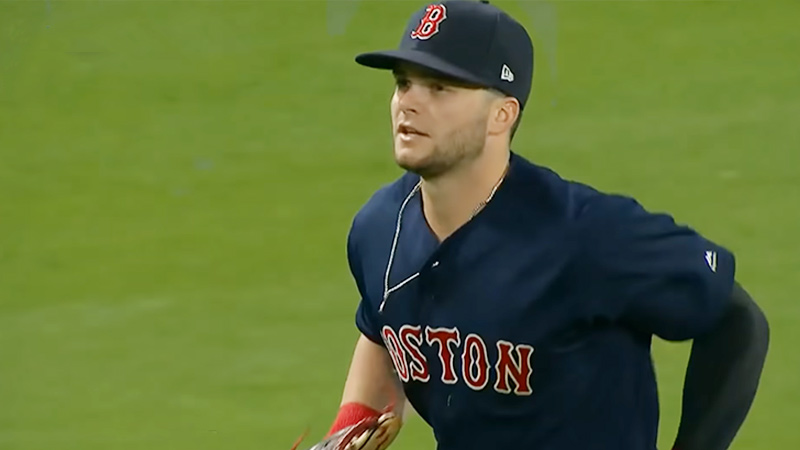
If you typed “what is wrong with Andrew Benintendi” into a search bar, you are probably remembering a very specific version of him.
That is the Benintendi who looked like Boston’s next franchise outfielder, then faded so quickly that the club traded him barely two years after a World Series parade.
Here is the short answer up front. Nothing is wrong with Benintendi in Boston today, because he no longer plays there. He has been with the Chicago White Sox since 2023 and is currently listed as healthy.
The more interesting question is what went wrong during his final two seasons in a Red Sox uniform.
The answer is a mix of a deliberate swing change, a body transformation that backfired, a brutal slump and an untimely rib cage injury. This breakdown walks through each piece, what happened after he left, and what the whole saga says about player development.
Where Benintendi Stands Today
Benintendi signed a five-year, $75 million contract with the Chicago White Sox before the 2023 season. At the time, it was the largest free-agent deal in franchise history, and it runs through 2027.
His 2026 season was a step forward after an injury-wrecked 2025. Across 376 at-bats he hit .245 with 14 home runs, 70 RBI and a .727 OPS. Those are useful everyday numbers for a corner outfielder, even if they fall short of what Boston once projected.
So when fans ask what is wrong with him, the honest reply is that the alarming version of Benintendi belongs to 2019 and 2020. To understand that stretch, you have to start with how high expectations climbed.
The Rise: Why Boston Expected So Much
Boston drafted Benintendi seventh overall in 2015 out of the University of Arkansas, where he won the Golden Spikes Award as the top amateur player in the country. He reached the majors in August 2016, barely a year after the draft.
His first full season in 2017 confirmed the hype. He hit 20 home runs, drove in 90 runs, stole 20 bases and finished second to Aaron Judge in American League Rookie of the Year voting.
Then came 2018, the best season of his career. He hit .290 with a .366 on-base percentage, 87 RBI and 21 stolen bases near the top of a historic lineup. His diving catch to end Game 4 of the ALCS in Houston became one of the defining plays of Boston’s 108-win, World Series-winning season.
His four seasons in Boston tell the story at a glance:
|
Season |
AVG |
OBP |
SLG |
HR |
RBI |
|---|---|---|---|---|---|
|
2017 |
.271 |
.352 |
.424 |
20 |
90 |
|
2018 |
.290 |
.366 |
.465 |
16 |
87 |
|
2019 |
.266 |
.343 |
.431 |
13 |
68 |
|
2020 (14 games) |
.103 |
.314 |
.128 |
0 |
1 |
The peak and the drop are both right there. The question is why a 24-year-old coming off a title season moved backward instead of forward.
What Went Wrong: The Power Push and the Added Muscle
The first crack showed in 2019. His average fell from .290 to .266, his home runs slipped from 16 to 13, and his strikeouts jumped from 106 to 140.
That combination is unusual. A hitter who sells out for power usually accepts more strikeouts in exchange for more home runs. Benintendi paid the strikeout price without getting the power return.
Two changes explain most of it. The first was a shift toward a launch-angle approach, an effort to lift the ball more often and tap into home run power. For a hitter whose strength had been line drives to all fields and excellent bat control, that shift altered the timing and path of his swing.
The second was the muscle he added before 2019. Extra strength sounds like a pure win, but added bulk can change how a hitter’s hands and hips move through the zone. For a player built on quickness, the new frame appeared to cost him some of the fluid, compact swing that made him special.
The result was a hitter caught between two identities. He was no longer the contact-first table setter of 2018, and he had not become the slugger the new approach was chasing.
2020: A Deep Slump, Then a Rib Cage Strain
Before the 2020 season, Boston showed faith in Benintendi with a two-year, $10 million deal that covered his arbitration years. The shortened 60-game season then turned into the worst stretch of his career.
He opened in a severe slump, going 2-for-29 with 12 strikeouts. For a former contact hitter, a strikeout rate that high was a clear sign the swing problems from 2019 had not been solved.
Just as he said he was starting to feel his swing come back, he strained his right rib cage in August. He went on the injured list and did not return, finishing the year at .103 across 14 games.
The injury mattered beyond the lost at-bats. It took away his chance to prove the slump was a blip, and it left the front office with a small, ugly sample to weigh against two years of decline.
The Trade: Why Boston Moved On
In February 2021, the Red Sox sent Benintendi to the Kansas City Royals in a three-team deal that also involved the New York Mets. Boston received outfielder Franchy Cordero and pitching prospect Josh Winckowski, plus additional young players.
From the front office’s side, the logic was simple. Chaim Bloom’s group was rebuilding depth in the farm system, and Benintendi’s trade value had dropped after two down years. Moving him before free agency at least brought back young talent, and Winckowski went on to become a useful arm for Boston.
From the fan’s side, it stung. A homegrown World Series hero was gone at 26, and many felt the club sold low on a player who might bounce back with a fresh start.
Life After Boston: Proof the Talent Never Left
The fresh start worked, at least at first. In 2021 with Kansas City, Benintendi hit .276 with 17 home runs and won an American League Gold Glove in left field.
He was even better early in 2022, earning his first All-Star selection while hitting above .300 for the Royals. Kansas City then traded him to the New York Yankees for the stretch run, but a broken hamate bone in his right wrist ended his season in September.
That track record earned him the White Sox contract. His years in Chicago have been uneven: a low-power 2023, a rebound to 20 home runs in 2024, and a 2025 season disrupted by a fractured right hand, adductor and calf strains, and left Achilles tendinitis.
His 2026 line of .245, 14 home runs and 70 RBI points to a durable, productive veteran rather than a broken hitter. The bigger takeaway is that his Boston collapse was not a permanent loss of skill. It was a fixable swing and approach problem made worse by bad timing.
Organization or Player? Weighing Who Was Responsible
Red Sox fans still argue about who deserves the blame for 2019 and 2020. The debate usually splits into two camps.
The first camp blames the organization. The late 2010s were the height of baseball’s launch-angle movement, and many clubs nudged hitters toward lifting the ball. In this view, Boston tried to turn a natural line-drive hitter into something he was not.
The second camp points at the player. Benintendi chose to add muscle, and a hitter ultimately owns his approach at the plate. From this angle, he chased a power profile on his own and lost his strengths along the way.
The most reasonable reading combines both. The wider game rewarded power, Benintendi bought in, and neither side corrected course quickly enough.
His bounce-back in Kansas City with a more balanced, contact-first approach supports the idea that the underlying talent never disappeared.
For fans and analysts, his Boston years offer a few lasting lessons:
- Refine strengths instead of replacing them. Benintendi’s value came from contact and on-base skills, and the push for power traded away what made him valuable.
- Watch for strikeouts without a power payoff. When strikeouts climb but home runs do not, the swing change is likely costing more than it gives.
- Be careful with small samples. A 60-game season and a mid-year injury left Boston deciding his future on very little evidence.
- A new setting can reset a player. Plenty of hitters recover after a trade, and Benintendi’s Gold Glove and All-Star seasons in Kansas City are a textbook example.
Final Verdict and What to Watch Next
So, what is wrong with Andrew Benintendi and the Red Sox? Today, nothing, because the two parted ways nearly six years ago.
What went wrong in 2019 and 2020 was a power-first swing change, an added-muscle experiment, a deep slump and a rib cage injury at the worst possible moment.
Benintendi has since rebuilt a steady career, and his 2026 season shows he can still be a reliable everyday bat when healthy. With his White Sox contract running through 2027, the next two seasons will shape how his post-Boston chapter is remembered.
In 2027, keep an eye on two numbers: his games played and his strikeout rate. If he stays on the field and keeps the strikeouts in check, he remains a valuable veteran outfielder for Chicago or any contender looking for a trade-deadline bat.