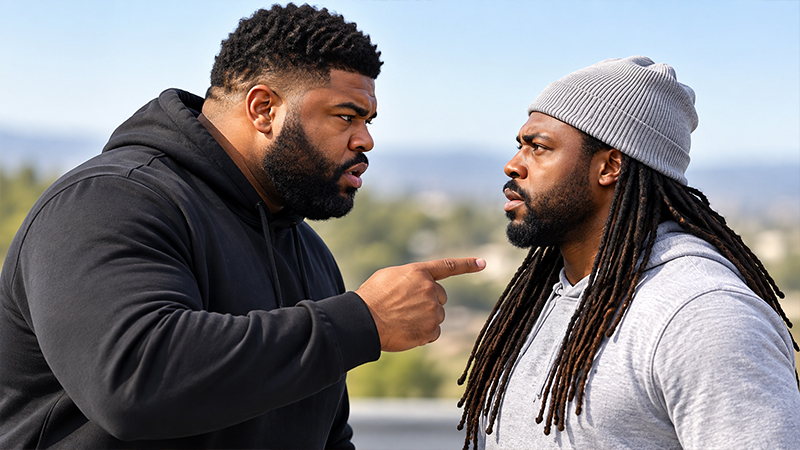
The Week 1 clash between the San Francisco 49ers and the Los Angeles Rams was marketed as the ultimate heavyweight title fight of the modern era.
On one side stood the reigning king of the pass rush, a defender coming off a record-setting season; on the other, a legendary left tackle often described as the “baddest dude in the league”.
The resulting performance was a masterclass in tactical containment that will be studied for years to come.
The Physical Paradigm: Comparing the Combatants
To understand why this matchup favored the veteran, one must first look at the physical metrics of the two athletes. While both are considered elite, their frames and styles represent a collision of different athletic philosophies.
| Attribute | Trent Williams | Myles Garrett |
|---|---|---|
| Position | Left Tackle | Defensive End / Edge |
| Team | San Francisco 49ers | Los Angeles Rams |
| Height | 6-foot-5 | 6-foot-4 |
| Weight | 320 pounds | 272 pounds |
| Age | Entering Year 17 (Age 38/39) | Entering Prime |
| Key Physical Asset | “Heavy Hands” & Elite Lateral Agility | Explosive Edge Rush & Bend |
| Historical Context | First-ballot Hall of Fame trajectory | NFL Top 100 #1 Player |
Williams utilized his superior size and significant weight advantage—nearly 50 pounds—to anchor against the sheer power Garrett typically uses to displace blockers.
Observers noted that Williams’ arm length appeared nearly inhuman, allowing him to establish contact before the defender could initiate his move.
The Statistical Anomaly: A Rare Shutout
In a league where the top-tier edge rushers are almost guaranteed a “cleanup” sack or a quarterback hit, the final box score for this matchup was staggering. Garrett, making his high-profile debut for the Rams, was effectively erased from the game’s outcome.
Table: Comparative Performance Metrics (Week 1)
| Performance Category | Trent Williams Performance | Myles Garrett Performance |
|---|---|---|
| Sacks Recorded/Allowed | 0 Allowed | 0 Recorded |
| Quarterback Hits | 0 Allowed | 0 Recorded |
| Total Tackles | N/A | 0 recorded |
| 1-on-1 Pass Blocking Win Rate | 91.7% (2nd highest of tenure) | Minimal (1 pressure in head-up reps) |
| PFF Grade | 68.8 | 69.4 |
| Penalties | 0 | 0 |
Despite the lack of traditional statistics, the Pro Football Focus (PFF) grades for both players were nearly identical.
This suggests that while Garrett was unable to reach the quarterback, his “wins” on specific reps did not translate into production because of the offensive system surrounding the left tackle.
Williams’ 91.7% win rate in 1-on-1 matchups was the second-highest of his time in San Francisco, emphasizing his individual dominance.
Mechanical Excellence: The “Kick Step” and Lateral Velocity
The technical brilliance of Williams remains one of the most remarkable sights in professional football, particularly given his age. His “kick step”—the initial backward movement to set the edge—is described as so fast that he appears to be hovering.
Key Technical Components of the Matchup:
- The Arc: Williams repeatedly forced Garrett to “run the arc,” steering him deep behind the pocket rather than allowing him to cut inside.
- Hand Fighting: Williams used “heavy hands” to blunt the initial explosiveness of Garrett’s bull rush.
- Physics Defiance: At 320 pounds, Williams displayed the agility of a much lighter player, matching Garrett’s spin moves and lateral shifts step-for-step.
- Leverage: Williams never overcommitted his weight, maintaining a low center of gravity that prevented Garrett from using a “rip” move to get under his pads.
The Tactical Architecture: How San Francisco Won the War
While Williams won the individual battle, the 49ers’ offensive coaching staff won the tactical war. They recognized that even a player of Williams’ caliber would need a specific environment to keep a game-wrecker like Garrett off the stat sheet.
Table: Strategic Neutralization Techniques
| Strategy Component | Tactical Execution | Impact on the Matchup |
|---|---|---|
| Quick Release | Brock Purdy averaged 1.85s per throw | Garrett could not reach the QB before the ball was gone. |
| Chip-Blocks | Usage of George Kittle and McCaffrey | Blunted Garrett’s initial explosive burst off the line. |
| Personnel Rotation | Consistent offensive line stability | Williams wore down Garrett, who was rotating out by the 4th quarter. |
| Diversionary Chaos | “Diverting” rather than “Stonewalling” | Williams used Garrett’s momentum to guide him past the play. |
The 49ers realized that trying to simply “block” Garrett for five seconds was a losing proposition. Instead, the ball was often out of Purdy’s hands in less than two seconds, rendering even a “won” pass-rush rep by Garrett irrelevant.
Contextual Factors: The “Worst Version” of Greatness
Following the game, Garrett was candid about his performance, describing it as the “worst version” of himself. While Williams’ brilliance was the primary factor, several external variables contributed to Garrett’s uncharacteristic lack of impact.
- Physical Health: Subsequent reports indicated that Garrett was dealing with a knee issue that eventually required surgery and a stint on Injured Reserve.
- Logistics and Travel: The Rams made the controversial decision to fly in just one day before the game after a 16-hour flight, leading to visible jet lag and fatigue among the defensive starters.
- Conditioning: By the fourth quarter, Garrett was visibly exhausted, frequently rotating out of snaps as Williams—at 38 years old—seemed to gain strength.
- Defensive Support: Without other elite threats like Aaron Donald, the 49ers were able to focus their entire protection scheme on neutralizing Garrett.
The Legacy of the “Silverback”
The performance solidified Williams’ status as a first-ballot Hall of Famer. His longevity is perhaps his most impressive trait; former greats like Luke Kuechly, who is already retired and in the broadcast booth, recalled playing against Williams when they were both rookies.
Current players and analysts now place Williams firmly in the “Greatest of All Time” (GOAT) discussion for offensive tackles. His ability to demand—and receive—raises every offseason is a testament to the fact that his value to the 49ers’ system is irreplaceable.
Comparative History: Williams vs. The League
To put this Week 1 performance into perspective, we must look at how Williams has fared against other top-tier defenders over his career.
| Season/Week | Opponent | Key Stat | Significance |
|---|---|---|---|
| Career Average | Various | Elite win rates | Sustained dominance for 17 years. |
| Previous Meeting | Myles Garrett | 31% win rate for Garrett | One of the highest win rates Williams ever allowed. |
| Week 1 (2024) | Myles Garrett | 0 Sacks, 0 Hits | Complete reversal of the previous matchup’s pressure rate. |
| Age 38/39 | Various | 1.85s release support | Evolution of playstyle to match modern QB mechanics. |
Expert Analysis: Why the Box Score is Misleading
An analytical review of the game reveals a paradox: Garrett actually “beat” Williams on several reps. However, the 49ers’ scheme ensured that these wins occurred after the ball had been released.
- The Two-Second Rule: Garrett reached the contact point on two specific reps where he beat Williams, but the ball was gone at the 1.85-second mark.
- The “Hold” Controversy: Some observers suggested Williams was holding on several reps where Garrett gained the edge. However, technical analysts noted that on “rip” moves, holding is rarely called, and Williams’ positioning remained technically sound within the rules.
- The Fatigue Factor: Garrett’s explosiveness dipped in every subsequent quarter, whereas Williams maintained a consistent technical floor throughout the game.
Final Verdict
The battle between Trent Williams and Myles Garrett was won by the veteran not just through physical force, but through a superior marriage of individual technique and team strategy.
By utilizing “heavy hands,” elite lateral speed, and a lightning-fast offensive scheme, Williams and the 49ers proved that even the most explosive defender in the world can be neutralized under the right conditions.
While Garrett may have put out a “lesser version” of himself due to injury and logistics, nothing should be taken away from Williams’ flawless execution.
He remains the gold standard for offensive line play, a “Silverback” whose dominance continues to defy the laws of physics and the constraints of age.