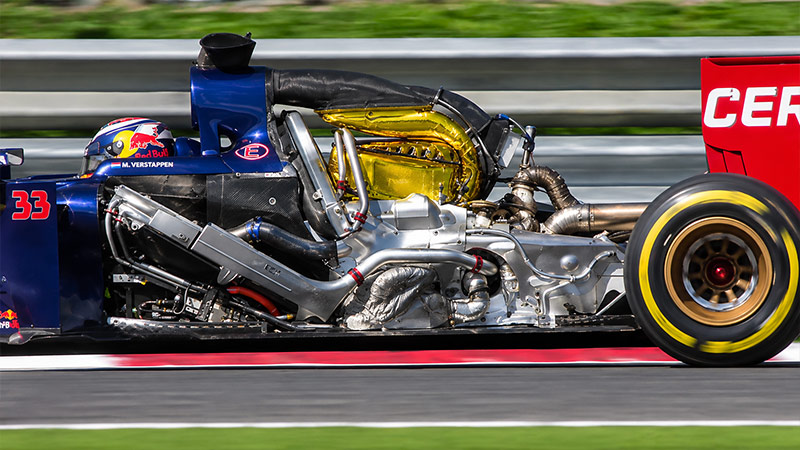
A 2026 Formula 1 car produces roughly 1,000 horsepower, or about 750 kW, when its hybrid system runs at full output. That number comes from two partners working as one: a 1.6-litre turbocharged V6 and a powerful electric motor.
Picture a single-seater that weighs less than a family hatchback, yet carries the punch of a road-going hypercar. That combination is why F1 cars accelerate, brake and corner like nothing else on four wheels.
The headline figure hides a far more interesting story, though. Unlike a road car with one fixed rating, an F1 car’s power rises and falls around every lap as drivers harvest and spend electrical energy.
F1 Power at a Glance: 2026 vs the Previous Era
The total output barely changed in 2026, but the recipe behind it changed completely. Electricity now supplies close to half of peak power, up from about one-sixth.
| Specification | 2014–2025 hybrid era | 2026 regulations |
|---|---|---|
| Combustion engine (1.6-litre V6 turbo) | 550–560 kW (736–750 hp) | about 400 kW (536 hp) |
| Electric motor (MGU-K) | 120 kW (161 hp) | up to 350 kW (469 hp) |
| Combined peak output | about 750 kW (1,006 hp) | about 750 kW (1,006 hp) |
| Electric share of peak power | 16% | 47% |
| Heat recovery unit (MGU-H) | Yes | Removed |
| Energy recovered per lap | 4 MJ | up to 8.5 MJ |
| Fuel | E10 blend | 100% sustainable |
| Minimum car weight, including driver | 800 kg (2025) | 768 kg |
Figures: Motor Sport Magazine, F1 2026 season guide. Exact outputs vary by manufacturer, and teams do not publish official dyno numbers.
Where the 1,000 Horsepower Comes From
The 2026 power unit blends a downsized combustion engine with a much stronger electric motor. Neither half could deliver F1 performance alone.
The combustion engine: about 536 hp
The 1.6-litre turbocharged V6 still sits at the heart of every car, but it now makes roughly 400 kW instead of about 550 kW. The FIA achieved that cut by capping the fuel energy the engine may burn each hour, rather than the fuel mass.
Every drop is now fully sustainable fuel, made from non-food biomass, municipal waste or captured carbon. F1 has targeted about 70 kg of fuel per Grand Prix in this era, compared with 160 kg in 2013.
The electric motor: up to 469 hp
The MGU-K is a motor-generator linked to the crankshaft. It now delivers up to 350 kW, nearly triple the old 120 kW limit, harvesting energy under braking and releasing it on acceleration.
The exhaust-driven MGU-H is gone. According to FIA powertrain chief Vincent Pereme, removing it cut costs and gave newcomers a fairer fight against manufacturers with a decade of hybrid experience.
The battery’s usable window is only about 4 MJ, roughly 11.5 seconds at full electric power. That tiny reserve is why energy management has become a core driving skill.
Why the figure changes around a lap
The full 1,000 hp is a peak, not a constant. Since the Miami Grand Prix in May 2026, the MGU-K may run at 350 kW only in key acceleration zones, from corner exit to the braking point, and at 250 kW elsewhere.
That creates three distinct power levels during a race lap:
- About 1,000 hp on corner exits and in overtaking zones, with both systems at full output
- About 870 hp in capped zones, where the motor is limited to 250 kW
- About 536 hp when the battery is empty and the combustion engine works alone
Drivers can also trigger extra deployment on demand. In races, that Boost is now capped at an extra 150 kW to prevent dangerous closing speeds, while a car within one second of a rival gets Overtake mode for an additional burst of energy.
What changes in 2027 and 2028
The 50/50 balance will not last long. In June 2026, F1’s stakeholders agreed that the combustion engine will rise to 420 kW in 2027 while the motor’s peak drops to 300 kW, a split of about 58/42.
In 2028, a 13% fuel-flow increase lifts the engine to 450 kW, completing the shift to 60/40. Total peak output should stay close to 1,000 hp throughout.
F1 Horsepower Through the Eras
Today’s roughly 1,000 hp matches the late hybrid era and beats every naturally aspirated F1 engine. Only the 1980s turbo cars went higher, and mostly in short qualifying runs.
F1 power is back near 1,000 hp, but 1980s qualifying turbos went higher
| Era | Engine | Estimated peak output |
|---|---|---|
| 1980s | 1.5-litre turbo | 850–1,000 hp in races; 1,200+ hp in qualifying |
| 1995–2005 | 3.0-litre V10 | 900–950 hp |
| 2006–2013 | 2.4-litre V8 | about 750 hp |
| 2014–2025 | 1.6-litre V6 hybrid | about 1,006 hp |
| 2026 | 1.6-litre V6, 50/50 hybrid | about 1,006 hp |
Estimates from GPblog and Motor Sport Magazine. Teams do not publish official figures.
Each dip in power was deliberate. The FIA banned turbos from 1989 over safety and cost, then shrank V10s to 2.4-litre V8s in 2006 to rein in cornering speeds. Rev limits fell too, from about 19,000 rpm in the V10 era to 18,000 for the V8s and 15,000 today.
The 2014 hybrid rules won back the lost horsepower through efficiency rather than engine size. In 2026, F1 kept that total but moved far more of it onto electricity.
How an F1 Car Compares With Hypercars and Other Series
An F1 car is not the most powerful machine on four wheels, but very few match its power for its weight. Most family hatchbacks make 100 to 200 hp, so a 2026 F1 car carries five to ten times that output in a far lighter package.
| Machine | Peak output | What sets it apart |
|---|---|---|
| 2026 F1 car | about 1,006 hp | 768 kg minimum with driver, about 1.31 hp per kg |
| Mercedes-AMG One | 1,049 hp | Road car with an F1-derived V6; about 1,695 kg, roughly 0.62 hp per kg |
| IndyCar with hybrid | over 800 hp | 2.2-litre twin-turbo V6 plus an ultracapacitor boost of about 120 hp |
| Formula E (Gen3) | 350 kW (about 469 hp) | Fully electric; equals the peak of F1’s 2026 electric motor alone |
The AMG One makes slightly more power than a 2026 F1 car, yet it weighs more than twice as much. That gap explains why the F1 car remains in a different league for acceleration, braking and cornering.
Why Horsepower Is Only Half the Story
Raw output wins headlines, but lap time comes from how well a car uses its power. Four factors matter as much as the engine itself.
Power-to-weight ratio
Lighter cars accelerate, brake and change direction faster. The 2026 cars dropped from 800 kg to 768 kg, and former Red Bull boss Christian Horner estimated that every 10 kg costs about 0.35 seconds per lap.
Active aerodynamics
DRS is gone. Front and rear wings now switch between a high-downforce corner mode and a low-drag straight mode, with the new rules targeting about 30% less downforce and 55% less drag than the 2025 cars.
Efficiency
Matching 1,000 hp while burning far less fuel is arguably the sport’s greatest engineering feat. The rules now reward energy that is recovered and deployed wisely, not simply fuel that is burned.
Driver skill and energy strategy
Drivers now manage harvesting and deployment corner by corner, with up to 9 MJ recoverable per lap. Mercedes driver Kimi Antonelli has likened the challenge to “speed chess”, where one greedy harvest can leave a car exposed on the next straight.
George Russell has made a similar point: carrying extra speed through a corner spends energy and harvests less, which can cost time on the following straight. The fastest lap is no longer simply the one with the latest braking.
Conclusion
So, how much horsepower does an F1 car have? In 2026, the answer is about 1,000 hp, split almost evenly between a 1.6-litre turbo V6 and a 350 kW electric motor. That peak is shared out carefully around each lap, dropping to roughly 870 hp in capped zones and about 536 hp on combustion alone.
The bigger lesson is that raw horsepower is no longer the whole contest. Weight, active aerodynamics, efficiency and smart energy management now decide who wins on Sunday.