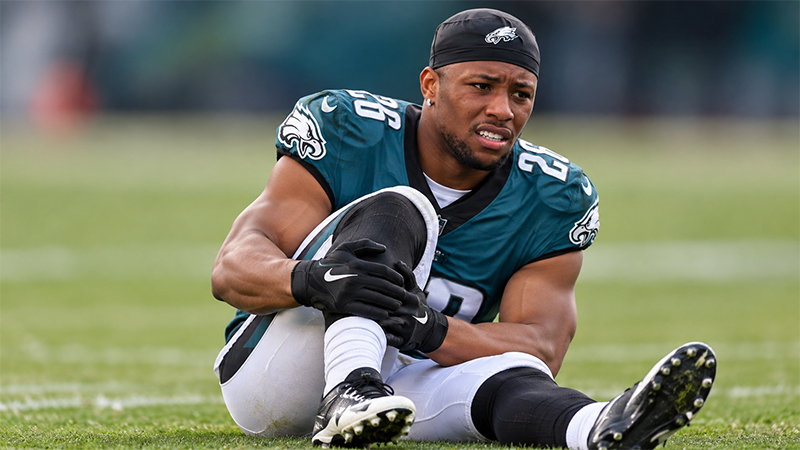
On the opening offensive play of a high-stakes matchup against the Tennessee Titans on September 20, 2026, the football world held its collective breath.
Philadelphia Eagles running back Saquon Barkley absorbed a significant hit from defensive lineman Jeffery Simmons, resulting in a cervical neck stinger.
While Barkley demonstrated his trademark resilience by returning to the field in the third quarter, the incident reignited a long-standing debate regarding his long-term durability and the mounting “medical ledger” of a career defined as much by elite athleticism as by physical recovery.
This report provides a granular examination of Barkley’s injury history, from his record-breaking days at Penn State to his current status as the centerpiece of the Philadelphia Eagles’ offense.
By analyzing the nature of these setbacks, the grades of severity, and the subsequent recovery timelines, we can move beyond the “injury-prone” label to understand the actual physical toll required to maintain a Hall of Fame-caliber trajectory.
The Collegiate Baseline: Durability at Penn State (2015–2017)
To understand Saquon Barkley’s professional durability, one must first look at the foundation established in State College.
During his tenure at Pennsylvania State University, Barkley was a four-star prospect who quickly evolved into a record-breaking workhorse. However, the lower-body joint issues that would occasionally resurface in the NFL began early.
In September 2015, during his freshman season, Barkley sustained a Grade 2 pedal ankle sprain. This injury sidelined him for two games, marking the first significant entry on his medical record. He followed this in 2016 with a Grade 1 ankle sprain sustained in the third quarter against Michigan State.
Notably, Barkley played the following week, establishing an early career pattern of high pain tolerance and a rapid return to play.
Despite these minor setbacks, he forwent his senior year for the 2018 NFL Draft after amassing 43 rushing touchdowns, a testament to his high-volume capacity.
The 2020 Watershed Moment: Managing Knee Reconstruction
The most pivotal moment in Barkley’s career ledger occurred on September 20, 2020, during a Week 2 contest against the Chicago Bears.
In what remains his most devastating professional setback, Barkley suffered a Grade 3 ACL tear and a concurrent Grade 2 MCL sprain in his right knee.
The implications of a Grade 3 tear are absolute: the ligament is completely ruptured, necessitating major reconstructive surgery and an extensive rehabilitation process. This injury cost Barkley the final 14 games of the 2020 season. The recovery from such a trauma is as much psychological as it is physical.
While many athletes struggle to regain their explosive lateral agility following a multi-ligament injury, Barkley’s 2022 and 2024 performances suggest a successful restoration of his joint integrity, though the 2020 incident remains the primary driver of his career “injury risk” metrics.
The Chronic Ankle Narrative: Mobility vs. Stability
Following his return from the ACL reconstruction, Barkley’s injury profile shifted toward recurring issues with his ankles. These “pedal ankle sprains” have become a recurring theme in his professional career:
- September 2019: Prior to the ACL tear, Barkley suffered a Grade 2 high ankle sprain against the Tampa Bay Buccaneers, missing three games.
- October 2021: During a Week 5 game against the Dallas Cowboys, he sustained a Grade 1 low-ankle injury, resulting in a one-game absence.
- September 2023: In a Week 2 matchup against the Arizona Cardinals, he suffered another Grade 2 high ankle sprain, which once again sidelined him for three games.
High ankle sprains are particularly debilitating for a running back like Barkley, whose game relies on “jump cuts” and sudden bursts of speed.
These injuries involve the syndesmotic ligaments that connect the tibia and fibula, requiring significant stability to handle the “valgus stress” of NFL-level contact.
The frequency of these ankle setbacks suggests a susceptibility to “pileup” injuries, a common hazard for high-volume rushers.
Philadelphia 2024: The Pinnacle of Recovery and Workload
The 2024 season stands as the gold standard for Barkley’s career durability and production. In his debut season with the Philadelphia Eagles, Barkley stayed remarkably healthy, appearing in 16 games while resting only in Week 18. His production was historic, leading the league with 2,005 rushing yards and 13 touchdowns.
However, this peak production came at a cost. Barkley logged a massive 345 carries in 2024. Analytical models suggest that such extreme usage often leads to “regression” in the following seasons due to the sheer volume of contact absorbed.
During this dominant run, he managed minor issues including back tightness and a calf/Achilles irritation noted during the NFC Championship, where he was seen using a massage gun on the sidelines.
His ability to win the NFL Offensive Player of the Year and the Bert Bell Award in 2024 proved that when his lower-body “ledger” is clear, his ceiling remains unrivaled.
Upper Body Resilience: Forearms, Elbows, and Stingers
While the majority of Barkley’s injuries are concentrated in his lower body, his upper body has not been immune to the rigors of the position. He has demonstrated a unique ability to play through arm-related traumas that might sideline less resilient backs:
- October 2023: Barkley hyperextended his left elbow against the Commanders. Despite the elbow sprain, he returned to the game wearing a brace and missed no significant time.
- November 2024: He suffered an injury to his left forearm early in a game against the Cowboys but returned shortly thereafter.
- The “Stinger” History: Barkley’s history with cervical stingers—essentially a pinched nerve in the neck—dates back to practice in December 2022. He played through the pain in Week 14 of that year. This history provided the context for his September 2026 stinger against the Titans, where he was evaluated for further impact via MRI.
Durability Metrics and the “Injury-Prone” Debate
To objectively assess Barkley’s health, we must look at proprietary health ratings. As of the 2026 season, Barkley maintains a durability score of 5.00. While this sounds robust, his “Chance of Injury in 2026” is projected at 35%, with a 2.5% chance of injury per game.
These numbers reflect the duality of Barkley’s career. On one hand, he has started all 90 games he has appeared in, totaling over 7,200 rushing yards.
On the other hand, the 2020 ACL tear and the multiple high ankle sprains have created a profile where “general soreness” often leads to a spot on the weekly injury report.
For example, in October 2025, he dealt with a Grade 2 inguinal groin strain that required monitoring, though he returned quickly after a bye week.
The 2026 Landscape: Assessing Current Risk
As Barkley moves through the 2026 season at age 29, the focus remains on his recovery from the recent cervical stinger. Early reports listed him as active for subsequent games, suggesting that the MRI did not reveal structural damage that would necessitate an extended absence.
However, the combination of his age (29.6 years) and his heavy career workload (1,546+ carries) puts him in a high-risk category for soft-tissue injuries, such as the groin strain and calf issues seen in 2025.
The Philadelphia Eagles’ medical staff appears to be managing him with a “rest-focused” approach.
In 2025, for instance, he exited a game early due to a groin injury, but the team explicitly noted his exit was due to the game’s score rather than the injury’s severity—a strategic move to preserve their star asset.
Tactical Analysis: The Impact of Running Style on Injury
Barkley’s injury history is intrinsically tied to his “explosive” running style. Unlike “north-south” power backs who absorb hits directly, Barkley’s “east-west” agility and frequent “jump cuts” place immense torque on his ankles and knees.
The valgus stress (inward collapse of the knee/elbow) mentioned in medical reports from 2023 and 2024 is a direct byproduct of his physics-defying changes of direction.
Furthermore, his high reception total (321 career catches) adds another layer of exposure. Many of his injuries, such as the 2018 hamstring pull and the 2019 high ankle sprain, occurred while he was in space or running pass routes.
This versatility makes him a triple-threat but increases the frequency and variety of hits he sustains from different angles.
The Professional Verdict: A Career of Persistence
Saquon Barkley’s medical ledger is a complex document. It is not merely a list of absences but a chronicle of high-level recovery. To return from a Grade 3 ACL tear to lead the NFL in rushing four years later is a feat rarely seen in professional sports.
As of late 2026, the key takeaways for any analysis of Barkley’s health are:
- Joint Integrity: His reconstructed knee has held up to massive workloads, including a 345-carry season in 2024.
- The Ankle Factor: High ankle sprains remain his most frequent “time-loss” events, usually costing him 3 games per occurrence.
- Workload Management: At nearly 30 years old, his efficiency may remain elite, but his “regression” risk is high after his 2,000-yard peak.
The “Medical Ledger of Saquon Barkley” is a testament to the resilience required to play the most punishing position in sports.
While the hits—like the one from Jeffery Simmons—will continue to come, Barkley’s history suggests that he is a master of the return, consistently defying the odds to remain the most dangerous player on the field.
For those tracking his status for the remainder of 2026, the focus should not be on whether he will be listed on an injury report, but on how effectively the Philadelphia training staff can manage the “stingers” and “strains” that are now part of his legendary career narrative.