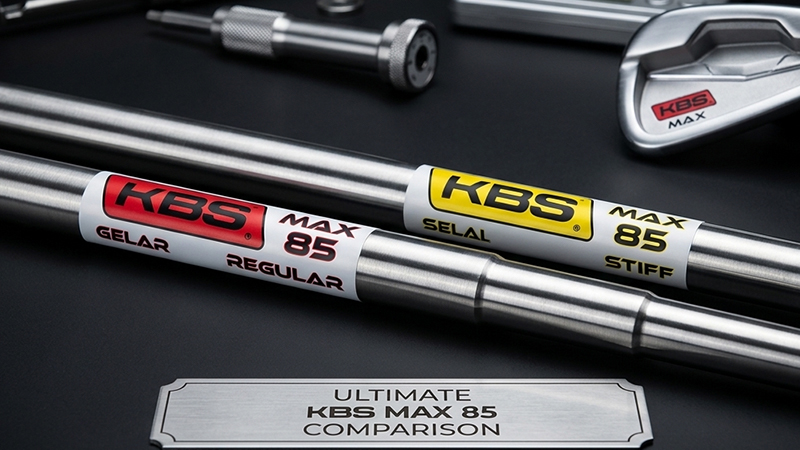
In the modern era of golf equipment, the “one-size-fits-all” mentality has been replaced by a data-driven pursuit of marginal gains. For the high-handicap golfer or the player with a naturally slower tempo, the quest for distance often begins and ends with the iron shaft.
Among the most discussed components in this category is the KBS Max 85, a lightweight steel powerhouse designed specifically to help players launch the ball higher and further with less effort.
However, a unique engineering choice sets this shaft apart: it is a combination shaft. This means a single shaft blank can be trimmed to achieve Regular, Stiff, or even Extra Stiff flex profiles.
This design is intended to impart a high level of consistency across the various flexes, but for the consumer, it raises a critical question: Which trim profile actually delivers the performance you need?
This comprehensive analysis breaks down the KBS Max 85 Stiff versus Regular debate using professional testing data, feel-based feedback, and technical specifications to ensure your next set of irons is optimized for your unique swing.
Understanding the KBS Max 85 Foundation
Before diving into the flex differences, it is essential to understand the “DNA” of the KBS Max 85. KBS has long been synonymous with a “signature smoothness,” a feel often associated with heavier tour-level shafts. Bringing that smoothness down to an 85-gram steel profile is a significant engineering feat.
The Philosophy of Lightweight Steel
Traditionally, 85g was the domain of graphite. Steel shafts in this weight class are designed to provide the stability of metal with the speed-boosting properties of a lighter material.
The KBS Max 85 is specifically reserved for high-handicap players. If iron distance is the primary “chief problem” in your game, this shaft was built for you.
The Combination Shaft Advantage
Because the KBS Max 85 is a combination shaft, it offers a unique level of manufacturing precision. Instead of producing three different shafts, KBS produces one high-quality blank that is “tip-trimmed” to the desired stiffness.
This ensures that whether you play Regular or Stiff, the quality of the steel and the internal wall thickness remain consistent across your entire set.
The KBS Max 85 Stiff: The Case for Precision
For many golfers, the word “Stiff” can be intimidating, especially in a lightweight category. However, in the Max 85 lineup, the Stiff flex is less about handling high swing speeds and more about enhancing feedback and stability.
Enhanced Feedback and Feel
One of the most notable findings in professional testing was the transition in feel. While the Regular flex can occasionally feel “harsh” on mis-hits, the Stiff version replaces that sensation with gentle and clear feedback.
This allows the player to understand exactly where they struck the ball on the face without the jarring vibration often associated with lighter steel.
Managing the High Launch
The Max 85 naturally wants to launch the ball high. For some players, this can result in “ballooning” shots that lose distance in the wind. The Stiff flex helps counteract this.
Testers found it significantly easier to achieve a shallow angle of attack with the Stiff flex, which helped manage that high-launch tendency and keep the ball flight more penetrating.
Spin Control and Stopping Power
The KBS Max 85 Stiff produces mid-spin rates. This is a “sweet spot” for the developing golfer. It provides enough spin to:
- Impart intentional shot shapes like draws and fades.
- Ensure the ball has enough “bite” to stop on elevated greens.
- Maintain enough stability to prevent mis-hits from “reeling off-line”.
The KBS Max 85 Regular: The Engine for Speed
If the Stiff flex is about control, the KBS Max 85 Regular is unequivocally about velocity. It is the ideal choice for the player who needs every possible yard of carry.
The Mid-Section “Kick”
The defining characteristic of the Regular flex is its “kick”. The kick point is located in the mid-section of the shaft, providing an active feel through the hitting zone. This creates a sensation of the shaft “loading and unloading” more dynamically than the Stiff version.
Speed Gains
Testing data confirms that the Regular flex provides upticks in both club head speed and ball speed compared to the Stiff version. While these improvements are described as “slight,” in a game of inches, those extra 1–2 miles per hour can be the difference between clearing a bunker and ending up in the sand.
The Trade-off: Dispersion
The increased “kick” and higher spin rates of the Regular flex come with a caveat. For players with faster swing speeds or aggressive tempos, the Regular flex can lead to wider dispersion.
The shaft becomes more difficult to square up consistently, meaning your “misses” might travel further left or right than they would with the Stiff flex.
Head-to-Head: Breaking the Distance Myth
One of the most surprising takeaways from head-to-head testing is the impact (or lack thereof) on total distance.
Data Insight: In terms of pure distance, there is no significant difference between the KBS Max 85 in Stiff or Regular flex.
This is a critical realization for the consumer. If you are choosing the Regular flex solely because you think it will hit the ball 10 yards further, the data does not support that conclusion. Instead, the choice should be based on how you want to achieve that distance:
- Choose Stiff if you want distance with acute spin control and stability on mis-hits.
- Choose Regular if you want distance achieved through increased raw speed and a more active feel.
Technical Pairing: Optimizing Your Iron Set
Selecting the right shaft is only half the battle; how that shaft interacts with the club head is where the real performance is found.
The “Iron Head” Rule
KBS experts and testers recommend a specific pairing strategy for the Max 85. Do not pair this shaft with “huge,” oversized iron heads.
Doing so often results in a loss of control, as the light weight of the shaft struggles to balance the high Moment of Inertia (MOI) of a massive head.
Instead, the KBS Max 85 works best with moderate-footprint Game Improvement (GI) irons. This pairing maintains a balanced “swing weight” and ensures the golfer can still feel the head throughout the swing.
The Wedge Advantage
Because the KBS Max 85 naturally launches high, it is an exceptional choice for weak-lofted wedges. Many golfers struggle to get enough height on their gap or sand wedges to stop the ball quickly; the Max 85’s natural launch characteristics solve this problem inherently.
Who Should Actually Buy the KBS Max 85?
As an industry-leading review, we must be clear about the target demographic to ensure you aren’t buying a product that doesn’t fit your profile.
Ideal Player Personas:
- The Senior Golfer: Players seeing a decline in swing speed who want to stay in steel rather than moving to graphite.
- The High-Handicap Improver: Golfers who need the launch help but want “clear feedback” to help them improve their ball striking.
- The Distance-Challenged: Players for whom “iron distance is the chief problem”.
Pros:
- Affordability (Great value for a premium brand).
- Signature KBS smoothness in a light package.
- Optimal launch for low-trajectory hitters.
Cons:
- Potential for poor shot dispersion if swing speed is too high.
- High-launch may be difficult to control in windy conditions.
Overall Score: 94/100.
Enhanced FAQ: Expert Insights
Q: Can I really use the same shaft for Stiff and Regular?
A: Yes. Because it is a combination shaft, the stiffness is determined by how much is trimmed from the tip during the build process. A professional club builder can dial this in exactly to your needs.
Q: Will the Regular flex feel “whippy”?
A: It has more “kick” in the mid-section, but it retains the KBS stability. However, if you have a fast tempo, you may find the dispersion wider than you’d like.
Q: Is 85g too light for steel?
A: Not for the target audience. The weight allows slow swingers to gain more distance while maintaining the “stable” feel of steel.
Final Verdict: The Strategist’s Conclusion
The KBS Max 85 is a masterclass in specialized engineering. By offering a lightweight steel solution that doesn’t sacrifice the “KBS feel,” the brand has created a lifeline for high-handicappers.
- Go with the Stiff trim if you value stability, feedback, and spin control. It is the “player’s” version of a game-improvement shaft.
- Go with the Regular trim if you are looking to maximize club head speed and prefer a shaft that feels active and “springy” through impact.
Regardless of your choice, ensure you pair them with moderate GI heads to maintain the control this 94/100 rated shaft is capable of delivering.