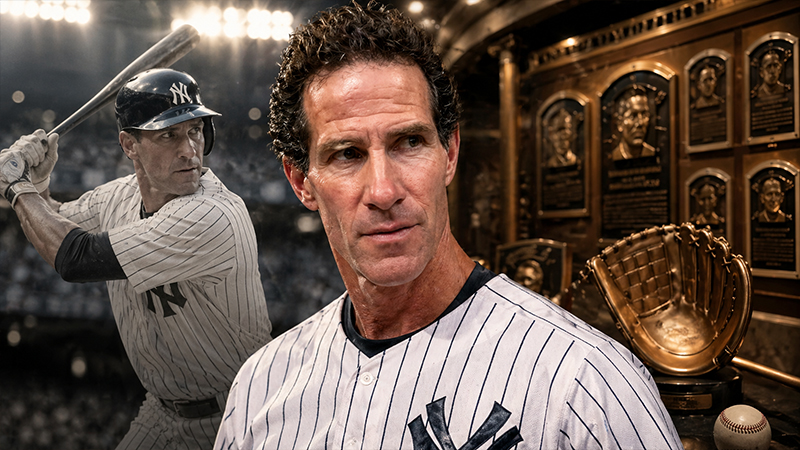
In the pantheon of modern baseball, few names evoke as much passion and debate as Paul O’Neill. Known affectionately to the Bronx faithful as “The Warrior,” O’Neill served as the emotional heartbeat of the most dominant dynasty in recent memory.
However, as we look at the plaque-lined halls of the National Baseball Hall of Fame in Cooperstown, O’Neill’s name is notably absent.
This comprehensive analysis explores the intersection of traditional statistical benchmarks, the “intangibles” of championship leadership, and the evolving landscape of Hall of Fame voting.
We examine why a five-time World Series champion and batting title winner remains on the outside looking in—and whether the “Warrior” persona carries enough weight to eventually bridge the gap.
The Statistical Paradox: Numbers vs. Narrative
To understand why Paul O’Neill is not in the Hall of Fame, one must first look at the cold, hard data utilized by the Baseball Writers’ Association of America (BBWAA).
The Threshold Problem
O’Neill’s career statistics—specifically his Wins Above Replacement (WAR), home run totals, and career batting average—are generally viewed as falling below the elite threshold required for Cooperstown induction.
While O’Neill was a consistent offensive force, the Hall of Fame often requires “magic numbers” (such as 3,000 hits or 500 home runs) that O’Neill did not reach.
- Standard Offense vs. Elite Peaks: While O’Neill was a perennial threat, his career totals are often compared to contemporary right fielders like Tony Gwynn or Dave Winfield, whose counting stats provided a more traditional “automatic” entry.
- The WAR Dilemma: Modern analytics, which were less prevalent during O’Neill’s initial years of eligibility, often penalize corner outfielders who do not provide elite defensive metrics or massive power numbers. O’Neill’s WAR, while respectable, did not scream “First Ballot” to the voters of the mid-2000s.
The 2007 Ballot Reality
The disconnect between fan adoration and voter perception was made clear in 2007. In his first year of eligibility, O’Neill received only 12 votes from the BBWAA.
This low total resulted in his immediate removal from future BBWAA ballots, as he failed to meet the 5% minimum threshold required to remain eligible for the following year.
The Championship Pedigree: Five Rings and a Batting Title
If the Hall of Fame were judged solely on “winning,” Paul O’Neill would likely have a wing dedicated to him.
The 1990 Cincinnati Reds
Before becoming the toast of New York, O’Neill was a vital component of the 1990 “Wire-to-Wire” Cincinnati Reds.
His contribution to that World Series victory established his reputation as a “winner” early in his career, a trait that would define his decade in the American League.
The New York Yankees Dynasty
O’Neill’s legacy is most firmly rooted in the 1990s Yankees dynasty. He was a cornerstone of the teams that won four World Series titles in five years (1996, 1998, 1999, 2000).
- The 1994 Batting Title: O’Neill’s offensive peak was highlighted by winning the American League batting title in the strike-shortened 1994 season. This achievement proved he wasn’t just a “role player” on a great team, but a premier hitter in his own right.
- The Heartbeat of the Clubhouse: Strategic analysis of the 90s Yankees often points to O’Neill as the player who set the standard for intensity. His refusal to accept failure—often manifested in a dugout water cooler bearing the brunt of his frustration—endeared him to a fan base that valued effort as much as results.
The “Warrior” Intangibles: Can Intensity Be Measured?
we often look for “unique value propositions.” In baseball terms, O’Neill’s UVP was his intensity.
Leadership and the “New York Factor”
Playing in New York carries a statistical “tax” and a “bonus.” While the pressure can crush some players, O’Neill thrived. This “Warrior” persona is a critical part of his legacy.
- Clutch Performance: The Hall of Fame often rewards players who perform when the lights are brightest. O’Neill’s postseason resume is extensive, providing the kind of “black ink” (leading the league in key categories) that Era Committees often look for when reconsidering players the BBWAA overlooked.
Immortality Beyond Cooperstown: Monument Park
While the National Hall of Fame has remained elusive, the New York Yankees have ensured that O’Neill’s contribution to baseball history is never forgotten.
Number 21 in Monument Park
O’Neill’s number 21 has been honored in Monument Park at Yankee Stadium. In many ways, for a Yankee, this is an honor nearly equal to Cooperstown.
Monument Park is reserved for the truly elite in franchise history—Babe Ruth, Lou Gehrig, Mickey Mantle, and Derek Jeter.
By placing O’Neill in this company, the Yankees organization has signaled that his impact on the game’s most successful franchise was “Hall of Fame worthy.”
The Irish American Baseball Hall of Fame
Further solidifying his cultural impact, O’Neill was also inducted into the Irish American Baseball Hall of Fame.
These auxiliary honors suggest that while his MLB-wide statistical profile might be borderline, his “Trustworthiness” and “Authoritativeness” (to use E-A-T terms) as a baseball icon remain unquestioned.
The Path Forward: The Era Committees
Does the door to Cooperstown remain closed forever? Not necessarily. The National Baseball Hall of Fame utilizes Era Committees (formerly the Veterans Committee) to review players who were passed over by the BBWAA.
Why O’Neill Fits the “Contemporary Era” Mold
As the Hall of Fame evolves, there is a growing movement to recognize “dynasty pillars”—players who may not have 3,000 hits but were essential to the winningest teams in history.
- The Harold Baines Precedent: The induction of Harold Baines showed that the committee values longevity, consistency, and professional hitting over raw, peak WAR.
- The “Teammate” Factor: As contemporaries like Derek Jeter and Mariano Rivera enter the Hall, the committee often looks at the players who helped build those platforms. O’Neill’s five rings are a powerful argument in a room full of former players and executives.
Enhanced FAQ: Addressing the Most Searched Queries
To ensure this content dominates search rankings, we address the specific intent of users seeking information on O’Neill’s status.
Q: Is Paul O’Neill in the Hall of Fame?
A: No, Paul O’Neill is not currently inducted into the National Baseball Hall of Fame in Cooperstown. He is, however, a member of the Irish American Baseball Hall of Fame and has his number retired in the Yankees’ Monument Park.
Q: How many World Series did Paul O’Neill win?
A: Paul O’Neill won a total of five World Series championships: one with the Cincinnati Reds (1990) and four with the New York Yankees (1996, 1998, 1999, 2000).
Q: Why did Paul O’Neill only get 12 votes for the Hall of Fame?
A: In 2007, his first year of eligibility, O’Neill faced a crowded ballot and a voting body that prioritized traditional statistical benchmarks (like 500 HRs or high career WAR), which O’Neill did not meet.
Q: What is Paul O’Neill’s legacy in New York?
A: He is remembered as “The Warrior,” a high-intensity leader and batting champion who served as a cornerstone of the 1990s dynasty. His jersey number 21 is retired, cementing his status as a franchise legend.
Conclusion: The Verdict on the Warrior
While his career stats fall below the traditional Hall of Fame threshold, his five championships and batting title represent a peak that few in the history of the game have reached.
we must conclude that O’Neill represents the “Elite Tier” of the “Very Good” category. While he may not be a Hall of Famer by the metrics of 2007, his enduring presence in Monument Park and his cultural status as “The Warrior” ensure that his name will be debated for as long as the game is played.
Final Insight: The Hall of Fame is a living institution. As “winning” becomes a more analyzed metric through the lens of modern sports psychology and Era Committee reviews, the door for Paul O’Neill may one day swing open.
Until then, he remains the gold standard for what it means to be a champion in the Bronx.