The short answer: yes, Albies hits from both sides
Yes. Ozzie Albies is a switch hitter. The Atlanta Braves second baseman bats both ways and throws right-handed, so he steps in left-handed against right-handed pitchers and right-handed against left-handed pitchers.
That is the quick answer. The more interesting story is how different he looks from each side. Over the last three seasons, Albies has posted a .747 OPS swinging right-handed and a .655 OPS swinging left-handed, a gap that shapes where Atlanta bats him, how rival managers use their bullpens, and how fantasy managers should value him.
In this guide, you will learn where his switch-hitting began, what the numbers from each side really say, why the split exists, and what it all means as the Braves head into 2027.
Who is Ozzie Albies?
Albies is Atlanta’s everyday second baseman and has spent all 10 of his big-league seasons with the Braves.
He was born January 7, 1997, in Willemstad, Curaçao, and signed with Atlanta on July 2, 2013, as an international free agent for $350,000.
The Braves’ Curaçao connection helped land him: fellow islanders Andruw Jones and Andrelton Simmons had both starred for the club. He moved fast through the minors, debuted on August 1, 2017, at age 20, and his first big-league hit two days later was a home run.
Detail | Ozzie Albies |
|---|---|
Team | Atlanta Braves (2017–present) |
Position | Second base |
Bats/throws | Switch/right |
Born | January 7, 1997, Willemstad, Curaçao |
MLB debut | August 1, 2017 |
Career line (through 2026) | .262 AVG, 1,232 hits, 179 HR, 655 RBI in 1,190 games |
Honors | 4× All-Star (2018, 2021, 2023, 2026), 2× Silver Slugger (2019, 2021), 2021 World Series champion |
How switch-hitting works for Albies
Albies always takes the platoon advantage. Against a right-handed pitcher, he bats left-handed; against a lefty, he crosses to the other box and bats right-handed.
That way, breaking balls tend to move toward him instead of away, and he picks up the ball from a better angle out of the pitcher’s hand.
Because most big-league pitchers throw right-handed, his left-handed swing does most of the work. In 2026, 422 of his 683 plate appearances, about 62%, came against right-handers. Since 2024, that share is closer to 69%.
Switch-hitting came relatively late for him: he began batting from both sides in 2013, the year he signed. In a 2019 FanGraphs community analysis, Albies explained that his big leg kick dates back to childhood and that he quieted it from the left side in the minors to time pitchers better.
His right-handed swing kept the high kick and, as that analysis noted, generates more upper-body torque.
That comfort showed in September 2024. After a fractured left wrist cost him two months, Atlanta activated him to bat only right-handed, an unusual arrangement for an established switch hitter.
The split, by the numbers
Albies has posted a higher OPS from the right side in each of the last five seasons, though the size of that gap swings widely from year to year.
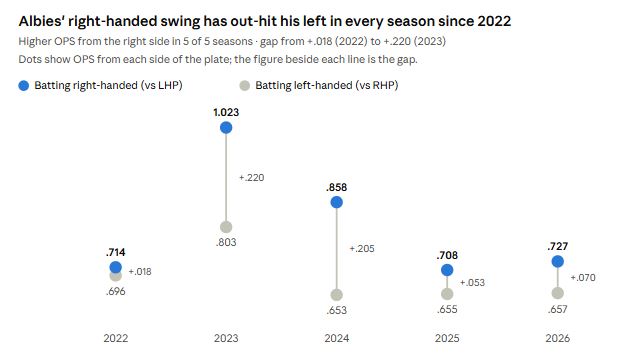
The gap peaked in 2023 and 2024, when he crushed left-handed pitching, then narrowed to under .100 in 2025 and 2026 as his right-handed production cooled. Power tells a different story: in his 33-homer 2023 season, 28 of those home runs came while batting left-handed.
Why the gap exists
No single cause explains the split, but several factors point the same way.
- Two swings, two timing systems. His right-handed swing is the one he grew up with. The left-handed version was reworked with a quieter leg kick, so he maintains two separate timing mechanisms across a 162-game season.
- Batting average drives the difference. Since 2024 he has hit .283 from the right side and .222 from the left. His home run rate is much closer: 16 homers in 556 plate appearances right-handed (2.9%) versus 32 in 1,229 left-handed (2.6%).
- Sample size. He sees lefties in only about three of every ten plate appearances. Smaller samples swing harder, which helps explain spikes like a 1.023 OPS from the right side across 133 plate appearances in 2023.
- Injuries to the same hand. A fractured left wrist in July 2024 and a fractured left hamate in September 2025 both hit his left hand. Tying them directly to the split would be speculation, but they belong in the picture.
- Softer contact overall. Statcast shows his barrel rate falling from 8.3% in 2023 to 3.8% in 2026, and his hard-hit rate from 39.0% to 27.7%. Less loud contact leaves less margin from either side.
The practical read: Albies is a contact-and-average threat from the right side and a volume power bat from the left, because that is where most of his at-bats happen.
Career milestones from both sides of the plate
Albies has built a decade of highlights as a switch hitter, from a home run in his first big-league hit to a historic walk-off on the international stage.
Date | Milestone |
|---|---|
Oct 2026 | Hit .250 with 2 HR and 5 RBI in 7 postseason games; Atlanta beat Philadelphia in the Wild Card Series, then fell to the Dodgers in the NLDS |
Jul 2026 | Named to his fourth All-Star Game |
Mar 2026 | Opening Day homer off left-hander Cole Ragans, swinging right-handed, giving Atlanta its first home run of the season for a second straight year |
Mar 2026 | Hit the first walk-off home run in World Baseball Classic history, a three-run shot for the Netherlands to beat Nicaragua 4–3 |
Sep 2025 | Left hamate fracture ended his season after he had played in all 157 of Atlanta’s games |
Jun 2025 | Recorded his 1,000th career hit |
Sep 2024 | Returned from a fractured left wrist batting only right-handed |
2023 | Career highs of 33 HR and 109 RBI; third All-Star selection |
2021 | 30 HR, 106 RBI and 20 steals; first second baseman in franchise history with 30 HR and 100 RBI in a season; Silver Slugger; World Series champion |
2019 | Hit .295/.352/.500 and led the NL with 189 hits; Silver Slugger; signed a seven-year extension in April |
2018 | All-Star in his first full season |
Aug 2017 | MLB debut at age 20; first hit was a home run |
How he stacks up against other switch hitters
Albies plays for a franchise with deep switch-hitting roots. Chipper Jones, the Braves’ Hall of Fame third baseman, hit 468 home runs from both sides and was around the club to help a young Albies refine his two swings.
The all-time standard belongs to Mickey Mantle, whose 536 home runs remain the most by a switch hitter.
With 179 homers through his age-29 season, Albies is not on that path, but he has produced rare power for a middle infielder: in 2021 he was one of only five players with 30 home runs and 20 steals.
His profile also fits a common pattern. Many switch hitters are clearly stronger from one side, and the question is whether the weaker side is good enough to justify keeping it.
For Albies, the answer has been yes: his left-handed swing still delivers most of his home runs, simply because it gets the most at-bats.
Modern rules make that versatility even more useful. Since 2020, relievers must face at least three batters or finish an inning, which limits late-game matchup moves.
Bringing in a lefty to face Albies is often a losing trade anyway, because it moves him to his stronger right-handed side.
What it means for the Braves, fans and fantasy managers
Albies enters the 2026–27 offseason as a durable, switch-hitting regular coming off a two-speed season.
He played all 162 games, the most in the National League, and finished at .237/.293/.392 with 22 home runs, 73 RBI and 85 runs. A strong first half (.759 OPS before the All-Star break) earned his fourth All-Star nod, but he faded to a .576 OPS after it.
Atlanta went 94–68 to win the NL East, beat Philadelphia in the Wild Card Series and lost to the Dodgers in four games in the NLDS. Albies hit two home runs in seven postseason games.
His contract keeps him affordable. The seven-year, $35 million extension he signed in April 2019 included $7 million club options for 2026 and 2027.
Atlanta exercised the first in November 2025, and MLB.com’s Mark Feinsand reported in October 2026 that the club is expected to pick up the second, which would make 2027 his final season under team control.
How to use the split:
- For the Braves: his right-handed bat makes him a natural fit higher in the order against left-handed starters, while his durability keeps him in the lineup daily.
- For fantasy managers: in daily formats, upgrade him when Atlanta faces a left-handed starter and temper expectations in weeks stacked with right-handers. In weekly leagues, his games-played totals (157 and 162 the last two seasons) keep his counting stats steady.
- For fans at the ballpark: watch which box he steps into. When he walks to the right side, the opposing manager has handed him his best matchup.
The bottom line
Ozzie Albies is a switch hitter, and a durable one. He bats left-handed against right-handed pitching and right-handed against left-handed pitching, and the numbers consistently favor his right-handed swing for average and on-base skills.
His left-handed swing, used in roughly two of every three plate appearances, supplies most of his home runs by sheer volume.
Heading into his age-30 season on a $7 million option, Albies remains one of the best-value contracts in baseball and a player whose matchups are worth checking every day.