The trajectory of a professional athlete’s career is often dictated as much by the training room as it is by the film room.
For Nakobe Dean, the 25-year-old linebacker now anchoring the Las Vegas Raiders’ defense, the narrative of the past two seasons has been one of elite potential intermittently interrupted by physical setbacks.
As the Raiders prepare for their upcoming campaign, the primary question from analysts and fans remains: Is Nakobe Dean fully healthy?
Based on the most recent reports from training camp and the historical context of his recovery, the answer is a definitive yes.
Dean is currently participating fully in team activities, having successfully navigated a rigorous multi-year rehabilitation process that saw him overcome a major knee injury and subsequent soft-tissue hurdles.
The current status: A healthy anchor in Las Vegas
As of the latest updates from the Las Vegas Raiders’ training camp, Nakobe Dean has been cleared for all team activities and practices.
This is a significant milestone for the linebacker, who has faced various physical challenges since the early stages of his professional career.
Perhaps the most telling indicator of his current health is his exclusion from the Physically Unable to Perform (PUP) list at the start of camp.
For a player with his injury history, starting camp on the active roster signifies that the medical staff has total confidence in his structural integrity and functional movement.
Furthermore, Dean has not merely been a “participant” in camp; he has reclaimed his status as a high-level communicator. He has been observed taking the defensive “green-dot” reps—the designated helmet that receives play-calls from the coaching staff.
This role requires a player to be the primary signal-caller and communicator in the middle of the defense, a responsibility typically reserved for players who are both mentally sharp and physically reliable enough to stay on the field for every down.
The road to recovery: Understanding the patellar tendon tear
To appreciate the significance of Dean’s current health, one must look back at the catastrophic injury that halted his momentum in Philadelphia.
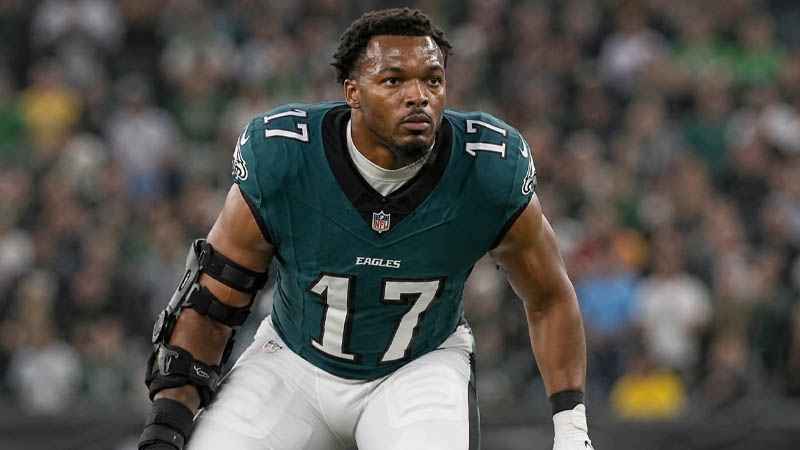
During the Eagles’ 22-10 wild-card victory over the Green Bay Packers in January 2024, Dean suffered a torn patellar tendon.
A patellar tendon tear is widely regarded as one of the most grueling injuries for a linebacker, as it directly impacts explosive power, jumping, and the ability to change direction—the literal “engine” of a defensive player’s movement.
Dean was forced to watch from the sidelines as his teammates navigated the remainder of the playoffs, eventually winning Super Bowl LIX.
The 2025 comeback attempt
The recovery was not instantaneous. Dean began the 2025 season on the PUP list, continuing a rehabilitation process that he described as a “day-by-day grind”.
He remained optimistic throughout the process, though he later admitted that as a human, he had moments where his positivity was tested.
Despite the long road back, Dean’s performance upon his return in Week 7 of the 2025 season was statistically dominant. In just half a season, he recorded:
- 55 tackles
- 4 sacks
- 2 forced fumbles
- 7 tackles for loss (TFLs)
- 6 quarterback hits
This level of production suggested that while his volume of play was limited, his efficiency and “burst” had largely returned.
Addressing the “setback” narrative: The hamstring issues
A common concern with players returning from major lower-body surgeries is the prevalence of secondary “compensatory” injuries.
In late 2025, Dean missed two weeks of play due to a minor hamstring injury.
While this caused some alarm among the fanbase, Dean and the medical staff characterized the tweak as insignificant.
He returned to practice shortly thereafter, asserting that he was ready for the postseason and expressing confusion when questioned about his availability.
As the calendar turned to the current training camp in Las Vegas, those hamstring issues have been categorized as fully resolved.
His ability to participate in full-speed drills without limitation indicates that the muscle imbalances often associated with major knee surgery have been corrected through his rigorous “day-by-day” approach.
The mental evolution: Seeing the game more clearly
Health in the NFL is not solely defined by the absence of pain; it is also defined by the ability to play without hesitation.
Dean has noted that his time away from the field allowed him to sharpen his mental acuity.
“The more ball I play, the better I see it, the more I understand it,” Dean remarked regarding his development.
He has transitioned from a young athlete relying on raw athleticism to a veteran signal-caller who understands the intricacies of defensive schemes.
This mental growth often allows a player to “play faster” than their stopwatch speed, as they can anticipate plays before they develop, thereby reducing the physical strain on their body.
Strategic implications for the Las Vegas Raiders
The Raiders’ decision to bring Dean into their defensive fold was a calculated move based on the belief that his injury-prone label was a byproduct of a specific, fluke incident (the patellar tear) rather than a chronic condition.
By taking the green-dot responsibilities, Dean is positioned to be the defensive anchor for Las Vegas. His presence provides:
- Elite Communication: As a signal-caller, he ensures that the secondary and defensive line are aligned correctly.
- Playmaking in the Gap: His 2025 stats (7 TFLs in half a season) highlight an ability to penetrate the backfield that few middle linebackers possess.
- Championship Pedigree: Having been part of a Super Bowl-winning organization in Philadelphia, he brings a standard of excellence to the Raiders’ locker room.