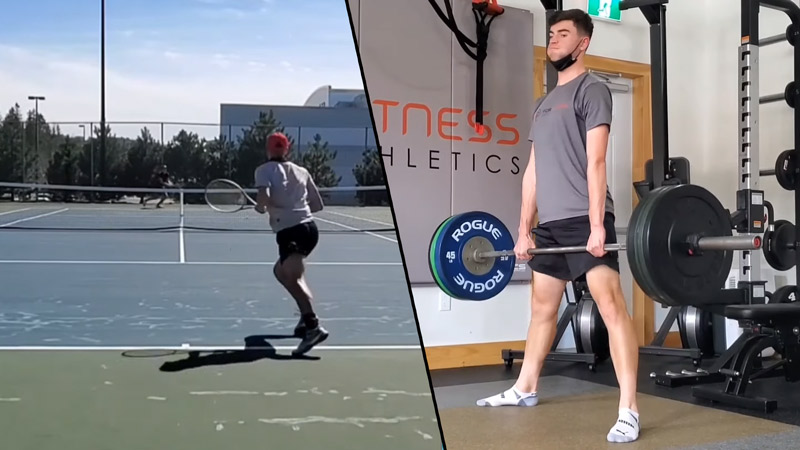
The image of a professional tennis player often evokes thoughts of lean, lithe athletes gliding effortlessly across a court, rather than the heavy-lifting powerhouses seen in a traditional gym.
This has led to a long-standing misconception among casual fans and amateur players: do professional tennis players actually lift weights?
The answer is a resounding yes. However, the objective of their training is fundamentally different from that of a bodybuilder or a powerlifter.
For a tennis professional, the weight room is not a place to build aesthetic bulk; it is a laboratory for developing functional power, resilience, and longevity.
The Performance Philosophy: Function Over Aesthetics
The primary reason you rarely see “bulky” tennis players is that excess muscle mass can be a hindrance on the court.
In a sport that requires rapid changes of direction and extreme flexibility, carrying unnecessary weight—even muscle—can slow a player down and lead to premature fatigue during a five-set match.
Professional athletes in this space utilize weightlifting for three specific outcomes: injury prevention, explosive power, and match endurance.
Their routines are precision-engineered to ensure that every ounce of muscle added serves a functional purpose, helping them survive the grueling physical demands of the modern tour.
The Power of the Kinetic Chain
One of the most critical concepts in tennis-specific training is the “kinetic chain.” To the untrained eye, a 130-mph serve looks like an act of arm strength. In reality, the arm is merely the final link in a complex sequence of energy transfer.
Power in tennis begins at the ground. It moves through the legs, travels into the hips and core, and is finally unleashed through the shoulder, arm, and racket.
Because of this, professional gym routines prioritize whole-body movements rather than isolated muscle exercises.
Lifts such as squats and deadlifts are staples for the elite player. These exercises develop the foundational leg strength required to push off the court surface with maximum force.
By strengthening the lower body, a player can generate more “easy” power, reducing the strain on their hitting arm and allowing them to maintain high-velocity shots late into a match.
Speed x Force: The Formula for Explosive Power
Traditional lifting often focuses on slow, controlled repetitions to maximize muscle fiber hypertrophy (growth). Tennis players take a different approach: they lift heavy weights quickly.
This explosive style of lifting is designed to mirror the “start-stop” nature of tennis. A player must be able to sprint to a drop shot in a split second or launch into a serve with maximum velocity.
By training the nervous system to recruit muscle fibers rapidly, players can improve their “first-step” quickness and the “pop” on their groundstrokes. When a player performs a high-velocity lift, they are essentially teaching their body how to translate gym-built strength into court-ready speed.
Rotational Strength: The Engine of the Modern Game
In the modern era of heavy topspin and high-speed rallies, the ability to rotate the torso is a player’s greatest weapon. The core is the bridge of the kinetic chain, responsible for transferring energy from the legs to the upper body.
Instead of traditional crunches, pro players focus on rotational exercises, such as woodchops. These movements mimic the twisting action required for forehands and backhands, allowing a player to “whip” the racket through the hitting zone with incredible speed.
A strong, stable core also provides the balance necessary to hit accurate shots while running at full speed or stretched out in a defensive position.
The “Invisible” Training: Stability and Longevity
Perhaps the most overlooked aspect of a professional’s gym routine is “pre-habilitation.” Tennis is a repetitive sport that places immense stress on specific joints, particularly the shoulders, wrists, and ankles.
To handle the impact of hitting thousands of balls over a season, players dedicate significant time to strengthening small stabilizing muscles.
By focusing on the rotator cuff and the fine muscles of the forearm and wrist, they create a protective “armor” around their joints.
This meticulous attention to detail is what allows the top athletes to compete at a high level for fifteen or twenty years without major structural breakdowns.
Implementing Professional Concepts into Your Game
If you are an amateur player looking to improve your performance, you can adopt the principles used by the pros without needing a full-time strength coach.
- Shift Your Focus: Stop thinking about “bicep days” or “chest days.” Instead, think about “movement days.” Prioritize compound movements that involve multiple joints.
- Prioritize the Core: Incorporate medicine ball rotations or cable woodchops to build the rotational power needed for a modern swing.
- Don’t Ignore the Small Stuff: Use resistance bands to strengthen your shoulders and wrists. It may not feel like a “hard” workout, but it is the key to staying on the court and out of the doctor’s office.
Enhanced FAQ: Strength Training for Tennis
Q: Will lifting weights make me lose my flexibility on the court?
A: Not if done correctly. Professional players prioritize a full range of motion in their lifts and supplement their strength work with intensive stretching and mobility routines. Functional strength actually supports better movement.
Q: How many days a week do pros spend in the gym?
A: During the off-season, it may be 4–5 days a week of heavy training. During the tournament season, this shifts to “maintenance mode,” which might be 2–3 shorter sessions focused on stability and keeping the nervous system sharp.
Q: Should I focus on heavy weights or high repetitions?
A: For tennis, a blend is ideal. You need enough resistance to build power, but the movement should be fast. The goal is to be “strong-fast,” not just “strong.”
Q: Is bodyweight training enough for tennis?
A: While bodyweight exercises like lunges and planks are excellent starters, adding external resistance (weights) is necessary to reach the levels of explosive power seen in the professional game.
Conclusion: A New Standard of Fitness
The modern tennis player is a complete athlete. The era of the “unfit specialist” is over. By embracing a sophisticated approach to weightlifting—one that values the kinetic chain, rotational power, and joint stability—the world’s best players have reached new heights of performance.
Whether you are competing for a Grand Slam or a local club trophy, understanding that strength training is a tool for movement, not just muscle, will transform the way you play the game. Success on the court is built in the gym, one explosive rep at a time.