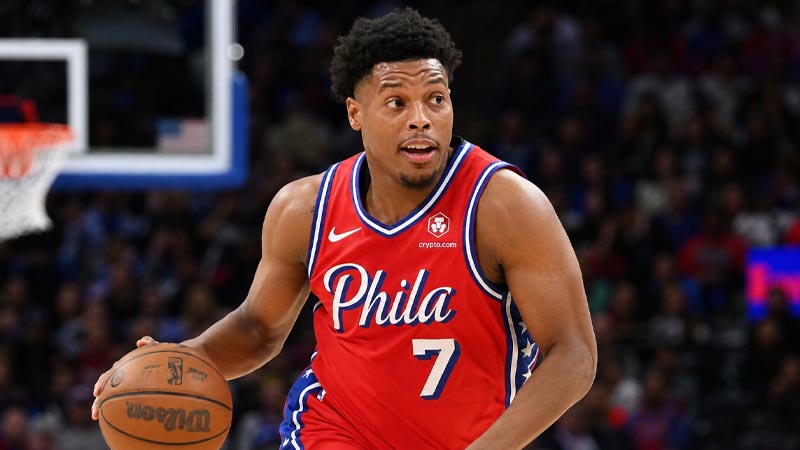
Kyle Lowry is undeniably an elite defender, defined by a masterclass in basketball IQ and “hidden” impact plays rather than just raw athleticism.
Despite never receiving an official NBA All-Defensive Team nod, his 20-season career is anchored by 1,501 steals—ranking top 75 all-time—and a record-breaking 280+ charges drawn.
His defensive architecture relies on extreme physicality, enabling him to anchor against larger forwards as an “unmovable fire hydrant”.
While aging has slowed his perimeter speed, his 108.6 career defensive rating and 39.16 defensive win shares prove he is a high-level, winning defensive floor general.
Is Kyle Lowry a Good Defender? The Statistical Truth
To understand if Kyle Lowry is a good defender, one must look beyond the highlight reels and examine the analytical blueprint he has constructed over two decades in the NBA.
His impact is a combination of traditional counting statistics and advanced metrics that consistently view him as an exceptional floor general who tilts a team’s defensive ceiling.
By maintaining a stifling individual points-allowed average over twenty seasons, Lowry has established himself as a high-volume producer whose value remains steady across different eras of basketball.
High-Volume Traditional Defensive Statistics
While box score totals can sometimes mask the true value of a perimeter guard, Lowry’s career numbers are staggering. He has logged 1,501 total steals, which places him in the top 75 in NBA history.
During his peak years with the Toronto Raptors, specifically the 2015–16 season, he averaged a remarkable 2.1 steals per game.
Furthermore, he has recorded over 330 career blocks, a figure that is considered remarkably high for a player officially measured at 6’0″.
Analyzing Advanced Impact and Win Shares
Advanced analytical models offer a more accurate look at Lowry’s historical impact because they capture positioning and team-wide influence. His career Defensive Rating stands at 108.6, reflecting an elite team-defensive floor.
In terms of Defensive Win Shares (DWS), he has accumulated 39.16, ranking him 18th all-time among active players. This metric places him in elite company, just behind Mike Conley and ahead of perennial defensive stalwarts like Jimmy Butler.
His consistency is further evidenced by his Defensive Box Plus/Minus, which remained positive in 15 of his first 17 seasons.
Career Defensive Data Overview
| Defensive Statistic | Career Metric Value | Historical Context |
|---|---|---|
| Total Steals | 1,501 | Top 75 All-Time |
| Defensive Rating | 108.6 | Elite Team Floor |
| Defensive Win Shares | 39.16 | 18th Among Active Players |
| Total Blocks | 330+ | High for 6’0″ Guard |
| Playoff Def. Rating | 109.15 | Top-30 Active Veteran |
Why Kyle Lowry Is the Unofficial King of Taking Charges
The definitive cornerstone of Lowry’s defensive legacy is the charge. While the NBA only began tracking “hustle stats” like charges taken in the late 1990s, Lowry has weaponized this skill to become the unofficial modern leader in forced offensive fouls.
This particular skill is often categorized by analysts as an elite, alternative form of rim protection. By stepping into the path of driving frontcourt players, Lowry effectively prevents high-percentage layups and disrupts the rhythm of opposing stars.
Redefining Rim Protection for Small Guards
Standard rim protection is usually reserved for 7-footers with high verticality, but Lowry has redefined the concept for the modern guard. He has taken over 280 charges in his career, surpassing previous record-holders like Ersan Ilyasova.
This ability requires a combination of elite anticipation and extreme physical bravery. During his peak years, he routinely led the entire league in this category, often averaging more charges drawn per minute than entire opposing team rosters.
The Tactical Advantage of Forced Turnovers
Beyond simply stopping a score, drawing a charge provides a massive tactical swing. It results in a turnover for the opponent and an additional personal foul for their player.
Lowry uses this to get opposing star players into foul trouble early in games, effectively neutralizing their offensive aggressiveness.
His quick reflexes and elite positioning allow him to see a drive developing before it happens, ensuring he is set and stationary before contact occurs.
Why Teams Can’t Post Up a 6’0″ Guard
One of the most common misconceptions in basketball is that a smaller guard is a liability in the post.
However, Lowry possesses an exceptionally strong build with a low center of gravity, which he uses to function like an “unmovable fire hydrant” when opponents try to exploit mismatches.
This physical profile allows him to hold his ground against much larger forwards, ensuring that teams cannot easily exploit him in modern switching schemes.
The Mechanics of the 45-Degree Low Post Seal
When caught in defensive switches against taller players, Lowry utilizes a specific technique known as the 45-degree low post seal. By anchoring his chest at a 45-degree angle, he creates a lever that pushes opponents below the first hash mark.
This positioning is critical because it prevents the offensive player from receiving deep entry passes and significantly limits the angles available for reverse layups or easy hook shots.
Physicality and Core Strength in Mismatches
Lowry’s ability to defend the post is rooted in his immense core strength. Unlike many guards who rely on reaching or fouling when switched onto a big man, Lowry uses his lower body to maintain position.
He relies on relentless physicality to prevent opponents from backing him down toward the basket. This “anchoring” ability is a key reason why his teams have historically been able to run versatile defensive schemes without having to “hide” their point guard.
Kyle Lowry’s Role as an On-Court Defensive Leader
Lowry’s impact extends beyond his individual matchups; he acts as an on-court defensive coordinator. He is constantly communicating rotations, identifying upcoming screens, and ensuring his teammates are in the correct positions to help.
During his prime years, he was a stellar point-of-attack defender who could single-handedly choke off opponent pick-and-roll sets.
Off-Ball Disruptions and Hand-Fighting
Even when he is not the primary defender on the ball, Lowry is a disruptive force. He utilizes relentless hand-checking and hand-fighting to slow down dynamic off-the-ball cutters.
By initiating contact before the ball even arrives, he disrupts standard team offensive sets and prevents players from reaching their preferred spots on the floor. This proactive approach to defense makes it difficult for offenses to find their flow.
Tracking Back and Boxing Out Big Men
A “hidden” defensive play that often goes unnoticed in traditional stats is Lowry’s commitment to rebounding. Despite his size, he tracks back aggressively to box out opposing big men, preventing second-chance opportunities.
He also excels at jumping into passing lanes for deflections, using his elite basketball IQ to anticipate where the ball is going before the passer releases it.
Does Kyle Lowry Still Have Good Defense at Age 40?
At this stage of his career, Lowry has naturally experienced a decline in lateral quickness and perimeter speed. Lightning-fast modern guards can occasionally beat him off the bounce, and his lack of verticality makes it easier for elite tall shooters to pull up over him.
However, the reality is that he remains a positive defensive presence through pure positioning and veteran craftiness.
- Anticipation Over Speed: He compensates for slower feet by playing the angles and forcing drivers into help defense.
- Veteran Craftiness: He remains an expert at hand-checking and subtle physical disruptions that slow down younger opponents.
- Playoff Reliability: His defensive value translates cleanly to high-stakes environments, as evidenced by his 109.15 active playoff defensive rating.
- Reduced Minutes Impact: Even in limited roles for teams like the 76ers, he continues to make highly intelligent, winning defensive plays.
Frequently Asked Questions About Kyle Lowry’s Defense
Has Kyle Lowry ever made an All-Defensive Team?
No, despite his elite metrics and reputation among coaches and players, Kyle Lowry has never been selected for an official NBA All-Defensive Team.
This is often cited as a discrepancy by analysts who point to his Defensive Win Shares and career impact as evidence of his elite status.
Who has taken the most charges in NBA history?
Kyle Lowry is the unofficial all-time NBA leader in charges drawn, having forced over 280 offensive fouls. He surpassed the previous modern record-holder, Ersan Ilyasova, who finished his career with 251.
Is Lowry considered a rim protector?
While he is not a traditional shot-blocker, analysts categorize his charge-drawing ability as an elite, alternative form of rim protection. By sacrificing his body to stop drives, he prevents high-percentage shots at the basket just as effectively as a traditional big man.
What is Kyle Lowry’s career defensive rating?
Kyle Lowry holds a career Defensive Rating of 108.6. This number reflects his ability to improve a team’s overall defensive performance consistently over a 20-year period.
The Definitive Verdict on Lowry’s Defensive Legacy
The evidence provided by both traditional counting stats and modern analytics confirms that Kyle Lowry is not just a good defender, but one of the most impactful defensive point guards of the 21st century.
His 1,501 steals and 39.16 Defensive Win Shares provide the statistical foundation, while his record-breaking 280+ charges drawn highlight a unique, sacrificial style of play that defines “winning basketball”.
Lowry’s career serves as the ultimate blueprint for undersized guards. He proved that through a combination of elite core strength, masterclass basketball IQ, and technical strategies like the 45-degree post seal, a 6’0″ guard can become a defensive anchor.
While his physical tools may have declined with age, his ability to coordinate a defense and execute “hidden” plays ensures that his defensive legacy remains untarnished.
For any team looking to build a championship culture, Lowry’s defensive architecture remains the gold standard for backcourt impact.