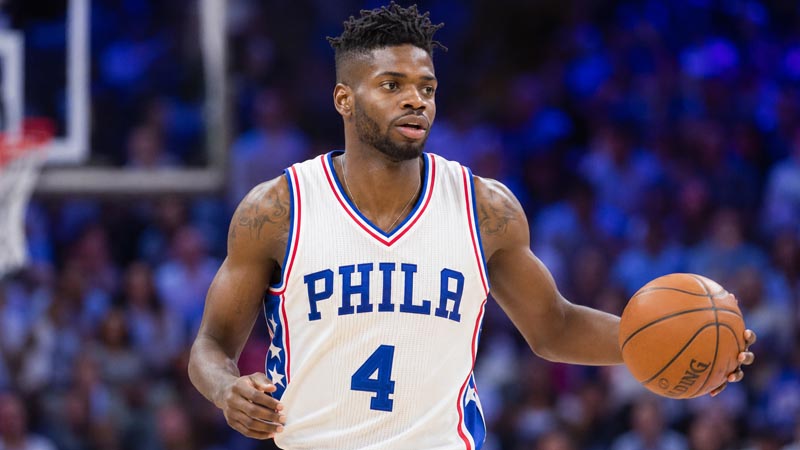
Nerlens Noel averaged just 14.6 minutes per game over his decade-long career because he was a highly specialized defensive asset whose style and physical profile were better suited for high-intensity bursts than sustained starter usage.
While an elite rim protector and disruptor, his limited offensive range, frequent foul trouble, and extensive injury history—including a pre-professional ACL tear—prevented coaches from relying on him for 30+ minutes.
Consequently, Noel became a quintessential “short-burst” specialist, providing maximum defensive impact in roughly 20 minutes before his efficiency dipped, turnover rates rose, or foul counts became a significant rotational liability.
Analyzing the Minute Distributions Across Noel’s Career
To understand why a player with such high defensive potential never became a 30-minute-per-night cornerstone, one must look at the hard data across his various professional stops.
Noel’s career trajectory shows a clear pattern: his highest usage occurred during rebuilding phases where efficiency was secondary to player development.
Once he moved to competitive environments, his minutes were strictly curtailed to maximize his defensive impact while hiding his offensive shortcomings.
As the following data illustrates, his floor time saw a precipitous drop as he transitioned from a primary developmental piece to a specialized role player on playoff-contending rosters.
| Season | Team | Minutes Per Game | Points Per Game | Rebounds Per Game |
|---|---|---|---|---|
| 2014–15 | Philadelphia 76ers | 30.8 | 9.9 | 8.1 |
| 2015–16 | Philadelphia 76ers | 29.3 | 11.1 | 8.1 |
| 2016–17 | PHI / DAL | 20.5 | 8.7 | 5.8 |
| 2017–18 | Dallas Mavericks | 15.7 | 4.4 | 5.6 |
| 2018–19 | Oklahoma City Thunder | 13.7 | 4.9 | 4.2 |
| 2019–20 | Oklahoma City Thunder | 18.5 | 7.4 | 4.9 |
| 2020–21 | New York Knicks | 24.2 | 5.1 | 6.4 |
| 2021–22 | New York Knicks | 22.5 | 3.4 | 5.6 |
| 2022–23 | DET / BKN | 11.5 | 2.1 | 2.7 |
Why Does Nerlens Noel Suffer from Extreme Foul Rates?
One of the primary reasons coaching staffs limited Noel to 20 minutes or fewer was his hyper-aggressive defensive philosophy.
While this aggression allowed him to disrupt passing lanes and alter shots at an elite level, it made him a frequent guest on the bench due to early and persistent foul trouble.
This creates a mathematical ceiling on a player’s availability, as an aggressive center cannot maintain a 30-minute rotation if they are constantly on the verge of disqualification.
The Defensive Gambling Strategy
Noel’s defensive brilliance was predicated on high-risk, high-reward gambles. He possessed incredibly quick hands and feet for a center, which he used to jump into passing lanes and swipe at the ball.
However, this “gambling” style often led to him being out of position or reaching unnecessarily, resulting in a high volume of whistles.
Coaches often prefer “verticality” and positional discipline over the high-variance disruptions Noel provided, especially in clutch moments.
The Mathematical Barrier of Personal Fouls
The data regarding his foul rate is staggering. For his career, Noel averaged 6.8 personal fouls per 100 possessions. In a standard NBA game, this rate makes it functionally impossible to play heavy starter minutes without fouling out before the fourth quarter.
Because he frequently lunged for steals and blocks rather than staying grounded, coaches were forced to use him in “short bursts” to preserve his availability for specific defensive possessions.
The Offensive Vacuum: Why Noel Is a Liability in the Modern Era
In the modern NBA, the role of the center has evolved significantly. A starting big man is now expected to either provide floor-spacing through perimeter shooting or act as a high-level playmaker from the post.
Noel struggled in both areas, effectively making his team play 4-on-5 on the offensive end during extended stretches. This offensive stagnation is a major reason why his minutes were capped, particularly in playoff settings where defenses exploit every weakness.
Zero Shooting Range and Floor Spacing
Noel lacked any significant shooting gravity outside of the immediate restricted area. With a career free-throw percentage of just 65.5%, he was not a threat from the stripe, nor could he reliably hit mid-range jumpers.
This allowed opposing defenses to “pack the paint,” ignoring Noel to double-team star players or cut off driving lanes. Without the threat of a jump shot, Noel’s presence on the floor often cramped the spacing for his teammates.
The Catching and Turnover Problem
Beyond his lack of range, Noel faced significant challenges with basic ball security. Often described as having “bad hands,” he struggled to catch entry passes cleanly or finish complex lob sequences.
This resulted in high turnover ratios relative to his limited offensive touches. For a coach, an offensive possession that ends in a fumble is a double-loss, as it often leads to fast-break opportunities for the opponent.
Physical Durability and the ACL Legacy
The physical toll of Noel’s playstyle and his extensive injury history played a massive role in his limited minutes. To play as a high-energy, “quick-twitch” defender, a player requires peak cardiovascular conditioning and structural health.
Unfortunately, Noel’s career was marked by recurring setbacks that prevented him from building the baseline stamina required for 30+ minutes of elite-level competition.
Chronic Injury Wear and Tear
The foundation of these struggles began before he even entered the professional ranks. Noel suffered a torn ACL during his collegiate career at Kentucky, which forced him to miss what should have been his true rookie season in the NBA.
This major surgery was followed by a decade of chronic knee issues, ankle sprains, and wrist injuries.
These persistent ailments hindered his ability to maintain a consistent training rhythm, often leaving him with “stamina gaps” during the grueling 82-game season.
The Stamina Gap in High-Energy Roles
Because Noel relied entirely on explosive athleticism, vertical leaping, and lateral quickness, his game was inherently exhausting.
Coaches observed that his energy levels—and consequently his defensive effectiveness—would dip significantly if he was pushed past a 5-to-7-minute stretch.
By limiting him to 15–20 minutes total, teams could ensure they were getting his maximum defensive intensity without risking the defensive lapses that come with fatigue.
The “Roster Clog” and Coaching Discipline
External factors, such as roster construction and coaching philosophy, also played a part in Noel’s restricted floor time. He frequently found himself on teams with established, high-minute stars at the center position, leaving him to battle for the remaining backup minutes.
Furthermore, his “gambling” style of play did not always align with the rigid, discipline-oriented systems of certain head coaches.
Competing with Elite Big Men
Noel’s career was often defined by playing in the shadow of generational talents. In Philadelphia, he was part of a “logjam” that included Joel Embiid and Jahlil Okafor. Later, in Oklahoma City, he served as the primary backup to Steven Adams.
These situations meant that even when Noel was playing well, his path to 30 minutes was blocked by superior offensive players who were the focal points of their respective franchises.
Positional Discipline and Professional Expectations
Certain coaches, most notably Rick Carlisle during Noel’s tenure with the Dallas Mavericks, openly questioned his positional discipline and work ethic.
In a league where “doing your job” predictably is often valued more than occasional flashy plays, Noel’s tendency to chase blocks at the expense of team structure was a point of contention.
Coaches frequently opted to play more reliable, “harder-working” role players who followed the defensive scheme more consistently.
The Conclusion: The Specialist’s Ceiling
Nerlens Noel remains a fascinating case study in the value and limitations of NBA specialization.
He proved that a player can have an elite impact in small windows, yet still be unplayable as a primary starter due to the compounding effects of foul trouble, offensive gaps, and physical durability.
His career serves as a reminder that in the modern professional landscape, versatility is often the key to longevity, while hyper-specialization often leads to the bench once the initial “burst” of energy fades.
Frequently Asked Questions
Why did Nerlens Noel never develop a jump shot?
Noel’s offensive development was hampered by early injuries and a focus on his defensive identity. His career 65.5% free-throw rate suggests that he lacked the natural shooting touch required to extend his range to the perimeter.
Is Nerlens Noel still in the NBA?
As of the 2022-23 season, Noel made his final appearances for the Detroit Pistons and Brooklyn Nets. His decline in minutes and recurring injuries eventually led to him falling out of standard team rotations.
What was Nerlens Noel’s best season?
Statistically, his rookie season (2014-15) was his most productive in terms of volume, as he averaged 30.8 minutes and nearly a double-double.
However, many analysts argue his most “efficient” defensive impact came during his time with the New York Knicks and Oklahoma City Thunder in a reduced role.
Did foul trouble really limit his minutes that much?
Yes. Averaging 6.8 fouls per 100 possessions meant that Noel was statistically likely to foul out if he played a full starter’s workload of 34-36 minutes. This forced coaches to be strategic about when they deployed him.