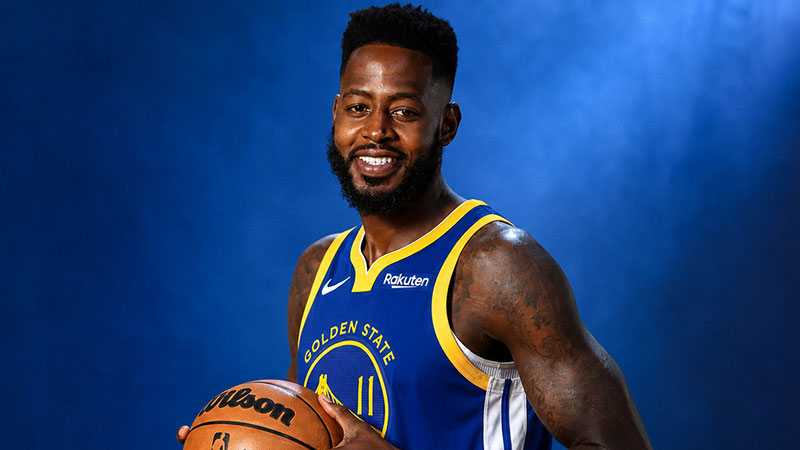
JaMychal Green remains one of the most intriguing “enigma” players of the modern NBA era, a journeyman whose value is often debated between coaching staffs and fanbases.
Emerging as an undrafted free agent, Green defied the odds to carve out a productive nine-year career as a quintessential “stretch-four” and small-ball center.
While he brought undeniable grit and a reliable perimeter stroke to winning cultures like the Memphis Grizzlies and Golden State Warriors, his tendency for high-profile mistakes often sparked intense discussion regarding his true impact.
This analysis explores the statistical reality versus the “eye test” of his career.
The Undrafted Journey of a Modern NBA Journeyman
The narrative of JaMychal Green is fundamentally one of resilience and adaptation, moving from the fringes of the league to a vital rotation piece for championship contenders.
His career trajectory serves as a blueprint for how a non-lottery prospect can maintain longevity through specialized utility and high-effort play.
From Underdog to Rotation Mainstay
Green’s ascent in the NBA was not a product of hype but of sheer physical imposition and defensive tenacity.
Throughout his decade-long tenure, he played for several high-level organizations, including the Los Angeles Clippers and Denver Nuggets, where he was consistently tasked with guarding multiple positions and spacing the floor for star players.
His ability to stay in the league for nearly ten years as an undrafted player is a testament to a “hard-nosed” defensive mentality that coaches find indispensable, even when fans are less convinced.
A Decade of Grit and Resilience
Longevity in the NBA is rarely an accident; it requires a player to accept a specific niche and excel within its constraints.
Green transitioned from a traditional high-energy rebounder to a modern “stretch” big man, adapting to the league’s shift toward perimeter play.
By embracing the “dirty work”—gathering offensive putbacks and boxing out larger opponents—he made himself a viable option for teams looking to bolster their frontcourt depth without a massive financial investment.
Analyzing the Numbers: Is the Production Real?
To determine if a player is “good,” one must look beyond individual games and assess the aggregate impact over a sustained period. Green’s statistical profile reveals a player who, despite his flaws, provided elite efficiency for his role.
| Career Metric | Value | Impact Analysis |
|---|---|---|
| Points Per Game (PPG) | 7.7 | Consistent secondary scoring threat. |
| Rebounds Per Game (RPG) | 5.5 | Strong board-crashing for a bench player. |
| 3-Point Percentage (3P%) | 36.8% | Reliable floor spacing for a big man. |
| Field Goal % (FG%) | 47.7% | High efficiency in limited attempts. |
| Effective FG% (eFG%) | 59%+ | Notable efficiency during specific stretches. |
Deciphering the Shooting Splits
While his career average sits at a respectable 36.8%, Green often experienced scorching-hot shooting streaks that fundamentally changed a team’s offensive gravity.
During his time with the Warriors, for instance, he shot a staggering 46% from beyond the arc over a 20-game span as his attempts increased.
This level of production from a veteran minimum contract is statistically an outlier, providing the kind of value that usually commands much higher market rates.
The Core Strengths of a Winning Role Player
Green’s value proposition was built on two pillars: the ability to stretch the defense and the versatility to switch onto different types of offensive threats. These “modern big” traits are why he was frequently signed by teams with championship aspirations.
Elite Floor Spacing for a Big Man
In the modern NBA, a “non-shooting” big man can be a liability that allows defenses to clog the paint. Green solved this issue by becoming a very reliable catch-and-shoot target.
His presence on the perimeter forced opposing centers out of the lane, creating driving lanes for playmakers.
This floor-spacing capability was particularly effective because it didn’t come at the expense of his interior toughness or willingness to compete for loose balls.
Modern Defensive Switchability
Defensively, Green utilized a 7-foot-2 wingspan and surprising lateral quickness to survive on an island against smaller, faster guards. This “switchability” is a cornerstone of modern playoff defenses.
Unlike traditional centers who are often exploited in pick-and-roll situations, Green could hold his ground against larger forwards or contest shots on the perimeter.
His “fast bounce” and athleticism allowed him to recover quickly, making him a versatile tool for coaches who prefer a fluid defensive scheme.
The “Enigma” Factor: Why Fans Are Divided
Despite his statistical utility, JaMychal Green often became a lightning rod for criticism, particularly during his tenure with the Golden State Warriors. The divide between his advanced metrics and the “eye test” often came down to the nature of his mistakes.
Addressing the “Boneheaded” Mistakes
The primary frustration cited by observers involved “boneheaded mistakes” that could kill a team’s momentum.
This included a high frequency of personal fouls, moving screens, and spectacular missed dunks that would “clang off the rim” and lead to fast breaks for the opposition.
These errors often felt more damaging because they appeared to be lapses in judgment rather than a lack of physical ability, leading some to label him a “low BBIQ” (Basketball IQ) player despite his physical tools.
The Struggle with Complex Offensive Systems
Green himself admitted that his struggles often stemmed from “overthinking” the game. Playing within a complex system like the Warriors’ motion offense requires split-second decision-making and a deep understanding of passing lanes.
For a player who thrives on effort rather than playmaking, this led to a steep learning curve. His passing was often described as “meh,” lacking the “hockey assists” or vision that fans had grown accustomed to seeing from previous veterans in that role.
The Golden State Warriors Case Study
Green’s season with the Warriors serves as the perfect micro-study of his career. It highlighted the tension between realistic expectations for a veteran minimum player and the high standards of a dynasty.
Filling Big Shoes on a Minimum Deal
Many critiques of Green’s performance ignored the reality of his contract. Signed to a veteran minimum deal, he was often asked to do too much because of a lack of depth elsewhere in the rotation.
Fans frequently compared him to previous bench legends like Shaun Livingston, which many argued was an unfair standard for an “end of the rotation” player.
When evaluated purely as a value-for-money asset, Green’s ability to provide high-energy minutes and spacing was objectively worth his contract.
The Learning Curve and Mid-Season Turnaround
Interestingly, Green’s performance followed a pattern of gradual improvement as he became more comfortable with his surroundings. After an initial period of struggling to find his rhythm and “getting in his own way,” he eventually began to play more “free”.
This late-season surge saw his shooting percentages climb and his defensive errors decrease, proving that he was capable of contributing at a high level once he moved past the “overthinking” phase of his integration.
Comparative Analysis: JaMychal Green vs. Nemanja Bjelica
To understand why some fans were hesitant to embrace Green, one must look at his immediate predecessor in the “small-ball big” role: Nemanja Bjelica.
Facilitating vs. Athleticism
Bjelica was often viewed as the “perfect” fit for a motion-heavy system because of his high BBIQ and exceptional facilitation skills. He could bring the ball up the floor and act as an offensive hub.
In contrast, Green was the “polar opposite”—a player defined by athleticism and verticality rather than playmaking.
While Bjelica offered cerebral play, Green offered “grit” and rim-running, a stylistic shift that felt jarring to those who valued the “point-forward” archetype.
Strategic Fit in Small-Ball Lineups
Green’s struggles were sometimes exacerbated by being played out of position. While he is naturally a power forward (the “4”), he was frequently forced to play small-ball center (the “5”).
At 6’8″, he was undersized against elite, traditional 7-foot centers, which occasionally made defensive assignments difficult.
Observers noted that he appeared much more comfortable at the 4, where his speed and length were advantages rather than his size being a disadvantage.
Final Verdict: Assessing JaMychal Green’s Legacy
When looking at the totality of his career, the answer to “Is JaMychal Green good?” depends on the context of the question. Is he a star? No. Is he a valuable NBA player who contributes to winning? The evidence suggests yes.
The Reality of Veteran Minimum Contracts
In a league where talent is expensive, finding a player who can shoot nearly 37% from three while providing switchable defense on a minimum contract is a win for any front office.
The “mystery” of JaMychal Green is that his mistakes were loud, but his contributions were steady. His career eFG% of over 59% in certain roles demonstrates an efficiency that is hard to replace at his price point.
A Career Defined by Effort and Utility
Ultimately, Green was a “self-made” player who lasted nine years in the world’s most competitive league because he did the things that don’t always show up in a highlight reel—boxing out, switching on defense, and stretching the floor.
While he may have been an “enigma” to those focused on his missed dunks or fouls, his longevity with top-tier organizations proves that NBA decision-makers viewed him as a “good,” productive role player.
Frequently Asked Questions (FAQ)
What were JaMychal Green’s career-high strengths?
Green was primarily known for his floor spacing as a “stretch” big, hitting nearly 37% of his career three-pointers. He also possessed excellent “switchability” on defense due to his lateral quickness and 7’2″ wingspan.
Why was he considered a “polarizing” player at Golden State?
The polarization stemmed from the contrast between his high effort and his “boneheaded mistakes,” such as frequent fouls and missed dunks. While his shooting stats were often elite, his errors were high-visibility and could disrupt the Warriors’ offensive flow.
Was JaMychal Green better as a 4 or a 5?
Most analysts and fans observed that Green was significantly more effective playing the power forward (4) position. When asked to play the small-ball center (5) role, his 6’8″ frame sometimes struggled against traditional 7-footers.
What are JaMychal Green’s career stats?
Over nine seasons, Green averaged 7.7 points and 5.5 rebounds per game while shooting 47.7% from the field and 36.8% from three-point range.
The Role Player’s Reality
Understanding the value of a player like JaMychal Green requires an appreciation for the “middle class” of the NBA.
Not every player can be a superstar, and a team’s success often hinges on whether their minimum-contract veterans can provide specific, high-leverage skills. Green provided those in spades—length, shooting, and a relentless motor.
While the “boneheaded” moments will always be part of his story, his decade of service in the league confirms his status as a high-value professional.