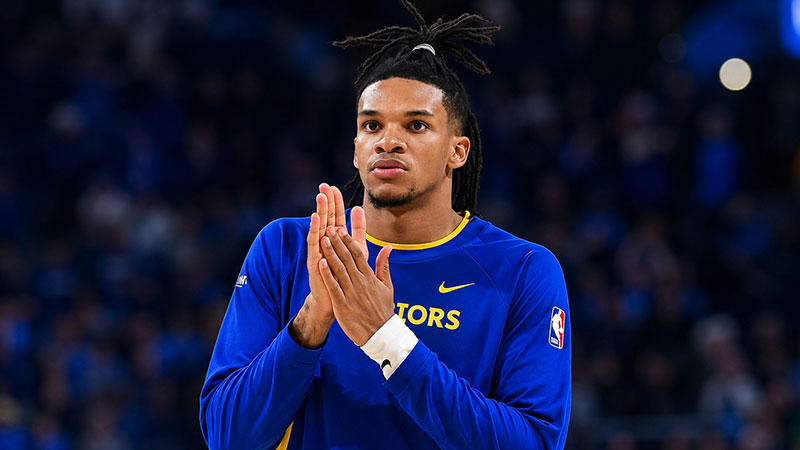
Moses Moody has emerged as a cornerstone for the Golden State Warriors, evolving from a rotational question mark into a highly reliable 3&D wing.
His 2025–26 season represented a significant statistical peak, showcasing his growth as an elite perimeter shooter and defensive disruptor with a seven-foot wingspan.
Despite a devastating patellar tendon injury in early 2026, Moody’s reputation as a “consummate professional” and his relentless work ethic suggest a resilient future.
This analysis explores his career trajectory, statistical breakout, and technical evolution to answer the definitive question: just how high is the ceiling for the Warriors’ lottery-picked guard?
The Statistical Evolution: From Rotation to Core Piece
To understand how good Moses Moody is, one must look at the steady, year-over-year progression that culminated in his 2025–2026 breakout campaign.
Initially drafted 14th overall in 2021, Moody spent his early years fighting for consistent minutes in a crowded Warriors rotation, often playing only when opportunities arose “by default” due to injuries or absences of veteran players.
However, by his fifth season, he solidified himself as a starter, significantly increasing his efficiency and volume across every major category.
The following table highlights his development from a deep-bench rookie to a high-impact starter before his 2026 injury:
| Season | Team | GP / GS | MPG | PPG | 3P% | Status |
|---|---|---|---|---|---|---|
| 2021–22 | GSW | 52 / 11 | 11.7 | 4.4 | 36.4% | Rookie Development |
| 2022–23 | GSW | 63 / 3 | 13.0 | 4.8 | 36.3% | Rotational Depth |
| 2023–24 | GSW | 66 / 9 | 17.5 | 8.1 | 36.0% | Bench Spark |
| 2024–25 | GSW | 74 / 34 | 22.3 | 9.8 | 37.4% | Part-time Starter |
| 2025–26 | GSW | 60 / 49 | 25.7 | 12.1 | 40.1% | Breakout Season |
Moody’s 2025–26 campaign was particularly notable for his shooting accuracy. For the first time in his professional career, he eclipsed the 40% mark from three-point range, headlined by a career-high 32-point performance against the Pelicans where he knocked down eight triples.
This efficiency, combined with his 60% True Shooting (TS) percentage, indicates a player who has mastered the art of being an elite “play-finisher” within a complex offensive system.
Scouting Report: The Technical “Sniper” and Defensive Anchor
Analyzing Moody requires looking beyond the box score to see how his physical traits and technical adjustments have improved his floor presence.
Analysts often describe him as a player who lacks elite vertical athleticism or “nuclear” speed, but compensates through high-level IQ and length.
His seven-foot wingspan on a 6’5″ frame is his greatest physical asset, allowing him to play much larger than his listed height.
Offensive Versatility and Shot Making
Moody has transitioned from a stationary shooter into a “second side attacker” who can punish defenses after the initial action.
While he is not a primary ball-handler, he has shown an underrated ability to make tough, contested shots due to his high release point and exceptionally large ten-inch hands, which grant him elite control of the basketball even under physical pressure.
Early in his career, he often attempted to dunk over defenders, a strategy that led to inconsistent results since he is not a “high flyer” like teammates such as Jonathan Kuminga.
In his breakout 2025–26 season, he adjusted by utilizing Euro-steps, scoops, and quick-shot finishes that don’t require high elevation, allowing him to score effectively in traffic.
His offensive ceiling is frequently compared to Chris Middleton, as both players are physical, high-release shooters who don’t need a large window to feel comfortable getting their shot off.
Defensive Length and Lateral Adjustments
The most significant hurdle Moody overcame was his lateral quickness. In his first two seasons, he struggled to stay in front of Twitchy NBA guards, often taking a “false step” when trying to slide defensively.
This technical flaw—where a player steps in the opposite direction before moving toward the defender—was a habit from high school and college where his superior athleticism allowed him to recover despite poor footwork.
By 2025, Moody had eliminated the false step and mastered “Know Your Personnel” (KYP) defense. He now uses a “cushion” strategy, giving ball-handlers extra space and using his massive wingspan to disrupt passing lanes or “poke” balls loose as players cross half-court.
This evolution has turned him into a defensive disruptor who can effectively trap ball-handlers and contest shots that smaller guards simply cannot reach.
Character and Mental Toughness: The “Pig and a Pancake” Philosophy
What truly elevates Moody from a “good player” to a “critical core piece” is his psychological approach to the game.
He has long been praised for being wise beyond his years, a trait that helped him navigate the inconsistent playing time he received during his first three seasons under coach Steve Kerr.
Moody views adversity as a universal experience, famously noting that while his peers were leaving college to figure out life, he was simply facing his own professional hurdles.
Professionalism Under Pressure
The Warriors’ coaching staff and veterans have consistently lauded Moody as the “consummate professional”.
He maintains a high-energy hustle, relentlessly diving for loose balls and fighting for offensive rebounds even when he isn’t the primary focus of the offense.
This “want to defend” and willingness to do the “dirty work” ensured that he remained a positive influence in the locker room and on the court, even when his minutes were sporadic.
The Drive for Greatness
Moody’s internal motivation is best summarized by his “Pig and a Pancake” analogy. During his rookie year, he remarked that once a player makes it to the NBA, they immediately want more—much like the children’s book character who asks for syrup after being given a pancake.
This drive took him from wanting to simply be in the league to aiming for All-Star status. This mindset explains his rapid improvement in shooting mechanics and defensive positioning; he is a “student of the game” who actively works to erase his deficiencies.
The 2026 Injury Setback and Long-term Value
Just as Moody was reaching his peak as a starter, disaster struck. On March 23, 2026, he suffered a devastating left patellar tendon tear during a game against the Dallas Mavericks.
This injury is notoriously difficult to recover from and has sidelined him indefinitely, casting a shadow over what was a career-defining year.
Impact of the Patellar Tendon Tear
The timing of the injury was particularly unfortunate, as Moody had just proven his sustainability as a replacement for veteran wings like Andrew Wiggins.
Before the tear, he was averaging a career-high 12.1 points and 3.3 rebounds, and he had become a player the Warriors could “not look back” from once he entered the starting lineup.
The recovery process for a patellar tendon injury is lengthy, and the primary concern for the Warriors is whether he can regain the lateral quickness he worked so hard to improve.
Strategic Value for the Warriors
Despite the injury, Moody remains a highly valuable asset. Before the 2025–26 season, he signed a three-year, $37.5 million rookie extension.
At an average annual salary of $12.5 million, he represents significant value for a player who provides elite 3&D production and high-level character.
While his name has frequently appeared in trade rumors, his catastrophic injury complicates his immediate market value, likely keeping him with the Warriors as he focuses on a long-term rehabilitation program.
Frequently Asked Questions About Moses Moody
Is Moses Moody still a good player after his injury?
While the patellar tendon tear is severe, Moody’s game is built more on IQ, length, and shooting than raw vertical explosiveness. If he can return to 90% of his former self, his shooting and wingspan will still make him an effective NBA wing.
What is Moses Moody’s greatest strength?
His elite perimeter shooting and defensive length. Shooting 40.1% from deep and possessing a 7-foot wingspan allows him to function as a premier 3&D asset in the modern NBA.
How does Moody compare to other young Warriors?
Unlike some younger players who rely on “nuclear” athleticism, Moody is more of a “tough shot maker” with a high release.
He is often cited as being more mature and disciplined than other lottery picks, which has allowed him to thrive in the Warriors’ complex system.
Can Moody become an All-Star?
Analysts see a “Chris Middleton-esque” ceiling for Moody. While he may not be a primary iso-scorer yet, his ability to move off-ball and hit contested shots gives him the potential to be a high-level starter or borderline All-Star in his prime.
Final Verdict: A Career at a Crossroads
Moses Moody is undeniably a “good” NBA player who was on the verge of becoming “great” before his 2026 injury. He successfully transitioned from a bench player who played “by default” into a legitimate statistical force and a “sniper” from the perimeter.
His journey from Montverde Academy to Arkansas, and finally to the Warriors core, is a testament to his ability to play whatever role is required of him.
The question of “how good” he is currently depends on his rehabilitation. If his physical recovery matches his mental toughness, the Warriors have a $12.5M-a-year bargain who fits perfectly into their long-term plans.
He has already proven he can live up to his lottery potential; now, he must prove he can overcome the greatest adversity of his professional career.
Based on his track record and “consummate professional” status, betting against Moses Moody’s return would be a mistake.