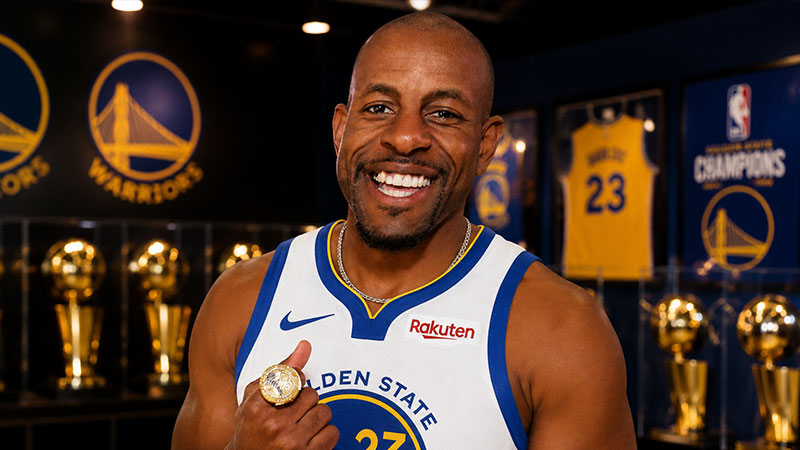
The 2015 NBA Finals remains one of the most debated series in basketball history, not because of the winner, but because of the individual honored with the Bill Russell Trophy.
When the Golden State Warriors defeated the Cleveland Cavaliers in six games, the Finals MVP was not the league’s first-time MVP Stephen Curry, nor was it the historically dominant LeBron James.
Instead, it was Andre Iguodala, a veteran who had not started a single game during the regular season. This decision sparked a decade of debate regarding how we value defense, efficiency, and the “gravity” of superstars versus the utility of role players.
The Strategic Pivot: How the “Death Lineup” Saved the Series
To understand why Andre Iguodala won the award, one must look past the final box score and analyze the trajectory of the series.
The Golden State Warriors entered the Finals as heavy favorites, but by the end of Game 3, they found themselves in a 2-1 hole against a Cleveland team missing two of its three best players.
The Cavaliers’ physicality and size were stifling the Warriors’ rhythm, and LeBron James was playing at a level that suggested he might win the title single-handedly.
The momentum of the entire championship shifted before Game 4 when head coach Steve Kerr made a season-defining adjustment.
By benching center Andrew Bogut and inserting Andre Iguodala into the starting lineup, the Warriors birthed the legendary “Death Lineup”.
This tactical masterstroke prioritized speed, shooting, and defensive versatility over traditional size, allowing the Warriors to reclaim their “pace and space” identity.
The 2-1 Deficit and the Need for a Catalyst
At the start of the series, the Warriors struggled to contain Cleveland’s grinding style of play. With LeBron James orchestrating every possession, the Cavaliers were able to slow the game down, making every Golden State possession feel labored.
The decision to start Iguodala was not merely about individual performance; it was about changing the fundamental geometry of the court.
By having five players who could switch defensively and run the floor offensively, the Warriors forced Cleveland into a style of play they could no longer sustain with a depleted roster.
The Immediate Result of the Lineup Change
The impact of this change was instantaneous and profound. Upon entering the starting lineup for Games 4, 5, and 6, Iguodala’s individual production saw a massive increase.
He averaged 20.3 points, 7.0 rebounds, and 4.0 assists over those final three games, all of which were Warriors victories.
His presence allowed the Warriors to thrive in transition and provided a secondary playmaker who could punish the Cavaliers for double-teaming Stephen Curry.
The “LeBron Stopper” Narrative: A Masterclass in Defensive Efficiency
The primary argument for Iguodala’s MVP win was his individual defensive performance against LeBron James. While LeBron’s raw numbers—35.8 points, 13.3 rebounds, and 8.8 assists per game—were historic, they came at a cost of extreme inefficiency.
The voters identified Iguodala as the primary reason LeBron was forced into a high-volume, low-efficiency role that eventually saw him wear down as the series progressed.
Defense in the NBA is often difficult to quantify, but the 2015 Finals provided stark data points that influenced the media panel.
Iguodala was tasked with the most difficult assignment in sports: guarding a prime LeBron James without a consistent second or third scoring option to help him.
His ability to contest shots without fouling and force LeBron into difficult jumpers rather than rim-runs was the cornerstone of the Warriors’ defensive strategy.
| Metric | LeBron James with Iguodala ON Floor | LeBron James with Iguodala OFF Floor |
|---|---|---|
| Field Goal Percentage | 38.1% | Over 44% |
| Defensive Impact | Forced 48.9% True Shooting % | Higher efficiency against other defenders |
| Late Game Performance | Reduced 4th Quarter Scoring | Higher scoring when guarded by others |
| Turnover Pressure | Increased critical turnovers | More controlled playmaking |
Statistical Anomalies and the “Starter Bump”
When comparing the raw counting stats of the two primary Golden State candidates, Stephen Curry appears to be the obvious choice.
Curry averaged 26 points and 6.3 assists, including an incredible fourth-quarter scoring average of 10.8 points on 55/50/91.7% shooting splits.
However, the voters were swayed by the narrative of Iguodala “elevating his game” when the team needed it most, whereas Curry was perceived—rightly or wrongly—to have struggled early in the series.
Iguodala’s efficiency was a major talking point. He shot 52.1% from the field and 40% from the three-point line, providing consistent scoring as the third or fourth option.
He even overcame a historic “Free Throw Anomaly,” winning the MVP trophy despite shooting a dismal 35.7% from the charity stripe during the series.
This suggests that the voters valued his floor game and defensive contributions far more than his proficiency at the line.
Comparing the Impact: Curry vs. Iguodala
While Curry was the engine of the offense, the voters viewed Iguodala as the player who “swung” the series from a potential loss to a victory.
Curry’s “gravity”—the way he draws defenders away from the hoop to create open looks for others—was not yet fully appreciated by the media in 2015.
Consequently, Iguodala was often the beneficiary of the space Curry created, notably in the clinching Game 6 where Iguodala exploded for 25 points.
The Context of the 2015 Cavaliers
It is important to note that the Cavaliers were playing without Kevin Love for the entire series and lost Kyrie Irving after Game 1. This meant that the Warriors’ defense, led by Iguodala, could focus almost exclusively on stopping LeBron James.
Critics argue that this made Iguodala’s defensive job easier, as he didn’t have to worry about other elite scorers, but the voters focused on the results: LeBron was held to sub-40% shooting when Iguodala was on the floor.
The Voting Breakdown and the Role of Momentum
The final tally for the 2015 Finals MVP was 7 votes for Andre Iguodala, 4 votes for LeBron James, and 0 votes for Stephen Curry.
The fact that the best player on the winning team received zero votes remains a major point of contention for Warriors fans and NBA historians alike.
However, the logic of the seven voters who chose Iguodala was rooted in the “catalyst” theory of the MVP award.
The award is often given to the player who most clearly defines the story of the series. In 2015, the story was the Warriors’ transition from a struggling traditional team to a dominant small-ball juggernaut. Because Iguodala was the face of that transition, he captured the narrative momentum.
Furthermore, some voters felt that giving the award to LeBron James on the losing team was a bridge too far, leading them to search for the best performer on the Warriors who specifically countered LeBron’s impact.
- The Narrative Factor: Voters often reward the “unexpected” hero who exceeds their regular-season role.
- Defensive Priority: In a league that was just beginning its offensive explosion, high-level perimeter defense was still viewed as a rare and premium asset.
- The “Clutch” Element: Iguodala’s ability to hit big shots in Game 6 and his steadying presence during Cleveland’s runs cemented his case in the eyes of the media.
- Series Momentum: The three-game winning streak that followed Iguodala’s insertion into the starting lineup was the strongest “evidence” in his favor.
Why Stephen Curry Was Overlooked in the 2015 Vote
The exclusion of Stephen Curry from the voting tally is often cited as a failure of the “eye test” versus the “stat sheet.” While Curry’s gravity allowed Iguodala to find open shots, the voters at the time were more impressed by Iguodala’s two-way production.
Curry’s Game 2 performance, where he struggled against the defense of Matthew Dellavedova, created a lasting impression of “struggle” that he had to fight against for the rest of the series.
In hindsight, many analysts believe that the 2015 vote was an indirect way of acknowledging LeBron James’ greatness while still honoring the champion.
By giving the award to the “LeBron Stopper,” the voters were essentially saying that the most impressive feat of the series was simply surviving the onslaught of LeBron James.
This inadvertently penalized Curry, whose offensive brilliance was seen as “expected” rather than a series-altering surprise.
Frequently Asked Questions About the 2015 Finals MVP
Did Andre Iguodala deserve to win over Stephen Curry?
This is subjective. Statistically, Curry had the superior series in terms of scoring and playmaking. However, Iguodala was the catalyst for the tactical change that allowed the Warriors to win three straight games after falling behind 2-1.
What were Iguodala’s stats in the 2015 Finals?
He averaged 16.3 points, 5.8 rebounds, and 4.0 assists per game. His scoring jumped to 20.3 PPG once he became a starter in Game 4.
How did LeBron James get 4 votes despite losing?
LeBron’s performance was so dominant (35.8/13.3/8.8) that many felt he was the most valuable player on the floor regardless of the outcome. He was the first player since Jerry West to receive serious consideration for the award on a losing team.
Why didn’t Stephen Curry receive any votes?
The media panel split their votes between the “narrative” of Iguodala’s defense and the “pure value” of LeBron’s volume. Because those two arguments took all 11 votes, Curry was left with none, despite his 26 PPG average.
The Lasting Legacy of the 2015 Finals MVP
Andre Iguodala’s win in 2015 redefined the criteria for the Finals MVP award. It proved that a player could win based on defensive utility and tactical impact rather than just being the leading scorer.
It also highlighted the “Death Lineup” as one of the most significant innovations in modern basketball history.
While the debate over whether Curry was “robbed” will likely continue as long as the NBA exists, there is no denying that without Iguodala’s specific contributions on both ends of the floor, the Warriors’ first dynasty-era championship would have been in serious jeopardy.
For more deep dives into NBA history and championship-level strategy, stay tuned to our latest analysis.
Whether you value the offensive gravity of a superstar or the defensive blueprint of a veteran, the 2015 Finals remains the ultimate case study in what it takes to win at the highest level.