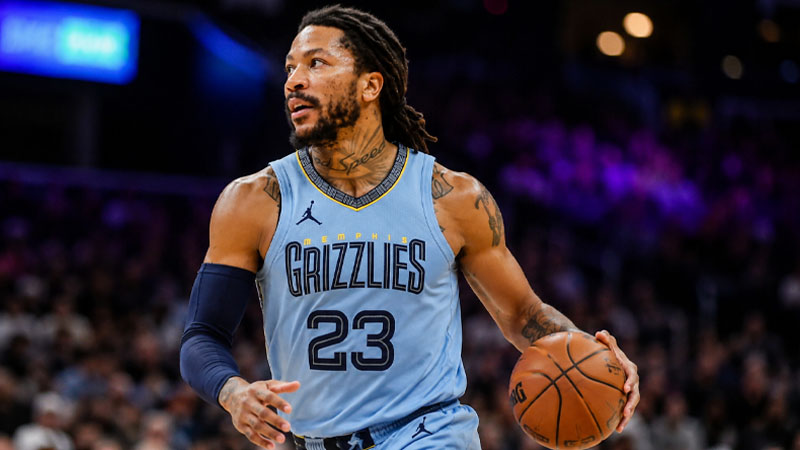
Yes, Derrick Rose was a career-long point guard who redefined the position through explosive athleticism and elite scoring. Entering the league as the top pick in 2008, he shattered the traditional pass-first mold, becoming the youngest MVP in history by 2011.
Over 15 seasons, he amassed 12,573 points and 3,770 assists, proving that a lead guard could be a primary scoring engine.
His journey from a high-flying slasher to a high-IQ veteran playmaker transformed how the NBA evaluates backcourt talent, cementing his legacy as the blueprint for today’s dynamic, scoring-heavy point guards.
Is Derrick Rose a Point Guard by Definition?
Throughout his entire professional career spanning from 2008 to 2024, Rose operated exclusively as a point guard.
While his height of 6’3″ often led casual observers to wonder if he was simply a shooting guard in a smaller frame, his role on the court was consistently that of the primary initiator and playmaker.
He was tasked with bringing the ball up the floor, orchestrating the offense, and serving as the focal point of defensive attention.
The Traditional Role vs. The Rose Standard
Historically, the point guard was viewed as a “floor general” whose primary objective was to facilitate for others and limit turnovers. Rose disrupted this archetype by proving that a point guard could be the team’s leading scorer without sacrificing playmaking duties.
In his peak MVP campaign, he not only averaged 25.0 points per game but also distributed 7.7 assists, leading the Chicago Bulls to a league-best 62 victories.
This balance of high-volume scoring and elite distribution set a new standard for what a modern lead guard should achieve.
Redefining the “Pass-First” Archetype
The shift Rose initiated forced defenses to change how they accounted for the backcourt. Before his arrival, many elite guards were either pure facilitators or perimeter-dependent shooters. Rose introduced a level of rim pressure that was previously unseen at the position.
By utilizing a lightning-fast first step and a jaw-dropping vertical leap, he forced interior defenders to help, which in turn opened passing lanes for his teammates.
This aggressive, “score-first” approach didn’t mean he lacked vision; rather, it meant his scoring gravity created the assists he recorded.
Career Statistics and Position Benchmarks
The following data highlights his consistency across different phases of his career, illustrating his efficiency as both a primary scorer and a veteran distributor.
| Category | Career Average (Regular Season) | Peak MVP Season (2010–11) | Playoff Career Average |
|---|---|---|---|
| Points Per Game (PPG) | 17.4 | 25.0 | 21.9 |
| Assists Per Game (APG) | 5.2 | 7.7 | 6.3 |
| Rebounds Per Game (RPG) | 3.2 | 4.1 | 4.3 |
| Field Goal Percentage | 45.6% | 44.5% | 41.8% |
| Games Played (Total) | 723 | 81 | 52 |
| Total Career Points | 12,573 | 2,026 | 1,137 |
How Did He Change the Position?
Rose’s impact on the game can be categorized into distinct eras that reflect his personal growth and the broader evolution of the league. He was never just a player; he was a catalyst for a tactical shift in how organizations prioritize backcourt talent.
The Explosive Slasher Era
During his early years with the Chicago Bulls, Rose was renowned for an unmatched combination of speed and power. He entered a league where point guards were expected to be cautious, yet he played with a level of aggression that demanded constant double-teams.
His ability to finish over much taller interior defenders using acrobatic mid-air body control became his signature. This era proved that a point guard could be the most dangerous athlete on the floor, regardless of the presence of elite wing or post players.
The Era of the Scoring Playmaker
Rose entered the NBA at a time when the “lead guard” role was beginning to carry a heavier offensive load. Coaches began optimizing him as the number-one scoring option rather than a rigid, traditional playmaker.
This shift paved the way for current superstars who dominate the ball and serve as primary engines for their respective offenses.
By successfully carrying the scoring burden for a championship-contending team, he demonstrated that the most effective way to run an offense was through a dynamic, multidimensional threat at the point.
Athleticism: Was He the Most Athletic Point Guard?
The debate regarding Rose’s athleticism often centers on how he compared to other legendary physical specimens like Russell Westbrook or John Wall. While pure power is often the metric for athleticism, Rose brought a unique level of flexibility and finesse to the position.
Speed, Verticality, and Mid-Air Flexibility
Observers often note that while other guards might have jumped higher in a straight line, Rose possessed a rare ability to contort his body in mid-air to avoid blocks. This flexibility allowed him to finish difficult layups that other players simply could not attempt.
His “waves” of movement—smoothly jumping around and through defenders—contrasted with the “electricity” and raw power of his contemporaries. This specific type of “functional athleticism” was key to his success as a 6’3″ guard in a league of giants.
Comparing Rival Archetypes
Discussion within the basketball community frequently weighs Rose’s peak against Russell Westbrook’s career-long dominance. Some argue that Westbrook was a more powerful, stronger athlete who could “will” his way to triple-doubles.
Others contend that Rose, pre-injury, was faster, more explosive, and possessed superior body control. This comparison highlights how Rose changed the position: he wasn’t just fast; he was a “puma” on the court, using a mix of craftiness and explosive verticality to dominate.
The Evolution into a High-IQ Veteran
Perhaps the most impressive part of the journey was the transition from a physical marvel to a “Sage Veteran Playmaker”. When severe knee injuries took away his elite leaping ability, he did not fade away; instead, he adapted his game to remain a high-level contributor.
Adapting After Physical Setbacks
Post-injury, the focus shifted from raw speed to tactical execution. He transformed his game to rely on a reliable mid-range jump shot and improved half-court floor vision. This transition proved his deep understanding of the game beyond mere physical gifts.
He moved from being a player who beat you with a first step to a player who beat you with a screen-and-roll read or a perfectly timed floater.
Mastering the Mid-Range and Floor Vision
In his later years, specifically during his time with the New York Knicks, he became a high-IQ orchestrator off the bench. He utilized his experience to mentor younger guards and manage the tempo of the game.
His career totals of 3,770 assists and a field goal percentage of 45.6% reflect a player who learned how to be efficient without relying on the highlight-reel dunks of his youth. This longevity is a testament to his intelligence as a basketball player.
What is the Legacy of His Playing Style?
The retirement of his jersey and the constant praise from his peers confirm that his impact was far-reaching. He didn’t just win games; he won the respect of a generation that grew up trying to emulate his style.
Influence on Modern NBA Stars
Today’s NBA is filled with “Rose-style” guards—players who are the primary scoring threats, elite finishers at the rim, and dynamic playmakers.
The standard he set during his 2011 MVP season, where he led his team to 62 wins, remains the gold standard for young guards entering the league.
Every time a modern point guard explodes to the rim for a contested finish, they are drawing from the blueprint he established over a decade ago.
Historical Significance and Awards
- Youngest MVP: Won at age 22, a record that still stands.
- Rookie of the Year: Impacted the league immediately in 2009.
- Leadership: Led the Bulls to the best record in the NBA (62-20).
- Longevity: Completed a 15-season career despite catastrophic injuries.
- Cultural Impact: His jersey retirement and “legend” status in the eyes of fans worldwide.
Frequently Asked Questions About His Role
Did he ever play shooting guard?
No, while he was a prolific scorer, his primary position was always point guard.
Why wasn’t he considered a “traditional” guard?
He prioritized rim pressure and scoring over the “pass-first” mentality that defined previous eras.
How do his playoff stats compare?
He actually elevated his scoring in the postseason, averaging 21.9 PPG compared to his 17.4 PPG regular-season average.
What was his peak assist season?
During his MVP year, he averaged 7.7 assists per game, showing elite distribution skills.
Was he efficient?
Yes, his career field goal percentage of 45.6% is highly efficient for a guard who lived in the paint.
Final Verdict: The Quintessential Modern Guard
Derrick Rose was not only a point guard; he was the architect of the position’s modern identity. By blending historic athleticism with a scoring-first mindset, he paved the way for the current era of basketball.
His ability to reinvent himself from a high-flying MVP to a high-IQ veteran remains one of the most respected career arcs in sports history.
Whether you analyze his 12,573 career points or his role in shifting the league’s tactical focus, it is clear that he was the spark that changed everything for the lead guard position.
Explore more in-depth player profiles and tactical breakdowns to see how the greatest athletes in the world are continuing to reshape the game.