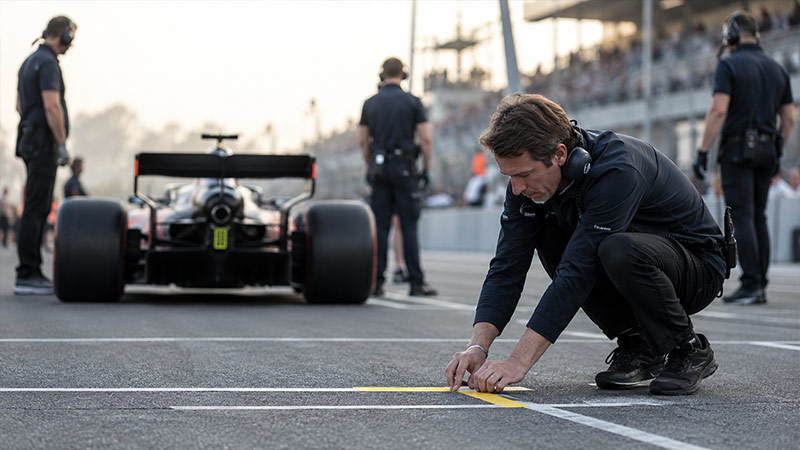
Formula 1 is a sport where small details can make a big difference. A tiny gain in time can decide who wins or loses. Because of this, teams plan each step on the starting grid with great care.
One moment on TV caught the eye of many F1 fans. Just before the formation lap, McLaren driver Lando Norris was given what looked like a small piece of paper in his car.
Many fans began to guess what it was. Some thought it had a new race plan on it. Others joked that someone had passed Norris a note. But the real reason was much more useful.
The moment points to two key parts of modern F1 racing.
First, teams may use paper sheets to give drivers key race details. This can help keep private data away from rival teams. Other teams can listen to radio calls, so some details are safer when shared on paper.
Second, the story links to a wider fight over marks used by teams on the pit wall. These marks can help drivers line up their cars on the grid. That led to debate between teams and drew the eye of race officials.
A small sheet of paper or a simple mark may not seem like much. But in F1, even a tiny detail can help a driver gain an edge. To see why these things matter, we need to look at the tight space inside an F1 car, how drivers line up for the start, and how teams search for every small gain.
The Ergonomic Challenge: Cockpit Visibility and Grid Slot Precision
To see why F1 drivers need visual help on the grid, it helps to look at how an F1 car is built. Modern F1 drivers sit very low in the car. This helps keep the car stable and fast. It also helps air flow over and around the car.
But this low seat makes it hard for the driver to see the track near the car. The high sides of the cockpit also block part of the view. The front wheels make this problem even worse.
The Driver Cannot See the Grid Lines
From the cockpit, the driver cannot clearly see the front wing or the ground just in front of the car. The painted lines of the grid box can also be hard or impossible to see.
After the formation lap, each driver must stop in the right grid spot. But the driver has a poor view of the lines below the car. This makes it very hard to judge the exact stopping point.
A Small Error Can Be Costly
The car needs to stop in the right place. If a driver stops too far back, they give up some ground before the race even starts. A rival may then have a small edge on the run to the first turn.
Going too far forward can also cause trouble. If the car is not placed within the allowed grid position, the driver may face a penalty under the race rules.
So, drivers need a simple way to judge where to stop. Before the start, the team can set up visual cues that the driver can see from the cockpit. These cues help the driver line up the car in the right spot.
With such a poor view of the ground, these visual guides can make grid placement much easier and more precise.
Pit Wall Guidance Tape: The Solution to Grid Alignment
Teams use a simple tool to help drivers stop in the right spot. It is known as pit wall guidance tape.
Before the cars reach the grid, team staff place a bright strip of tape on the pit wall. The tape lines up with the point where the driver should stop.
How the Visual Guide Works
A driver cannot see the front of the car well from the cockpit. This makes it hard to see the grid lines on the track.
So, the driver looks to the side as the car moves into its grid spot. They look for the bright tape on the pit wall.
When the driver’s helmet lines up with the tape, they know where to stop. They can then press the brakes and hold the car in place.
This guide helps the driver start as far forward as the rules allow. It also helps them avoid going over the front line.
Why Grid Position Matters
A small gap can matter at the start of an F1 race. Even half a meter may have an effect on the run to Turn 1.
A good grid position can help a driver keep the lead. A poor one may give a rival an edge.
That is why teams take great care when they place the tape. It is a simple tool, but it can help the driver make a clean and well-timed start.
Paddock Interventions: The United States Grand Prix Incident
Because grid visual markers provide a tangible operational edge, they have also become targets for competitive tactics and paddock rivalry.
A prime example of this dynamic unfolded during the United States Grand Prix, leading to a high-profile investigation by race officials.
The Removal of the Marker
During pre-race preparations, McLaren mechanics had secured Norris’s customary visual reference tape along the pit wall adjacent to his starting position.
However, after the field had departed on the formation lap, cameras captured a rival Red Bull mechanic walking into the grid area and physically removing McLaren’s marker from the wall.
The intent behind this maneuver was clear: to deprive Norris of his primary lateral reference point upon his return.
Without the bright visual guide, the driver would be forced to estimate his stopping distance relying purely on spatial intuition, increasing the likelihood of parking too far back or misaligning the chassis and incurring a starting penalty.
Regulatory Response and Safety Penalties
The governing body evaluated the incident not only through the lens of unsporting conduct but, more critically, as a major track safety violation.
Allowing team personnel to re-enter an active pit straight or track grid area after cars have begun their formation movement poses severe hazards to marshals, officials, and incoming vehicles.
Consequently, race stewards imposed a €50,000 fine on Red Bull for the safety breach. This ruling established a definitive precedent across the paddock, underscoring that while competitive tactics are woven into the sport’s history, track safety boundaries remain absolute.
Decoupling Rumor from Reality: What Real Grid Strategy Cards Contain
Beyond the pit wall tape dispute, fans often observe drivers handling physical paper sheets while seated in the car prior to the engine start sequence.
While online discussions frequently generate lighthearted theories regarding these exchanges, these physical documents serve a crucial, data-intensive purpose.
Protecting Sensitive Strategic Data
Formula 1 teams operate under constant technical surveillance. Radio transmissions between pit wall strategists and drivers are unencrypted and monitored in real time by every competing garage across the paddock.
Broadcasting critical target numbers or procedural adjustments over open radio frequencies exposes team strategy to immediate counter-tactics.
Core Information on Pre-Race Strategy Cards
To maintain data privacy during critical pre-race windows, race engineers hand drivers a physical, condensed strategy card containing vital performance variables:
- Pit Stop Loss Times: Exact delta calculations for pit entry and exit times under green flag, Virtual Safety Car, and full Safety Car conditions.
- Pit Commit Points: The precise geographical location on track where a driver must decide to enter the pit lane without compromising lap time.
- Hybrid Energy Deployment Targets: Custom state-of-charge management curves designed for early-lap defending or overtaking.
- Clutch Launch Values: Fine-tuned clutch bite-point targets calculated from practice start grip assessments conducted on the reconnaissance laps.
- Event Note Specifics: Reminders regarding track-specific starting procedures, track limit warnings, or variable weather updates.
Drivers review these key figures to anchor their mental focus. Moments before the tyre blankets are removed and mechanics clear the grid area, the physical paper card is collected back by team personnel to ensure no sensitive documentation remains inside the cockpit during the race.
Strategic Lessons for High-Performance Organizations
The grid slot marker controversy offers valuable insights into organizational efficiency, risk mitigation, and performance optimization that extend well beyond motorsport:
- Protecting Operational Integrity: Systems that rely on simple, reliable execution—such as physical reference markers—often outperform complex digital alternatives in high-stress, low-visibility environments.
- Information Security in Competitive Markets: When open communication channels are subject to external monitoring, low-tech vectors (such as physical strategy sheets) provide essential data privacy.
- Regulatory Boundary Enforcement: High-stakes competition inherently tests the limits of regulations, requiring clear, decisive governance to maintain safety standards and operational fairness.
Conclusion
The intrigue surrounding Lando Norris’s pre-race preparation illustrates how Formula 1 championships are contested in the fine margins.
Whether through physical strategy cards designed to bypass open radio channels or pit wall guidance tape engineered to solve cockpit visibility limits, teams rely on every available tool to gain a competitive edge.
As regulatory bodies enforce strict penalties to protect safety and fairness, the interplay between technological ingenuity, operational privacy, and tactical gamesmanship remains the defining hallmark of modern elite motorsport.