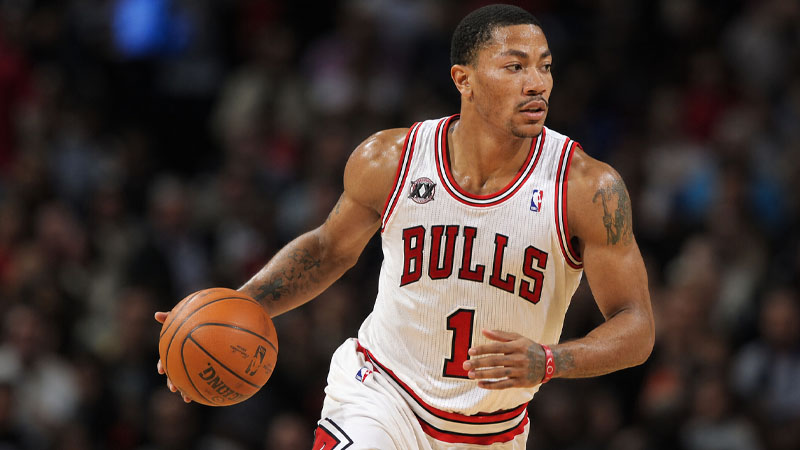
Derrick Rose is a three-time NBA All-Star, earning consecutive selections from 2010 to 2012 during his iconic tenure with the Chicago Bulls.
His rise to stardom was meteoric, as he became the first Bulls player since Michael Jordan to represent the franchise in the mid-season classic.
Beyond these accolades, Rose made history as the youngest player to win the NBA Most Valuable Player award in 2011.
Although physical setbacks limited his total All-Star count, his peak performance remains legendary, leading to his jersey retirement in early 2026 as a tribute to his enduring basketball legacy.
The Foundation of a Chicago Legend
The journey of Derrick Rose began with a level of local expectation rarely seen in professional sports. As a Chicago native, the pressure to perform for his hometown team was immense, yet he exceeded every projection from his first day on the hardwood.
His initial years in the league were characterized by an explosive athleticism that redefined the point guard position, combining speed and power in a way that left defenders helpless.
Winning the 2009 Rookie of the Year
The 2008-09 season served as the launchpad for what would become an illustrious career. Rose’s ability to navigate the pick-and-roll and finish at the rim with acrobatic flair earned him the NBA Rookie of the Year award.
This honor was not merely a recognition of his individual statistics but a signal that the Chicago Bulls had finally found a cornerstone player to lead them into a new era of competitiveness.
Dominating the 2009 Skills Challenge
Rose’s technical proficiency was on full display during the 2009 All-Star Weekend, where he participated in and won the Skills Challenge.
By defeating a field of established veterans, he proved that his game was built on a foundation of elite ball-handling and passing accuracy.
This victory was a precursor to his first official All-Star selection the following year, establishing him as a rising star who could perform under the brightest lights.
Examining the 2010-2012 All-Star Selections
For three seasons, Rose was the undisputed face of the Eastern Conference backcourt. These years represent the peak of his physical powers, a period where he was widely considered the most difficult player in the league to guard one-on-one.
His presence in the All-Star Game was a guaranteed highlight reel, as he used the exhibition format to showcase the full range of his offensive arsenal.
2010: Breaking the Chicago Drought
In 2010, Rose made his All-Star debut in Dallas, Texas, appearing as a reserve selected by NBA head coaches. This was a historic moment for the franchise, as the Bulls had not sent a player to the All-Star Game since 1998.
During his 15 minutes of play, he contributed 8 points and 4 assists, helping the Eastern Conference secure a narrow 141-139 victory. This appearance solidified his status as an elite guard, backed by regular-season averages of 20.8 points and 6.0 assists.
2011: The Year of the Youngest MVP
The 2011 All-Star Game in Los Angeles marked Rose’s transition from a rising star to a global superstar. Voted in as a starter by fans, he shared the backcourt with Dwyane Wade in a game that celebrated his historic MVP campaign.
During this season, he led the Bulls to a league-best 62 victories, proving that his individual brilliance translated directly into team success. In the game itself, he recorded 11 points and 3 rebounds across 29 minutes of action.
2012: Maintaining Elite Efficiency
In his third and final All-Star appearance, Rose demonstrated a refined level of efficiency that suggested he was still improving. Playing in Orlando, he scored 14 points on an impressive 75% shooting from the field.
This selection occurred just before the knee injury in the 2012 playoffs that would alter the course of his career, serving as a final glimpse of the player who had dominated the league for three straight years.
Analyzing All-Star Game Production
To understand the impact Rose had during these mid-season showcases, it is helpful to look at the consistent contributions he made to the Eastern Conference roster.
| Year | Location | Minutes | Points | Assists | Shooting % |
|---|---|---|---|---|---|
| 2010 | Dallas | 15 | 8 | 4 | 50% |
| 2011 | Los Angeles | 29 | 11 | 5 | 45% |
| 2012 | Orlando | 18 | 14 | 3 | 75% |
This data illustrates that while Rose was often the primary playmaker for his team, he was also capable of scoring in bunches when the game was on the line. His 2012 performance, in particular, highlighted a growing maturity in his shot selection and offensive efficiency.
Why Derrick Rose is Considered a Bulls Legend
The legacy of a player is often measured by more than just trophies and All-Star nods. For the city of Chicago, Rose represented hope and a return to the glory days of the 1990s.
He played with a relentless intensity that resonated with the blue-collar spirit of the city, making every game an event that fans could not afford to miss.
Restoring Championship Aspirations
Before Rose arrived, the Bulls struggled to find a consistent identity in the post-Jordan era. Rose changed the culture of the organization almost overnight, instilling a belief that they could compete with any team in the league.
His leadership during the 2010-2012 stretch saw the Bulls become a perennial title contender, a feat that had seemed impossible just a few years prior.
Cultural Impact Beyond Basketball
Rose’s influence extended far beyond the box score. As a product of the Chicago Public Schools system, he became a symbol of what was possible for young athletes in the city.
His humility and dedication to his craft made him a beloved figure, and his jersey remained one of the top sellers in the league long after his peak years.
The emotional connection between the player and the city is what ultimately fueled the decision to honor him with the ultimate tribute.
Navigating the Injury Era and Career Longevity
The narrative of Rose’s career is often split into two distinct chapters: the explosive MVP years and the resilient veteran years.
While the injuries he sustained starting in 2012 prevented him from adding to his All-Star total, they also revealed a depth of character and a love for the game that many players lack.
The 2012 Playoff Turning Point
A devastating knee injury during the opening round of the 2012 playoffs served as the primary reason Rose never returned to an All-Star Game.
At the time, he was at the height of his powers, and the injury robbed the basketball world of seeing what his true ceiling could have been.
However, rather than letting this define him, Rose embarked on a long and difficult journey of rehabilitation that would span several years and multiple surgeries.
Evolution into a Respected Veteran
Despite the physical limitations imposed by his injuries, Rose adapted his game to remain a productive contributor in the NBA for 15 seasons.
He transitioned from a primary scoring threat into a savvy veteran leader, providing mentorship and spark-plug scoring for teams like the New York Knicks and Minnesota Timberwolves.
This longevity is a testament to his basketball IQ and his ability to evolve when his raw athleticism began to fade.
The Culmination of a Career: Jersey Retirement
In September 2024, Derrick Rose officially announced his retirement from professional basketball, bringing an end to one of the most storied careers in modern NBA history.
The outpouring of support from fans, players, and coaches highlighted the universal respect he had earned throughout his journey.
Details of the January 2026 Ceremony
The Chicago Bulls organization ensured that Rose’s contributions would never be forgotten by retiring his No. 1 jersey in a ceremony held in January 2026.
Surrounded by former teammates and family, Rose watched as his number was raised to the rafters of the United Center, joining the likes of Michael Jordan and Scottie Pippen.
This event served as the official closure on his time in Chicago, cementing his status as a permanent fixture in the city’s sports history.
Evaluating the Future Hall of Fame Candidacy
The debate regarding Rose’s Hall of Fame eligibility often centers on his peak versus his longevity. As the youngest MVP in history and a three-time All-Star, his peak was higher than many current Hall of Famers.
While his career totals were suppressed by injury, his impact on the game and his cultural significance within one of the league’s flagship franchises make a compelling case for his eventual induction.
Common Questions Regarding the Career of Derrick Rose
How many All-Star games did Derrick Rose play in?
Derrick Rose was selected to three NBA All-Star games, appearing in 2010, 2011, and 2012.
Did Derrick Rose ever win an All-Star Game MVP?
No, while he was a starter and a major contributor, he did not win the All-Star Game MVP award. However, he did win the league MVP in 2011.
What was Derrick Rose’s best All-Star performance?
Statistically, his 2012 performance was his most efficient, as he scored 14 points on 75% shooting from the field.
Was Derrick Rose an All-Star after his injury?
No, Rose’s final All-Star selection came in 2012, the same year he suffered his first major knee injury.
The Final Word on a Historic Career
The career of Derrick Rose remains one of the most compelling “what-if” stories in basketball, but the facts of what he did accomplish are undeniable.
As a three-time All-Star and the youngest MVP the league has ever seen, he reached heights that few players can ever dream of.
His journey from the South Side of Chicago to the rafters of the United Center is a story of immense talent, heartbreaking setbacks, and incredible resilience.
Whether he was soaring for a dunk in 2011 or leading a young bench unit in 2023, Rose played with a passion that will be remembered for generations.
His legacy is now forever preserved in the history of the Chicago Bulls, a fitting end for a player who gave everything to the game and his city.