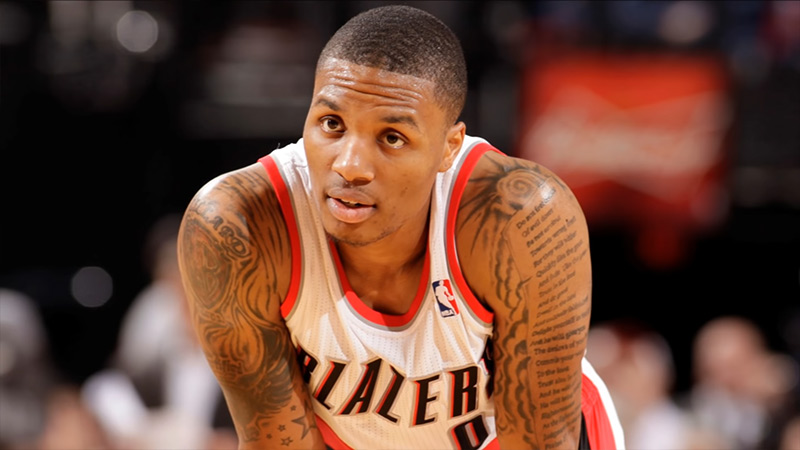
Yes, Damian Lillard is currently recovering from a complete rupture of his left Achilles tendon sustained in April 2025.
After undergoing successful surgery in early May 2025, Lillard elected to sit out the entire 2025–26 NBA regular season to focus on a comprehensive 12-to-15 month rehabilitation protocol.
Now entering the final stages of his recovery, the 36-year-old guard is participating in intensive on-court workouts and is officially on track to be “1,000 percent” for the Portland Trail Blazers’ 2026–27 training camp.
His return marks a highly anticipated homecoming following a three-year, $42 million contract signing.
The Medical Reality of Lillard’s Achilles Rupture
The path to recovery for an elite athlete often begins with a singular, devastating moment. For Damian Lillard, that moment arrived on April 27, 2025, during the first round of the playoffs while competing for the Milwaukee Bucks.
This injury represents the most significant physical challenge of his professional career, requiring a total shift in his approach to health and longevity.
The Nature of the Non-Contact Tear
Lillard suffered a catastrophic, non-contact rupture of his left Achilles tendon. Non-contact injuries of this magnitude are often the result of cumulative micro-trauma or sudden physiological overload.
In Lillard’s case, the rupture occurred during a high-stakes playoff environment, immediately ending his postseason and forcing a multi-year perspective on his playing future.
The severity of a complete rupture means the tendon was entirely severed, necessitating immediate surgical intervention to reattach the fibers and restore the structural integrity required for the explosive movements of a professional point guard.
Surgical Intervention and the 15-Month Protocol
Following the injury, Lillard underwent corrective surgery in early May 2025. Rather than attempting a “miracle” return within the typical nine-month window, Lillard and his medical team opted for a deliberate 12-to-15 month protocol.
This conservative approach was designed specifically to rebuild tendon strength and ensure that his return to the court would not lead to a secondary catastrophic failure.
By sitting out the entire 2025–26 regular season, Lillard allowed the biological healing process to complete without the stress of a professional game schedule, prioritizing his long-term health over immediate availability.
Understanding the Blood Clot and Calf Complications
While the Achilles tear was the injury that sidelined Lillard for a year, it did not happen in a vacuum. A series of medical setbacks in early 2025 created a volatile physiological environment that many experts believe contributed to the eventual rupture.
Deep Vein Thrombosis: The Hidden Danger
In March 2025, just weeks before the Achilles injury, Lillard was diagnosed with Deep Vein Thrombosis (DVT), a highly dangerous blood clot in his right calf.
This condition transcended standard basketball safety protocols because of the inherent risks of internal bleeding associated with contact sports while on blood thinners.
This diagnosis forced him into a period of mandatory deconditioning and rest, missing the final 14 games of the regular season and the opening game of the playoffs.
How a Rushed Return Impacted the Achilles
Medical experts have noted that the ramp-up following his blood clot diagnosis may have been a primary factor in his subsequent injury. Seeking to save his team’s season, Lillard rushed his return for Playoff Game 2 against Indiana.
This accelerated return to peak intensity is believed to have overloaded his lower body, placing undue stress on his left leg as it compensated for the recent calf issues on the right.
The catastrophic rupture of the left Achilles occurred only days after this return, serving as a cautionary tale regarding the dangers of bypassing proper physiological reconditioning.
A Comprehensive History of Career Health Setbacks
To understand the current status of Damian Lillard, it is essential to look at the broader context of his health history. For much of his early career, he was celebrated as an “Iron Man” for his ability to play through minor discomfort and avoid the injured list.
However, the last few seasons have seen a notable uptick in both frequency and severity of medical issues.
| Date | Injury Type | Duration/Impact |
|---|---|---|
| April 2025 | Left Achilles Rupture | Missed 2025–26 Season |
| March 2025 | Deep Vein Thrombosis (Right Calf) | Missed 15 Total Games |
| Feb–Mar 2025 | Hamstring, Groin, and Eye Issues | Multiple Game Absences |
| Nov 2024 | Concussion Protocol | Missed 3 Games |
| Jan 2022 | Chronic Abdominal Tendinopathy | Missed 47 Games (Surgery) |
| Oct–Nov 2022 | Calf Strains | ~12 Games Total |
| Feb 2020 | Groin Strain | ~4–6 Games |
This table illustrates a clear transition from sporadic, minor issues to more systemic, long-term challenges. The abdominal surgery in January 2022 was a major milestone, as it addressed a lingering sports hernia that had restricted his lateral movement and explosiveness for over a year.
While that surgery was successful and led to a healthy 2022–23 campaign, the subsequent lower-body injuries—specifically the calf and hamstring strains—hinted at the vulnerabilities that culminated in the 2025 Achilles tear.
Assessing the “Injury Prone” Label and Longevity
As Lillard prepares for his return at age 36, fans and analysts alike are debating whether he should now be classified as “injury prone”. The answer is complex, involving his historical durability versus the biological realities of aging in a high-impact sport.
From Iron Man to Medical Uncertainty
During the first decade of his career, Lillard was a model of consistency, rarely missing time for anything other than major corrective procedures.
However, the cluster of injuries in early 2025—including the hamstring, groin, and calf issues—suggests a body that is becoming more susceptible to soft-tissue strains.
This shift often happens as players age, where recovery times increase and the margin for error in physical preparation narrows.
The Impact of Chronic Abdominal Tendinopathy
It is worth noting that many of Lillard’s recent lower-body struggles may trace back to his core strength. His battle with chronic abdominal tendinopathy required significant rehabilitation.
Although he recovered fully from the 2022 surgery, any disruption in core stability can lead to compensatory patterns in the legs.
This history of core and leg issues necessitates a more sophisticated approach to injury management as he enters the final chapter of his career with the Portland Trail Blazers.
Age and Recovery in the Modern NBA
Returning from a torn Achilles at age 36 is an ambitious goal. However, the landscape of sports medicine has evolved.
By taking a full year off to focus on healing, Lillard is following a path similar to other veteran stars who successfully extended their careers after major setbacks.
His participation in the 2026 3-Point Contest, where he secured a victory, served as a non-contact proof of concept for his shooting mechanics and balance, even while he was still restricted from full-speed basketball activities.
Rehabilitation Milestones for the 2026–27 Season
The “Road to a Rose City Return” has been marked by specific milestones that indicate Lillard is nearing the finish line of his recovery. His commitment to a methodical process has been the cornerstone of this comeback.
The All-Star Weekend Milestone
In February 2026, while still officially sidelined for the regular season, Lillard made a brief appearance to win the NBA 3-Point Contest. While this was a non-contact event, it was a significant psychological and physical milestone.
It demonstrated that his shooting stroke remained elite and that he could handle the pressure of a televised competition, providing a glimpse of the “Dame Time” heroics fans expect in Portland.
Final Stages: Intensive On-Court Workouts
As of mid-2026, Lillard has been cleared for intensive on-court offseason workouts. This phase of rehabilitation moves beyond mere strength building and into basketball-specific conditioning.
He is currently working on lateral quickness, jump-stop stability, and the explosive first step that defines his offensive game. The goal is to ensure that by the time training camp opens, he is not just healthy, but in peak game shape.
Frequently Asked Questions About Lillard’s Health
Will Damian Lillard be ready for the 2026–27 season opener?
All current medical updates indicate that he is on track. He has completed the most dangerous phases of Achilles rehabilitation and is now focusing on conditioning. He has publicly stated his goal is to be at “1,000 percent” when camp begins.
How does his new contract affect the Blazers’ strategy?
Lillard signed a three-year, $42 million deal in July 2025. This contract was structured with the knowledge that he would sit out the first year.
It positions him as a veteran leader and a high-value asset for a Portland team looking to blend his experience with their young roster.
What is the most severe injury of his career?
The April 2025 complete left Achilles tendon rupture is objectively the most severe and career-altering injury he has faced.
While the 2022 abdominal surgery was significant, the Achilles tear carries a much longer recovery timeline and higher risks for a player at his stage of life.
Looking Forward: The Final Act in Portland
Damian Lillard’s return to the Portland Trail Blazers is more than just a roster move; it is the culmination of a year of intense discipline and physical trial.
By choosing to prioritize a full recovery over a rushed return, Lillard has given himself the best possible chance to rewrite the ending of his career story.
As training camp approaches, the focus shifts from medical reports to on-court chemistry. The Rose City is ready for its icon to return, and if his recent milestones are any indication, the league should be prepared for the return of a healthy, motivated Damian Lillard.
His journey serves as a powerful reminder of the resilience required to maintain elite status in professional sports, proving that even after the most catastrophic setbacks, a return to form is possible with patience and proper care.