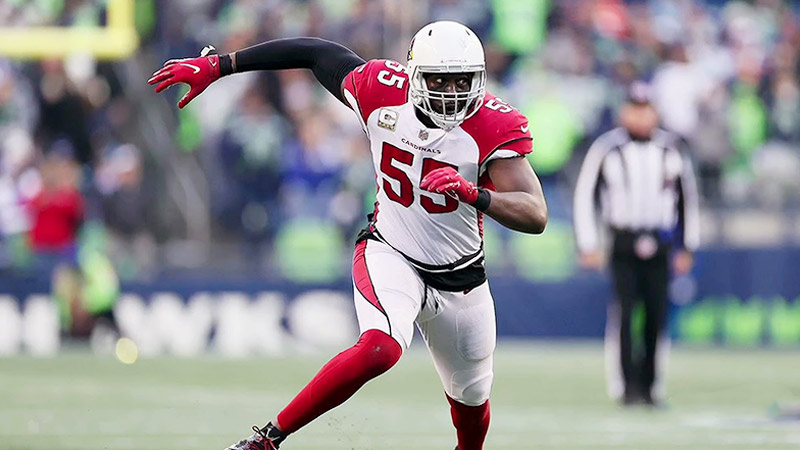
The debate surrounding the Pro Football Hall of Fame often centers on a singular, difficult question: Was this player the definitive story of their era, or were they merely a high-level contributor to it? For Chandler Jones, this question is particularly nuanced.
As one of the most prolific pass rushers of the 2010s, Jones finds himself in the “borderline” or “fringe” category of candidacy.
His resume is a masterclass in consistent production, yet it lacks the singular “crown jewel” award—a Defensive Player of the Year (DPOY) trophy—that often serves as an automatic entry pass into Canton.
To understand the Hall of Fame case for Chandler Jones, one must look beyond the simple box scores and analyze his impact through the lens of historical benchmarks, peer comparisons, and the prestigious All-Decade designation.
The Statistical Foundation: Consistency Over Time
Elite defensive ends are measured by their ability to disrupt the pocket and manufacture sacks.
Chandler Jones excelled at this with a quiet efficiency that often flew under the radar of national media. Throughout his career, he secured over 110 career sacks, placing him in an elite bracket of edge defenders.
Reaching the 100-sack milestone is generally the entry point for Hall of Fame consideration, but Jones pushed well past that.
His ability to maintain this level of production across multiple franchises—beginning with a Super Bowl-winning stint in New England before reaching his statistical peak in Arizona—demonstrates a rare adaptability.
He wasn’t just a product of a specific system; he was a portable, high-impact asset that forced opposing offensive coordinators to reshape their game plans regardless of the jersey he wore.
Resume Overview: The Metrics of Greatness
The following table outlines the key milestones of Chandler Jones’ career relative to the standard expectations for a Hall of Fame defensive end.
| Metric | Chandler Jones’ Career Achievement | Hall of Fame Significance |
|---|---|---|
| Total Sacks | 110+ | High (Elite benchmark) |
| All-Decade Team | NFL 2010s All-Decade Team | Very High (Strongest predictor) |
| All-Pro Selections | 2 First-team selections | Moderate/High |
| Pro Bowl Nods | 4 to 7 (depending on tracking) | Moderate |
| Championships | 1 (Super Bowl XLIX Champion) | High (Valued by voters) |
| HOF Monitor Score | 68.90 | Below average (Avg. is ~103) |
The All-Decade Trump Card
If there is one factor that tips the scales in favor of Jones, it is his inclusion on the NFL 2010s All-Decade Team. Historically, being named to an All-Decade team is one of the most reliable predictors of future enshrinement.
The selection committee for the Hall of Fame effectively uses these lists to document who the “best of the best” were during a ten-year window.
By being named to this list, Jones is officially recognized as one of the premier edge rushers of his generation.
While his career sack total is impressive, the All-Decade honors provide the necessary “prestige” to supplement his raw data. Historically, players with this distinction have a remarkably high probability of eventually receiving their Gold Jacket.
The Complexity of the Hall of Fame Monitor
When evaluating modern candidates, many analysts look to the Pro-Football-Reference Hall of Fame monitor, a system designed to estimate a player’s chances of induction based on accolades and statistics. Chandler Jones currently holds a score of 68.90.
While a 68.90 is technically below the historical average for defensive ends already in the Hall (which typically hovers above 100), it is important to contextualize this number. His score is notably higher than some modern inductees, such as the legendary Charles Haley.
Haley’s induction was driven largely by his five Super Bowl rings and his terrifying presence on the field, proving that the committee is willing to look past a lower “monitor score” if the player’s peak dominance and impact on winning are undeniable.
The Competition Gap: Overshadowed by Legends
The primary challenge for Jones’ candidacy isn’t his own lack of production, but rather the era in which he played. His peak years coincided with two of the greatest defensive players in NFL history: J.J. Watt and Von Miller.
- J.J. Watt: A three-time DPOY who redefined the interior and exterior pass rush.
- Von Miller: A Super Bowl MVP with a “signature” playoff run that cemented his first-ballot status.
Because Watt and Miller frequently occupied the first-team All-Pro spots and dominated the Defensive Player of the Year voting, Jones often found himself as the “third man” in the conversation.
In many other eras, Jones’ 17-sack or 19-sack seasons would have easily earned him a DPOY trophy, which is often the “missing piece” in his current resume.
The committee must decide if Jones should be penalized for playing in a “Golden Age” of pass rushers or celebrated for being one of the few who could keep pace with such generational talents.
The Case for “The Peak” vs. “The Plateau”
In Hall of Fame debates, voters often weigh “The Peak” (how dominant was the player at their absolute best?) against “The Plateau” (how long did they stay very good?).
- The Peak: Jones had a phenomenal stretch in Arizona, including a 2019 season where he recorded 19 sacks and 8 forced fumbles. This was a “Defensive Player of the Year” caliber performance in almost any other season.
- The Plateau: From 2013 to 2021, Jones was a model of consistency, rarely dipping into “average” territory until the very end of his career.
This combination of a high peak and a sustained plateau makes his case stronger than players who had one or two great years but faded quickly.
The Intangibles: Super Bowl Pedigree
Winning matters to the Hall of Fame selection committee. Jones was a vital component of the New England Patriots’ defense during their Super Bowl XLIX victory.
His ability to perform on the largest stage adds a “championship pedigree” to his statistical accomplishments.
This championship, combined with his role in transforming the Arizona Cardinals’ defense during his tenure there, provides a narrative of a player who contributes to a winning culture.
Final Strategic Verdict
Chandler Jones is the quintessential “wait-and-see” candidate. While he may not be a first-ballot inductee, his resume has the structural integrity to withstand the test of time.
The combination of 110+ sacks, a Super Bowl ring, and a spot on the All-Decade Team creates a compelling narrative that is difficult to ignore. In the world of professional football, consistency is often undervalued in favor of flash.
However, for a player who spent a decade as one of the most feared edge rushers in the league, the path to Canton is clear—it just might take a few years for the committee to fully appreciate the breadth of his impact in an era of giants.