In the hyper-competitive landscape of the NFL, few metrics carry as much weight—or as much mystery—as the 40-yard dash.
For elite wide receivers, a fraction of a second can be the difference between a top-ten selection and a slide into the second round.
Yet, one of the fastest players in modern professional football, Jaylen Waddle, occupies a unique space in scouting history: he has no official NFL Combine time.
This absence of a verified measurement has led to a fascinating divide between traditional stopwatch scouting and modern analytical tracking.
To understand the true velocity of the player often described as having a “boost button” in his cleats, we must look beyond the missing Combine data and into the high-performance metrics that define his career.
The Missing Metric: Why No Official Time Exists
The primary reason for the lack of an official 40-yard dash time for Jaylen Waddle is centered on the timing of his transition from collegiate to professional football.
During the 2021 draft cycle, Waddle was recovering from a significant ankle injury sustained during his final season at Alabama.
Because he was still in the rehabilitation phase during the NFL Combine and Alabama’s subsequent Pro Day, Waddle opted to skip formal testing.
For most prospects, a lack of speed data would be a red flag. However, Waddle’s reputation was so firmly established on film that his status as a premier deep threat remained undisputed.
Analysts and scouts generally projected his speed to fall comfortably in the low-to-mid 4.3-second range based on his collegiate body of work.
Historical Benchmarks and High School Foundations
While the NFL lacks a verified 40-yard dash entry for Waddle, his historical data provides a solid baseline. In 2017, while attending a high school camp in Houston, Waddle was electronically timed at 4.37 seconds.
It is a well-documented phenomenon in scouting that elite athletes often improve their linear speed as they move into high-level collegiate strength and conditioning programs.
Consequently, many scouts believe that by the time he reached the draft, Waddle was significantly faster than his 18-year-old self.
| Metric Type | Timing/Speed | Context/Source |
|---|---|---|
| High School Camp (2017) | 4.37 Seconds | Verified Electronic Timing |
| NFL Scout Projection | 4.28 – 4.35 Seconds | Professional Evaluation |
| Top In-Game Speed (NFL) | 21.80 MPH | Next Gen Stats Tracking |
| Top In-Game Speed (College) | #1 GPS Speed | National Collegiate Rankings |
The Alabama Rivalry: The Ruggs vs. Waddle Footrace
Perhaps the most compelling evidence of Waddle’s speed comes from the practice fields of Tuscaloosa.
During his time at the University of Alabama, Waddle played alongside Henry Ruggs III, who later recorded a blistering 4.27-second 40-yard dash at the NFL Combine.
Reliable accounts from Alabama’s training sessions describe footraces between the two that were consistently “photo finishes”.
Some observers even noted that Waddle occasionally beat Ruggs in a dead heat over 40 yards. If Ruggs is a verified 4.27 runner, the logic follows that Waddle possesses the mechanical capability to run in the high 4.2 or low 4.3 range.
The Great Speed Debate: 4.3 or 4.5?
Despite the overwhelming consensus, some analysts have questioned Waddle’s top-end velocity. Most notably, analyst Chris Simms sparked a significant debate by suggesting that Waddle lacked elite top-end speed, placing him closer to the 4.5-second range.
Simms argued that while Waddle is exceptional on underneath routes, he could potentially be run down from behind on vertical deep shots.
This take was met with significant pushback from the scouting community and fans alike. Critics of this view point out that “the tape doesn’t lie” and that Waddle is rarely, if ever, caught from behind in the open field.
Furthermore, scouts highlight that Waddle possesses “A+ speed in all facets,” suggesting that his acceleration is so violent it makes defenders look like they are “moving underwater”.
- Acceleration (The 10-Yard Split): Many evaluators believe Waddle is a 10/10 in acceleration, even if they conservatively rate his long-range gear as a 9/10.
- Lateral Agility: Beyond linear speed, Waddle’s “wiggle” is projected to result in a 3-cone drill in the 6.6x range, placing him in the elite tier of change-of-direction athletes.
- Low Center of Gravity: His physical build allows him to maintain speed while making sharp cuts, a trait shared by other elite speedsters like Tyreek Hill.
Digital Tracking: The 21.80 MPH Reality
In the modern NFL, GPS data is increasingly viewed as more relevant than a static 40-yard dash performed in shorts and a t-shirt. This is where the case for Waddle’s elite speed becomes undeniable.
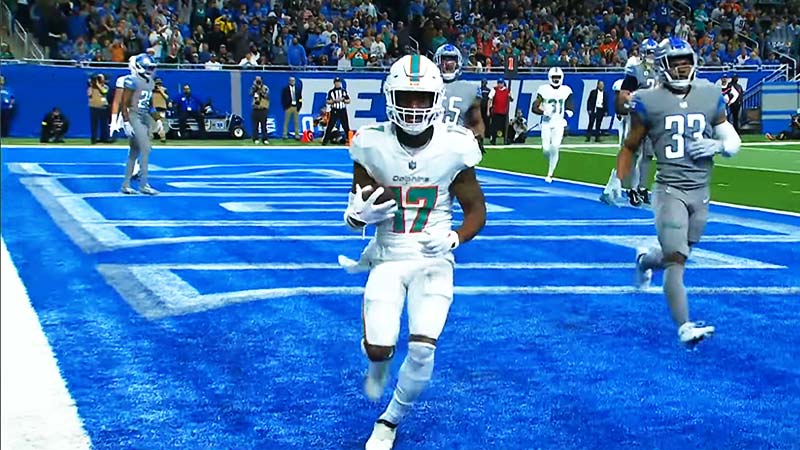
During his rookie campaign, NFL Next Gen Stats recorded Waddle reaching a top speed of 21.80 mph on a 57-yard reception. To put this in perspective, that was the fourth-fastest speed recorded by any ball-carrier in the league at that point in the season.
He only trailed a few of the league’s most notorious burners:
- Marquez Valdes-Scantling (22.09 mph)
- Jonathan Taylor (22.05 mph)
This data confirms that Waddle’s “game speed” is significantly higher than what a 4.5-second projection would suggest. Analysts like Daniel Jeremiah have noted that during his college years, Waddle recorded some of the fastest GPS tracking speeds of any wide receiver in the country.
Architecture of an Elite Speed Room
The validation of Waddle’s speed is further cemented by his role in the Miami Dolphins’ offensive scheme. Following his trade to the Dolphins, he joined forces with Tyreek Hill to form what many consider the fastest wide receiver duo in the history of the NFL.
The organization has prioritized high-velocity athletes, building a roster that resembles a track relay team. When looking at the 40-yard dash times of his teammates, Waddle fits perfectly into the high-speed ecosystem:
- Tyreek Hill: 4.29 Seconds
- Devon Achane: 4.32 Seconds
- Raheem Mostert: 4.32 Seconds
- Jaylen Waddle: 4.37 Seconds (High School Baseline)
This concentration of speed forces defenses to play deeper, yet Waddle’s specific brand of speed—defined by suddenness and elite acceleration—allows him to thrive in the intermediate areas of the field before turning a short gain into a touchdown.
Final Assessment: Game Speed vs. Track Speed
The question of “What did Jaylen Waddle run?” may never have a definitive, official NFL-stamped answer. However, the synthesis of high school timing, collegiate peer competition, and professional GPS data provides a clear picture.
Waddle is a “fluid” mover who maintains his velocity throughout his route progression. While some might argue over whether he is a 4.28 or a 4.35, the distinction is largely academic when applied to the football field. His ability to hit the “boost button” the moment the ball touches his hands creates a level of separation that few players in the history of the game can replicate.
Ultimately, Jaylen Waddle represents the evolution of scouting, where the absence of a 40-yard dash time is no longer a hindrance to identifying a generational speed talent. His 21.80 mph top speed and his “dead heat” races with verifiable 4.2 runners serve as his true professional resume.